It's the very first question most people ask before getting into the hobby, and it's a smart one: what's this actually going to cost me? The honest answer is "it depends" — but that's not very helpful, so let's make it concrete. We'll break down the real upfront costs of setting up a tank, the ongoing running costs people forget about, and where it's worth spending versus where you can save.
How much does a fish tank cost to set up and run?
Budget for two costs, not one. The upfront cost covers the tank and equipment and scales with size; the running cost continues every month and is the one beginners forget.
The Two Kinds of Cost
There are two cost buckets to think about, and beginners almost always focus on the first and forget the second.
The upfront cost is everything you buy to get started — the tank, equipment, and initial supplies. The running cost is what you spend month after month to keep it going — electricity, food, water treatments, and replacement parts. Both matter. A cheap tank with high running costs can end up pricier than a well-chosen setup. Let's look at each.
Upfront Costs: Getting Started
Here's what goes into a first setup, roughly in order of expense.
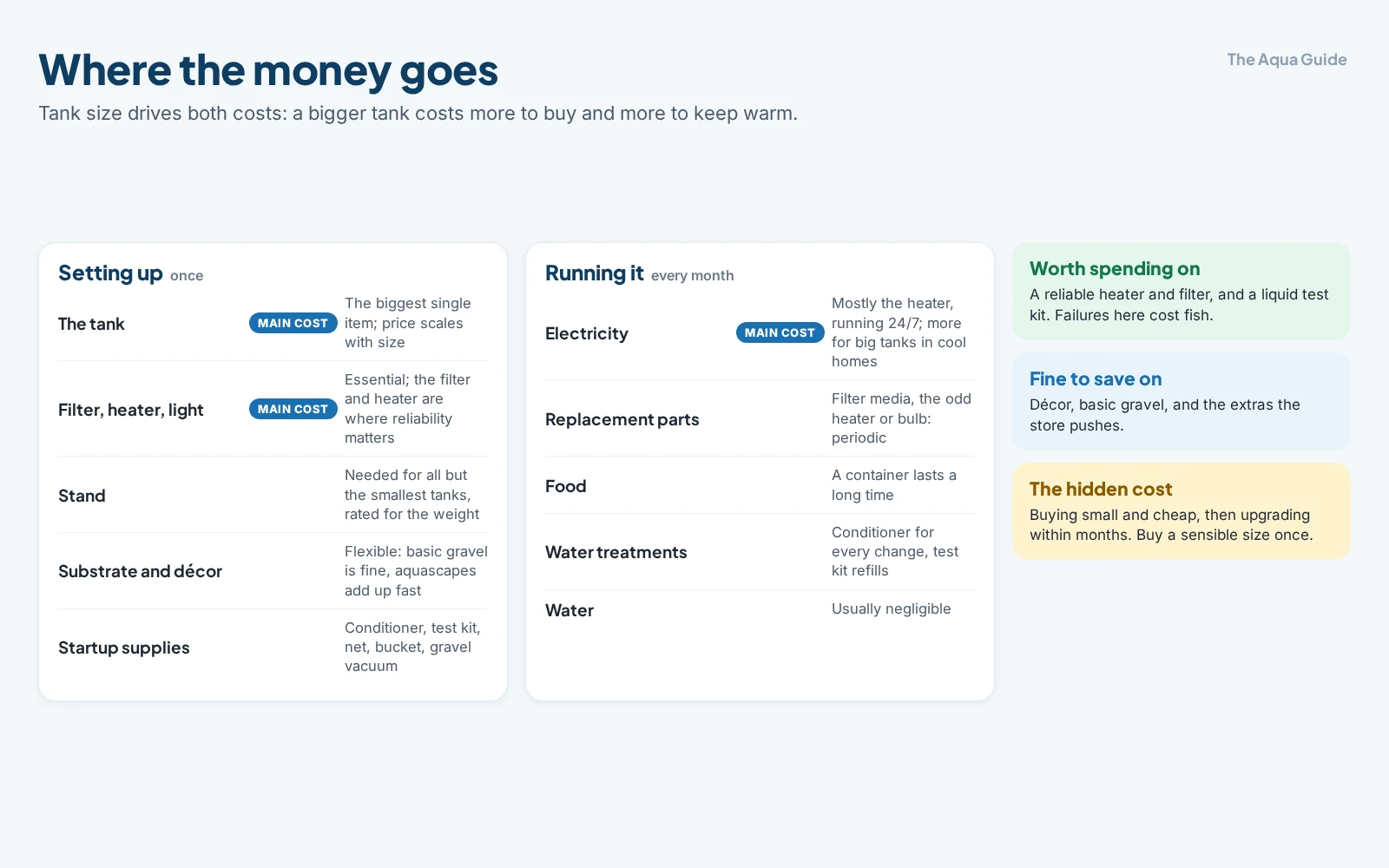
The tank itself is usually the biggest single item, and price scales with size. Small tanks are cheap; large tanks cost considerably more — and bigger tanks also need bigger (pricier) equipment. This is the main lever on your total budget.
Essential equipment comes next: a filter, a heater (for tropical fish), and a light. These are non-negotiable for most setups, and quality varies enormously in price. You don't need the most expensive options, but you also shouldn't buy the very cheapest, since filters and heaters are the parts most worth reliability.
Substrate and décor — gravel or sand for the bottom, plus any rocks, driftwood, or plants. This is flexible: a simple setup costs little, while an elaborate aquascape with premium substrate, lots of plants, and specialty hardscape adds up fast.
Startup supplies — a water conditioner (dechlorinator), a test kit, a net, a bucket, and a gravel vacuum. Individually inexpensive, but they add up, and a liquid test kit in particular is a worthwhile spend.
A stand if you don't already have suitably strong furniture. A full tank is extremely heavy, so the stand isn't optional for anything but the smallest tanks — and it needs to be rated for the weight.
The takeaway: the tank and equipment dominate the upfront cost, and both scale with tank size. A small starter setup is genuinely affordable; a large, fully-kitted planted tank is a serious purchase.
At a glance: the running costs
| Cost | How it behaves |
|---|---|
| Electricity | Usually the biggest ongoing cost, and the heater is the main culprit — keeping water warm 24/7 uses meaningful power, especially in a larger tank or a cooler home. Filter and light add smaller amounts |
| Food | Modest and steady. A container lasts a long time, so this is minor for most setups |
| Water treatments | Dechlorinator for every water change, plus occasional test kit refills. Small but recurring |
| Replacement parts | Filter media or cartridges, the occasional heater or filter when one fails, replacement bulbs. Periodic rather than monthly — but budget for them |
| Water itself | Your water-change water adds a little to the bill. Usually negligible |
A bigger tank costs more both to buy and to run — which is the single most important thing to understand before choosing a size, because the running cost is the part people underestimate.
Running Costs: What You Pay Every Month
This is the part people underestimate, so it's worth spelling out.
Electricity is usually the biggest ongoing cost, and the heater is the main culprit — keeping water warm 24/7 uses meaningful power, especially for larger tanks in cooler homes. The filter and light add smaller amounts. Bigger tanks cost more to run, again because they need more heating.
Food is a modest, steady cost — a container lasts a long time, so this is minor for most setups.
Water treatments — dechlorinator for every water change, plus occasional test kit refills. Small but recurring.
Replacement parts — filter media or cartridges, the occasional new heater or filter when one fails, replacement bulbs. These are periodic rather than monthly, but budget for them.
Water itself — your water-change water adds a little to your water bill, usually negligible.
Overall, running costs are dominated by electricity (mostly heating), with everything else being relatively minor. A bigger tank costs more both to buy and to run — which is the single most important thing to understand before choosing a size.
Where to Spend and Where to Save
Some practical guidance on allocating a budget:
Worth spending on: a reliable heater and filter (failures here can kill fish), and a liquid test kit (it prevents expensive mistakes). These are the items where cheaping out can cost you more later — in dead fish or replacements.
Fine to save on: décor (driftwood and rocks can be sourced cheaply or found), substrate (basic gravel works fine), and the "nice to have" extras the store will push. You can always upgrade aesthetics later.
Worth thinking carefully about: tank size. Because size drives both upfront and running costs, choosing the right size for your budget and goals is the most important financial decision you'll make. (There's a whole separate guide on what size to start with.)
The "Hidden" Cost: Buying Twice
The most common expensive mistake is buying small and cheap, then quickly wanting bigger and better — and effectively paying twice. Many beginners start with a tiny tank, find it limiting and harder to keep stable, and upgrade within months, having wasted money on the first setup. Often the smarter financial move is to buy a sensible size and decent equipment once, rather than the cheapest possible version you'll outgrow. Think of it as buying for where you'll be in a year, not just day one.
A Note on "Kits"
All-in-one starter kits (tank plus filter, heater, and light bundled together) can be good value and convenience for beginners — they remove the guesswork of matching components. Just check that the included equipment is adequate (some kits skimp on the filter or heater), and that the essentials like a test kit and conditioner, which kits often omit, are factored into your budget separately.
The Bottom Line
A fish tank's cost comes in two parts: the upfront setup (dominated by the tank and equipment, both scaling with size) and the ongoing running cost (dominated by electricity for heating). A small starter tank is genuinely affordable to buy and run; a large planted setup is a meaningful investment on both fronts. Spend on a reliable heater, filter, and test kit; save on décor and extras. And avoid the classic trap of buying cheap twice — choosing a sensible size and decent gear once is often the most economical path. Decide your budget, pick your tank size accordingly (since that drives everything), and you'll know what you're getting into.
Related guides
- What size aquarium should a beginner start with?
- What equipment do you actually need?
- Setting up the stand: levelling and weight safety
- Where to place your aquarium at home
- First aquarium setup: a day-by-day guide
- How to use a liquid test kit
Got questions about your specific setup? Drop them in our Community Forum — we love helping new fishkeepers get started right.