This is the least glamorous part of setting up an aquarium and the one beginners most often rush — which is unfortunate, because getting it wrong can be genuinely dangerous. A full tank is one of the heaviest objects in your home, and it sits on a stand for hours, days, and years. If that support isn't strong, level, and stable, you risk a cracked tank, a catastrophic leak, or worse. Let's make sure your foundation is solid.
Just How Heavy Is a Full Tank?
People badly underestimate aquarium weight, so internalize this first: water alone weighs about 8.3 pounds per gallon (roughly 1 kg per litre). Add the tank itself, substrate, rocks, and water, and even a modest tank becomes extremely heavy — a mid-sized tank can weigh as much as a couple of adult people, and a large one weighs as much as a small car. This is not furniture-you-can-improvise territory. The weight is the reason every point below matters.
Water weight at a glance
At about 8.3 lb per gallon (1 kg per litre), for the water alone. The glass, substrate and rock add more on top.
| Tank | Water weight |
|---|---|
| 10 gallons (38 L) | 83 lb (38 kg) |
| 20 gallons (76 L) | 166 lb (76 kg) |
| 40 gallons (151 L) | 332 lb (151 kg) |
| 55 gallons (208 L) | 457 lb (208 kg) |
| 75 gallons (284 L) | 623 lb (284 kg) |
| 125 gallons (473 L) | 1,038 lb (473 kg) |
Use a Stand Rated for the Weight
The single most important rule: the stand must be designed and rated to hold a full aquarium of your size. Purpose-built aquarium stands are engineered for this load and are the safest choice. If you're repurposing other furniture, it must be genuinely strong enough — solid, sturdy, and rated for far more than the tank's full weight, with no flex or wobble. A dresser, a bookshelf, or a flimsy table is not adequate, no matter how solid it looks; furniture not built for this can fail slowly (sagging, weakening) or suddenly (collapsing). When in doubt, use a proper aquarium stand. The cost is small insurance against a disaster.
The Surface Must Be Perfectly Level and Flat
This is the detail that causes the most preventable tank failures. An aquarium must sit on a surface that is both level (not tilted) and flat (fully supporting the entire base evenly).
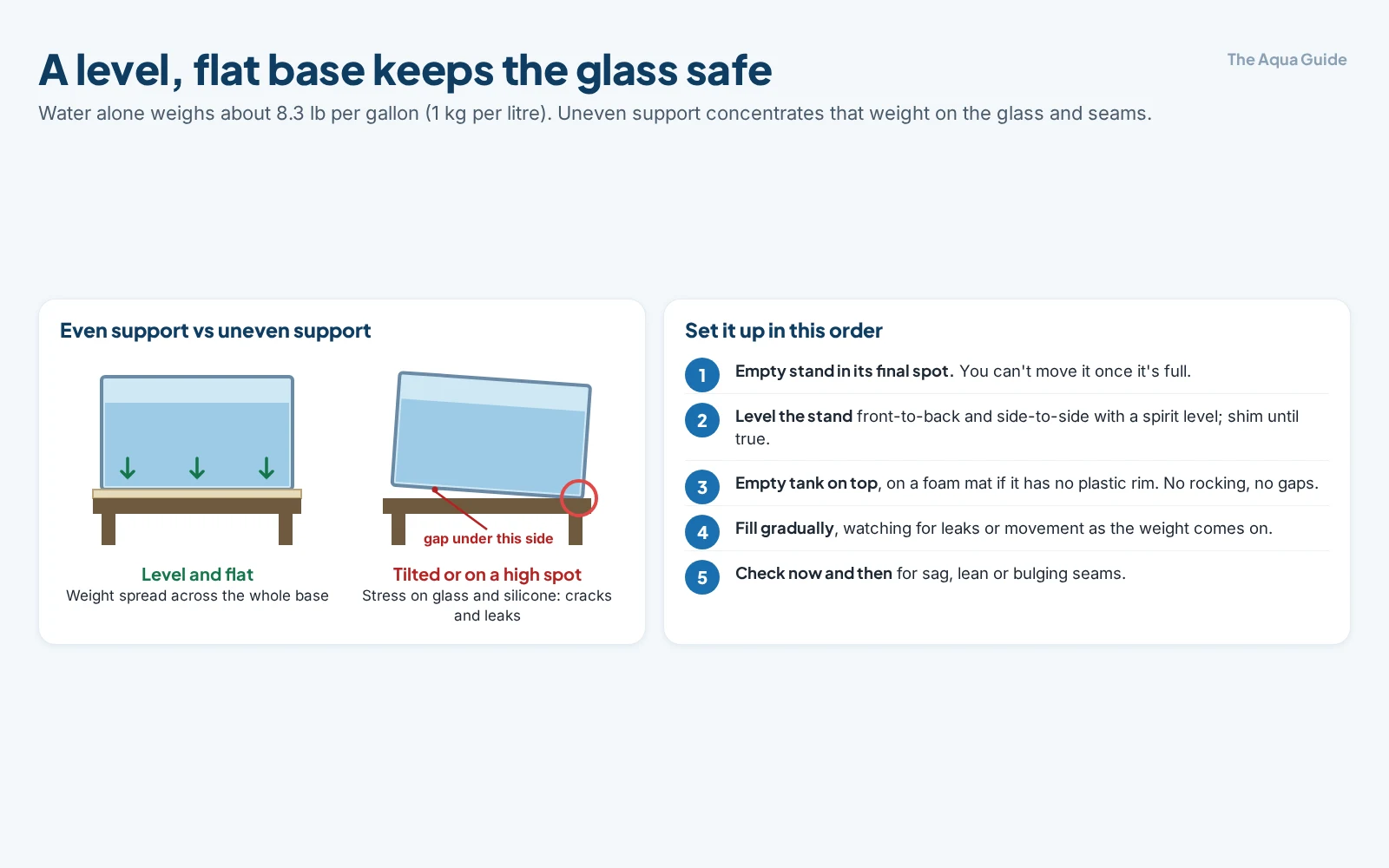
Why it matters so much: glass and acrylic tanks are designed to bear their load evenly across the whole bottom. If the tank sits unevenly — tilted, or resting on high spots with gaps underneath — the weight concentrates on certain points, creating enormous stress on the glass and the silicone seams. Over time (or sometimes suddenly), that stress causes cracks, seam failures, and leaks. A tank that would be perfectly safe on a flat, level surface can fail on an uneven one.
So before filling, check level in both directions (front-to-back and side-to-side) with a spirit level, and adjust the stand with shims until it's true. Make sure the entire base of the tank is supported — no gaps, no rocking. Many people also place a thin foam or polystyrene mat between the tank and stand (especially for glass tanks without a plastic rim) to cushion minor imperfections and distribute the load evenly. Take your time here; it's far easier to level an empty stand than to deal with a stressed, leaking full tank later.
Check the Floor Beneath
The stand holds the tank, but the floor holds everything. For larger tanks especially, consider whether your floor can bear the concentrated load. Placing the tank near a wall or over a floor joist (rather than the unsupported middle of a span) puts the weight where the structure is strongest. On upper floors or older buildings, large tanks warrant genuine thought about floor capacity. For typical beginner-sized tanks on a normal ground floor, this is rarely an issue — but the bigger the tank, the more it matters.
Set It Up in the Right Order
A sensible sequence prevents problems. Place the empty stand in its final spot (remember, you won't easily move it once full). Level the stand carefully before the tank goes on. Set the empty tank on the leveled stand, add the cushioning mat if using one, and confirm the tank sits flat with no rocking and is itself level. Only then begin filling — and add water gradually, watching that everything remains stable and there are no leaks or stress as the weight comes on. Never fill a tank that isn't sitting on a properly leveled, fully-supporting surface.
Stability and Safety Once Set Up
A few ongoing safety points. Make sure the stand can't be easily bumped or tipped, especially around children and pets. Route cords and equipment so nothing pulls on the tank. And periodically, glance at your setup — a stand showing any sag, lean, or stress, or a tank developing any bulge or seam issue, is a warning to address immediately, not later. Catching a developing problem early prevents a flood.
The Bottom Line
A full aquarium is enormously heavy — about 8.3 pounds per gallon of water alone — so its support is a safety matter, not an afterthought. Use a stand rated for your tank's full weight (a purpose-built aquarium stand when in doubt), set it on a floor that can bear the load, and above all make sure the surface is perfectly level and fully flat so the tank's weight is supported evenly — uneven support is the leading cause of cracked, leaking tanks. Level the empty stand first, confirm the tank sits flat with no rocking, then fill gradually while watching for stability. Get this foundation right and your tank stays safe for years; rush it and you risk one of the messiest, most damaging failures in the hobby.
Related guides
- Where to place your aquarium at home
- Glass vs acrylic: which tank should you buy?
- What size aquarium should a beginner start with?
- First aquarium setup: a day-by-day guide
- What equipment do you actually need?
Got questions about your specific setup? Drop them in our Community Forum — we love helping new fishkeepers get started right.