You wake up one morning and your tank looks like pea soup. The water is unmistakably green, you can barely see the fish, and the green just keeps getting more intense over the days that follow. Welcome to green water — caused by free-floating algae multiplying through the entire water column. It looks scary but it's actually one of the easier algae problems to fix completely. Here's how to clear it, and how to prevent it from coming back.
How do I clear green water in my aquarium?
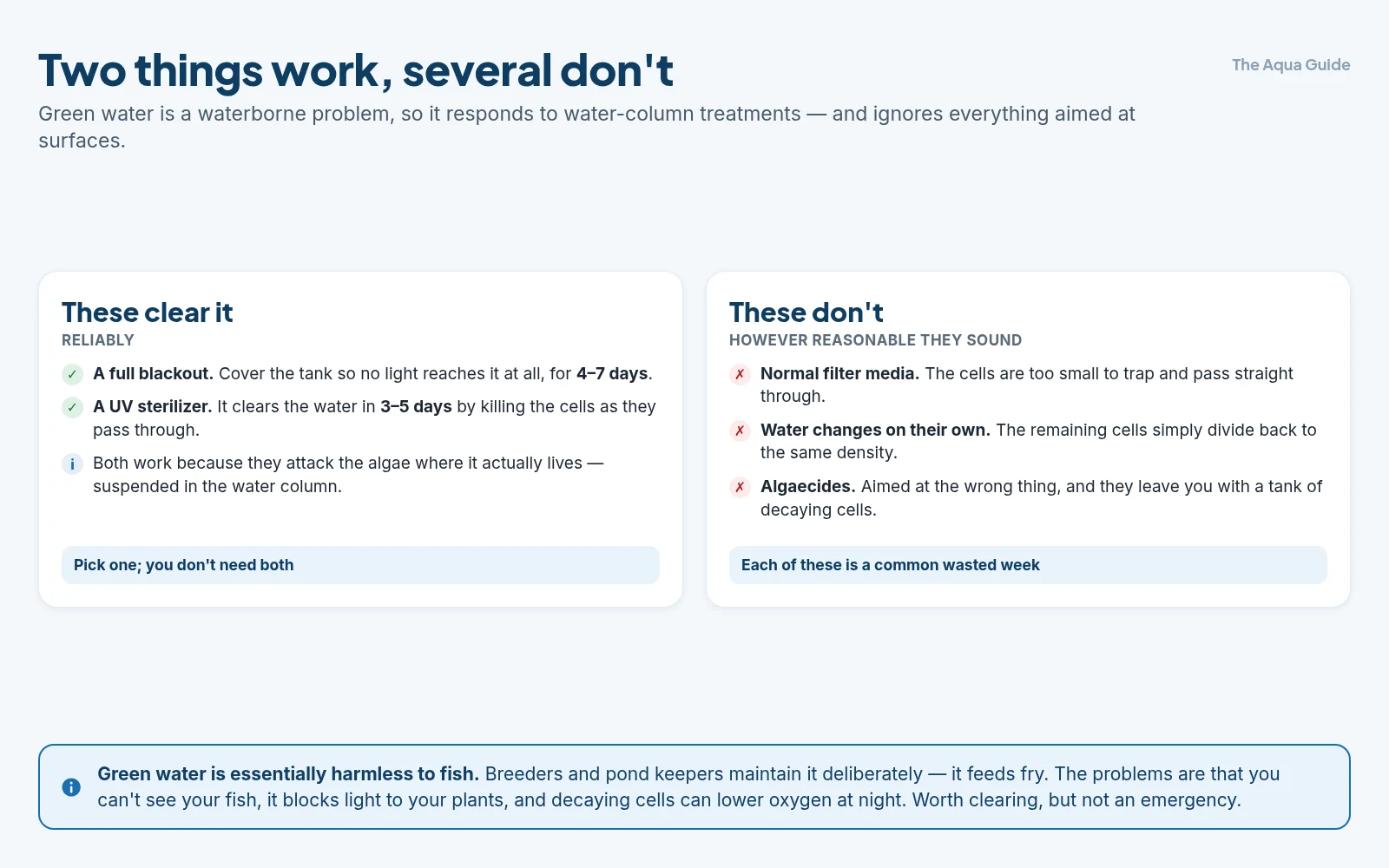
Two methods work reliably: a full blackout, covering the tank so no light reaches it for 4–7 days, or a UV sterilizer, which clears the water in 3–5 days. Normal filter media, water changes on their own and algaecides do not work, because the algae cells are free-floating and too small to trap.
At a glance: what set it off
| Ingredient | Where it comes from |
|---|---|
| Abundant light | Too long a photoperiod, very strong lighting, or — most commonly — direct sunlight reaching the tank. The spectrum and intensity of natural light is ideal for these algae |
| Abundant nutrients | Dissolved nitrogen and phosphorus from overfeeding, decaying matter, or a disturbance that released them — a deep substrate vacuum, or a dead fish unnoticed for days |
| Speed | The cells reproduce by simple division, doubling rapidly. A handful becomes millions in days, which is why a clear tank turns pea-soup green so suddenly |
The cells are too small for normal filter media to catch — they pass right through. That single fact explains why the usual responses do nothing here.
What Green Water Actually Is
"Green water" isn't dirt or murk — it's billions of microscopic single-celled algae (most commonly Chlorella or related species) suspended freely in the water column. Unlike algae that grows on surfaces, these algae float in the water itself, multiplying rapidly when conditions favor them. A clear tank can turn pea-soup-green in a matter of days.
The cells are too small to filter out with normal filter media — they pass right through. They reproduce by simple division, doubling rapidly when light and nutrients are abundant. A handful of cells becomes millions in days, which is why blooms appear suddenly and intensify fast.
The good news: green water is fundamentally a waterborne problem, which means it responds to water-column treatments that surface algae don't. The bad news: while the bloom lasts, it blocks light from reaching your plants and can interfere with viewing your fish.
Is Green Water Dangerous?
For your fish, no — green water is essentially harmless to fish health. Many breeders and pond keepers actually maintain green water on purpose because it provides natural food for fry and beneficial conditions for some species.
The issues are aesthetic and practical:
- You can't see your fish
- It looks bad
- It blocks light to your plants
- Over time, decaying algae cells can lower oxygen at night
So green water isn't an emergency, but it's worth clearing for the sake of viewing and plant health.
What Causes Green Water?
The recipe is the standard algae formula, intensified:
Abundant light — either too long a photoperiod, very strong lighting, or (most commonly) direct sunlight reaching the tank. Green water blooms are particularly associated with sunlight exposure, since the spectrum and intensity of natural light is ideal for these algae.
Abundant nutrients — especially dissolved nitrogen and phosphorus from overfeeding, decaying matter, or after a tank disturbance that released nutrients (such as a deep substrate vacuum or a dead fish unnoticed for days).
Triggering events. Green water often appears after specific events:
- After uncovering a tank that wasn't getting sunlight, to one that suddenly does
- After a deep gravel vacuum that releases trapped nutrients
- After a dead fish or large amount of decay
- After heavy fertilization in a planted tank
- During seasonal changes (more daylight, warmer temperatures)
If you can identify the trigger, that's useful — you can prevent recurrence.
How to Clear Green Water
There are several effective methods, ranging from cheapest/slowest to fastest/most reliable.
Method 1: Blackout (Free, takes 4–7 days)
The cheapest method — algae need light to live; deprive them and they die. Steps:
- Cover the tank completely, blocking ALL light for 4–7 days. Use towels, blankets, cardboard, dark trash bags — whatever it takes. Multiple layers to be sure no light gets through.
- Stop feeding during the blackout (or feed very sparingly — fish will be fine for several days without food).
- Don't peek. Every time you uncover it, you reset progress.
- After 4–7 days, uncover. The water should be substantially clearer.
- Do a 50% water change to remove dead algae cells.
- Resume normal lighting but at a shorter photoperiod (6 hours) and ideally on a timer.
This method is free, effective, and works on essentially any green water bloom. Downsides: takes a few days, you can't see your tank during it, and plants suffer somewhat (though most recover fine).
Method 2: UV Sterilizer (Fast, $40–100)
The most effective and quickest method, especially for stubborn or repeat blooms. A UV sterilizer is a chamber containing a UV bulb that water flows through — the UV light kills free-floating algae cells as they pass through. Steps:
- Install a UV sterilizer appropriate for your tank size (typically 1 watt of UV per 5–10 gallons).
- Run continuously for several days to a week.
- The green tint noticeably reduces within 24–48 hours and is usually fully gone within 3–5 days.
- Once clear, you can turn the UV off (or run it occasionally for prevention).
UV is the gold standard for green water because it kills the cells directly. The downside is the upfront cost of buying a sterilizer. (UV sterilizers have their own dedicated guide in Part 6.)
Method 3: Diatom Filter or Polishing Filter (Fast, varies)
Specialty filters with very fine media can physically capture free-floating algae cells. A diatom filter is designed for this; some canister filters with fine polishing pads also work to some degree. Usually faster than blackout, less expensive than UV, but requires specialty equipment.
Method 4: Floating Plants in Large Numbers
Adding lots of fast-growing floating plants (water lettuce, frogbit, salvinia, duckweed) can outcompete algae for nutrients and shade the water from above. This is slow (weeks) compared to UV or blackout, but addresses the root cause permanently. Best as prevention or a longer-term shift, not a quick fix for an active bloom.
What Doesn't Work for Green Water
A few things that don't clear green water (despite occasional claims):
Normal filter media. Standard sponges and floss don't catch cells that small. Water passes right through.
Water changes alone. A water change removes some cells but the remaining ones reproduce fast — within days you're back to green. Water changes support other methods but don't solve green water on their own.
Algaecide chemicals. Most algaecides target other types of algae poorly and are hard on fish and plants. Not recommended as a green-water solution.
"Filter starters" or bacterial additives. Don't address the issue.
Tap-water flocculants. Sometimes claimed to clear green water; effects are limited and they can stress fish.
After Clearing — Preventing Recurrence
Once clear, the bloom can return if conditions remain favorable. To prevent recurrence:
Address the cause. Block any direct sunlight reaching the tank. Reduce photoperiod to 6–7 hours. Reduce feeding portions. Improve water-change schedule.
Keep a UV sterilizer on hand. If you've had green water once, the equipment is worth the investment for the future. Even if not running constantly, having it available means future blooms can be killed before they peak.
Add or improve plants. Especially fast-growing floating plants, which compete strongly for the nutrients algae uses.
Watch for the early signs. A slight greenish tint to the water is the early warning. Acting then (cutting lights, water change, UV on) prevents the full bloom.
Identify your trigger. If you noticed the bloom started after a specific event (deep vacuum, heavy fertilization, sunlight exposure), avoid repeating it.
A Special Case: Green Water in New Tanks
New tanks (within the first few months) sometimes go through a green water phase as the ecosystem balances. This is more common than people expect and usually resolves on its own with regular maintenance, possibly accelerated by reducing lighting and feeding. If it's persistent or severe, treat as above.
The Bottom Line
Green water is caused by free-floating microscopic algae multiplying in the water column, usually triggered by excess light (especially direct sunlight), excess nutrients, or specific events that release nutrients suddenly. It looks dramatic but isn't dangerous to fish, and it's one of the easier algae types to fully clear. The two reliable methods are the blackout (cover the tank completely for 4–7 days, free but slow) and the UV sterilizer (installs in the filter line, kills cells as water flows through, fast and reliable but costs $40–100). Standard filter media, water changes alone, and algaecides don't work. Once clear, prevent recurrence by addressing the root causes — block sunlight, shorten the photoperiod, reduce feeding, add fast-growing plants, and keep a UV sterilizer available. Green water has a clear cause and a clear solution; most keepers experience it once, fix it properly, and never see it again.
Related guides
- How to clear green water without a UV sterilizer
- Do I need a UV sterilizer, and what wattage?
- How long should you run a blackout for algae?
- The beginner's guide to aquarium algae
- The best live plants for clearing cloudy water
- Where to place your aquarium at home
- Preventing algae long term: the balanced tank
- Why algae keeps coming back: the root-cause framework
Got questions about your specific setup? Drop them in our Community Forum — we love helping new fishkeepers get started right.