Of all the algae types you'll meet, black beard algae (BBA) is the one keepers complain about most — and for good reason. It's stubborn, it's ugly, it sticks to everything, it's hard to remove physically, and most algae eaters won't touch it. The good news is that once you understand why it grows, BBA can be beaten — and unlike many algae types, it stays gone if you address the cause. Here's the full BBA playbook.
How do I get rid of black beard algae?
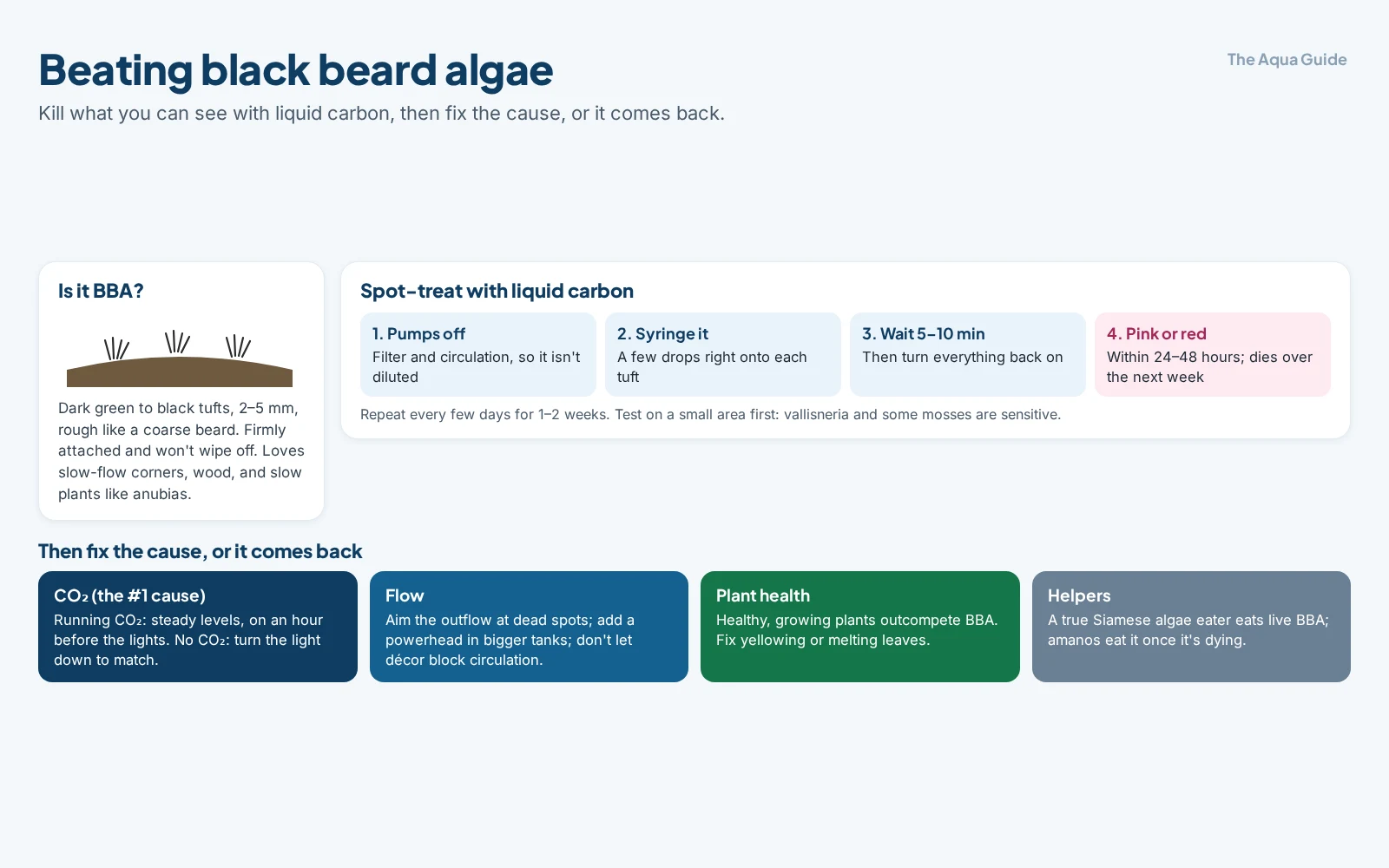
Spot-treat the visible tufts with liquid carbon applied by syringe with the pumps off; the algae turns pink or red within a day or two and dies over the following week. That kills what you can see but not the cause, so fix the CO₂ supply or reduce the light to match a tank without it, and clear the dead spots where water is not circulating.
What BBA Looks Like
Black beard algae appears as dark green, dark grey, or black tufts of fine fuzzy filaments — like tiny tufts of dyed hair — growing on:
- Plant leaf edges, especially slower-growing plants like anubias and java fern
- Driftwood, rocks, and hardscape
- Filter intake tubes and equipment
- Substrate near décor
- Glass corners in areas with slow water flow
The texture is unmistakable: short (typically 2–5mm) bristly tufts that you can't easily wipe or rub off. They feel rough, like a coarse beard. Color ranges from dark green to almost black, with a slight reddish tint when wet (it's actually a red algae despite looking dark, which matters for treatment).
If your tufts wipe off easily or look greener and softer, you probably have a different algae type (hair algae or green dust). BBA specifically is rough, dark, firmly attached, and resistant to brushing.
At a glance: what brings it on
| Cause | What's happening |
|---|---|
| CO₂ deficiency or fluctuation | The #1 cause in tanks running added CO₂. Low or inconsistent levels favour BBA over the plants |
| Inconsistent or low flow | BBA loves areas with poor circulation — filter outflows that don't reach the corners, and dead spots |
| Poor plant health overall | Weak plants — yellowing, melting, growing slowly — don't absorb the available nutrients, so the algae does |
| High organic load | Heavy stocking, infrequent water changes, or substrate detritus all raise organics |
| Direct intense light | Strong continuous light without matching plant uptake favours most algae, BBA included |
Spot-treating with liquid carbon kills BBA but doesn't address the cause, so it returns. It also damages some sensitive plants — vallisneria and some mosses — at high doses, and overdosing beyond the stated dose can stress fish.
Why BBA Appears
BBA is one of the more diagnostic algae types — its appearance points pretty clearly at specific causes:
CO₂ deficiency or fluctuation in planted tanks. This is the #1 cause in tanks running added CO₂. If CO₂ levels are low, inconsistent (CO₂ on/off cycles with bad timing), or insufficient for the lighting intensity, BBA exploits the gap. Plants struggle to grow without enough carbon, BBA fills the void.
Inconsistent or low flow. BBA loves areas with poor water circulation. Filter outflows that don't reach corners, dead spots behind décor, and slow areas accumulate BBA. Conversely, well-flowing high-circulation areas rarely grow BBA.
Poor plant health overall. When plants are weak — yellowing, melting, growing slowly — they don't absorb the available light and nutrients. BBA, being more tolerant than most plants, takes advantage.
High organic load. Heavy stocking, infrequent water changes, or substrate detritus all elevate organics in the water that BBA can use.
Direct intense light. While not unique to BBA, strong continuous light without matching plant uptake favors most algae including BBA.
The most common BBA case is a planted tank where the plants are slightly under-served by CO₂, lighting is moderate-to-strong, and flow has dead zones. Each factor compounds.
The BBA Response: A Multi-Pronged Approach
Unlike easier algae types, BBA usually needs multiple interventions at once. Here's the full toolkit:
1. Spot-Treat with Liquid Carbon (Excellent)
The most effective single tool against BBA is liquid carbon (sold as Seachem Excel, EasyCarbo, or generic liquid carbon products). These contain glutaraldehyde-related compounds that act as both a plant carbon source AND a strong algaecide for BBA specifically.
How to use it as a spot treatment:
- Turn off filter and circulation pumps to prevent dilution.
- Use a syringe or pipette to apply liquid carbon directly to visible BBA tufts — a few drops on each affected area.
- Wait 5–10 minutes before turning equipment back on.
- The BBA will turn pink/red over the next 24–48 hours (the chemical bleaching effect) and die over the following week.
- Algae eaters often eat the dead red BBA once it's dying.
This is the single most effective tool against BBA in localized patches. Repeat treatments every few days for 1–2 weeks usually clears established BBA completely.
Important cautions:
- Liquid carbon at high doses can damage some sensitive plants (vallisneria, some mosses). Test on a small area first.
- Don't overdose for whole-tank treatment beyond the manufacturer's stated dose — it can stress fish.
- Liquid carbon kills BBA but doesn't address the cause. If you don't fix the underlying issue (CO₂, flow, plant health), BBA returns.
2. Manual Removal Where Possible
Remove what you can physically. Take affected items (decorations, hardscape, removable filter parts) out of the tank and either:
- Scrub vigorously under tap water with a brush
- Soak in 1:20 bleach-to-water solution for 2–3 minutes, rinse thoroughly, soak in dechlorinator solution before returning to tank (use carefully — bleach kills BBA but is toxic; rinse completely)
- Boil affected wood briefly to kill BBA (works for hardy wood pieces)
Plants with BBA are trickier — heavy BBA on plant leaves often means removing/trimming those leaves entirely is easier than trying to scrub them.
3. Fix the CO₂ Situation (For Planted Tanks)
If you're running added CO₂ and have BBA:
- Increase your CO₂ levels modestly — measure using a drop checker; aim for stable green color throughout lights-on.
- Ensure CO₂ is on BEFORE lights come on (typically 1 hour before) so the tank already has CO₂ when photosynthesis demands it.
- Eliminate fluctuations — get reliable equipment, check for leaks, replace tired regulators.
- Consider liquid carbon dosing daily as supplemental carbon — it consistently reduces BBA in many planted tanks.
If you're NOT running added CO₂ and have BBA in a high-light tank, the answer is usually to reduce the lighting to match a low-CO₂ environment — bringing light back into balance with available carbon.
4. Improve Water Flow
Address dead spots:
- Adjust filter outflow to circulate the whole tank — point it where water doesn't currently move much
- Add a powerhead or circulation pump for larger tanks where filter flow alone isn't enough
- Rearrange décor to eliminate corners where water stagnates
- Trim plants that have grown to block flow paths
Within weeks of fixing flow, BBA in those zones usually retreats.
5. Get Better at Plant Health
Healthy actively-growing plants outcompete BBA. Audit your plants:
- Are leaves yellowing or melting? (Nutrient deficiency)
- Are leaves pale or growing slowly? (Light or nutrient issue)
- Are roots well-established? (May need replanting)
- Is there enough fast-growing plant mass?
Fixing plant health (covered in Part 5) reduces BBA's competitive advantage.
6. Algae Eaters That Help
Most algae eaters won't touch live BBA, but a few are useful:
- Siamese algae eaters (Crossocheilus oblongus) are the only fish that reliably eats live BBA. Buy carefully — many fish labeled "SAE" are actually different species that don't eat BBA. True SAEs have a single horizontal black stripe running from snout to tail without other markings.
- Amano shrimp will eat dying/dead BBA after liquid carbon treatment but won't touch live BBA.
- Florida flagfish (Jordanella floridae) eat BBA but can be territorial.
Don't rely on algae eaters as the primary BBA solution; they're support after fixing the conditions.
The Long Game: Preventing BBA Return
After clearing BBA, prevent its return with sustained habits:
Maintain consistent CO₂ if you're running it. Replace cylinders before they're empty; check timers; ensure delivery is steady.
Maintain water flow. Keep the filter cleaned (so flow doesn't reduce), don't let plants block circulation, periodically check for new dead zones as the layout changes.
Maintain plant health. Trim dying leaves promptly. Replace failing plants. Keep fast-growers established as nutrient consumers.
Keep up the water changes. Weekly 25–30% changes prevent the organic buildup BBA loves.
Watch for early appearance. Small tufts at first appearance are easily spot-treated with liquid carbon; once BBA has covered surfaces, it's a major battle.
When BBA Won't Go Away
If you've done all the above and BBA persists, consider these less-common factors:
- Inconsistent lighting (timers failing, photoperiod creeping longer) — recheck your schedule
- Source of dissolved CO₂ from elsewhere — fish respiration can affect tanks in unusual ways with poor flow
- Hidden nutrient sources — leached substrate, old fish food trapped under décor, dead fish unseen
- Phosphate excess — though less commonly the primary issue, very high phosphate can support BBA when other factors align
A water test panel (including phosphate, which most basic kits skip) can reveal hidden chemistry. Sometimes BBA persists because something unusual is feeding it.
The Bottom Line
Black beard algae is the toughest common algae type, almost always pointing at CO₂ deficiency or fluctuation in planted tanks plus inadequate water flow and possibly weak plant health. The most effective response combines multiple tools: spot-treat visible BBA with liquid carbon (the most effective single intervention), physically remove what you can, fix CO₂ stability or reduce light to match a no-CO₂ setup, improve water circulation to eliminate dead zones, strengthen plant health overall, and consider Siamese algae eaters as biological support. Unlike easier algae types, BBA usually needs sustained multi-pronged effort rather than a single fix — but once cleared and the underlying conditions are corrected, it tends to stay gone. Treat BBA as a diagnostic signal telling you something specific about your tank, and use the response to actually fix the underlying issue, not just kill the visible algae.