You scrub the glass, do a big water change, and the tank looks great — for a week. Then the algae is back. Maybe worse. This is the most common algae story in fishkeeping, and the reason it happens is simple: scrubbing and water changes treat the symptom, not the cause. Until you fix what's actually feeding the algae, it will keep returning. Here's the root-cause framework that lets you actually stop the cycle.
Why does algae keep coming back after I clean the tank?
Because scrubbing and water changes remove the visible algae without changing what feeds it — too much light, too many nutrients, or too little plant competition. Until you fix the driver, the algae regrows within a week or two, which is why algaecide, a single big water change, or adding algae eaters on their own never holds.
The Algae Equation
Algae growth, simplified, comes down to this:
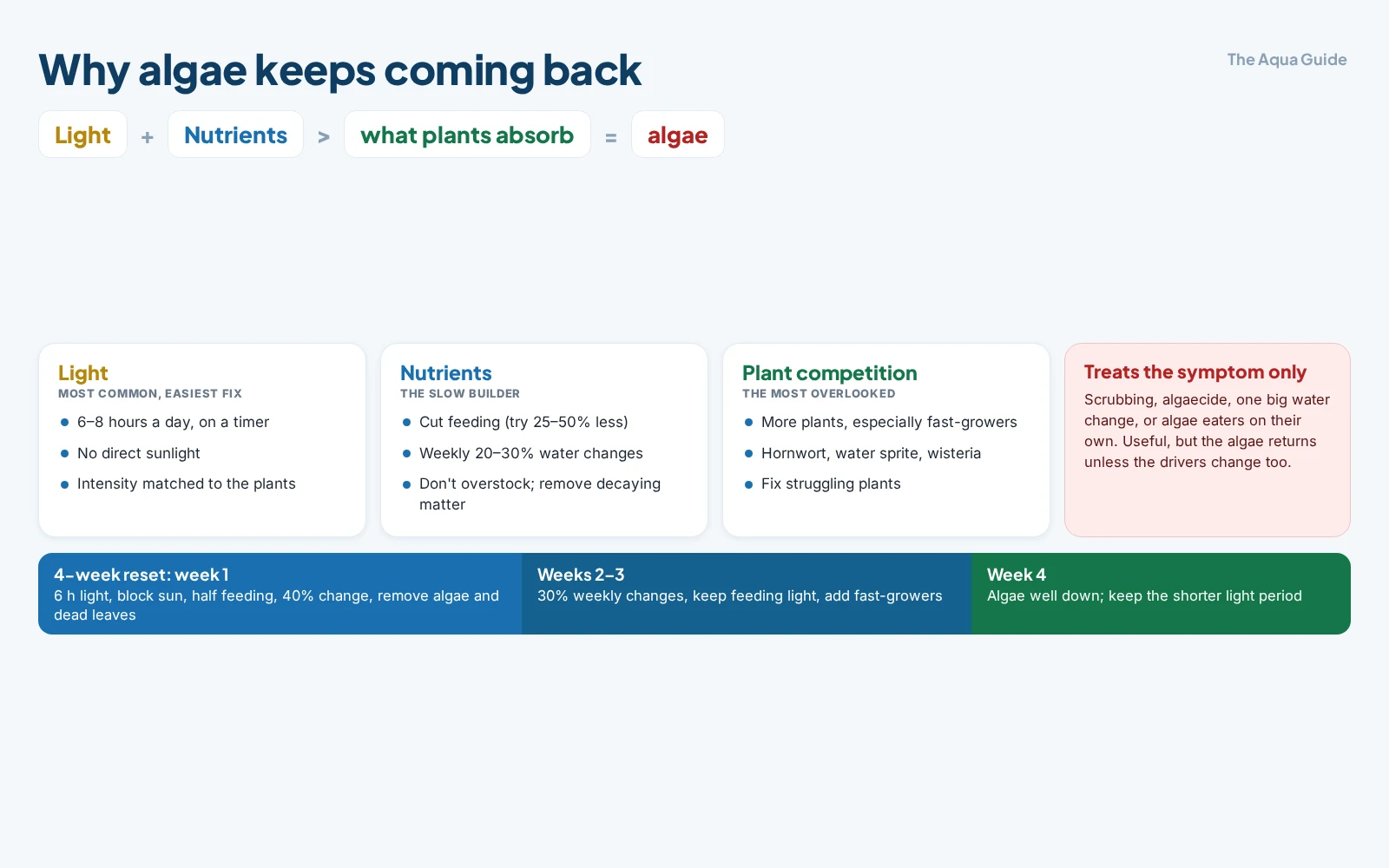
Algae thrives when light + nutrients exceed what plants and beneficial processes absorb.
Three inputs drive algae blooms:
- Light — the energy source. More light, more growth.
- Nutrients — particularly dissolved nitrogen (from ammonia/nitrate) and phosphorus (from food). The "food" for algae.
- Lack of competition — fewer plants means more leftover light and nutrients for algae.
A balanced tank has all three in check: appropriate lighting, modest nutrients, healthy plant competition. An imbalanced tank tips one or more of those toward algae's advantage. The cure is always to identify which factor(s) are out of balance and adjust.
Light: The Most Common Offender
Light is the single biggest driver of algae problems in beginner tanks, and the easiest to fix.
Photoperiod too long. Lights running 10, 12, 14 hours a day is far too much for any tank. Plants stop benefiting after about 8 hours; everything beyond that just feeds algae. The sweet spot is 6–8 hours of light per day, on a consistent schedule, ideally via a timer.
Light too intense. High-output planted-tank lights without matching CO₂ and nutrient supply create the perfect algae environment — strong light, no plants able to keep up. If you've bought a powerful light for a low-tech tank, dial it down or use it for shorter periods.
Inconsistent schedule. Lights on whenever you remember, off at random times — this confuses plants and favors algae, which adapts to inconsistency better than plants do.
Direct sunlight. The most uncontrollable light source. Even partial direct sun on a tank for an hour or two a day can fuel persistent algae problems. Block sunlight, move the tank, or close blinds during sun hours. (Tank placement is its own topic.)
Fix: Set lighting to 6–8 hours per day on a timer, eliminate direct sun, match light intensity to your plant load.
Nutrients: The Slow Builder
Algae's food comes mostly from organic waste in your tank — fish waste, uneaten food, dead plant matter, decomposing material. Over time these break down into dissolved nitrogen and phosphorus, which algae loves.
Overfeeding. The biggest beginner cause. Every uneaten pellet becomes ammonia, then nitrate, all of it feeding algae. If your tank has chronic algae issues, look at feeding first. (Overfeeding has its own dedicated guide.)
Infrequent water changes. Nitrate accumulates between water changes. A tank with monthly (or rarer) water changes builds up high baseline nutrients. Weekly water changes of 20–30% keep nutrients comfortable for fish and inadequate for algae blooms.
Overstocking. Too many fish produces too much waste for the filter and water changes to keep up with. The result: chronically elevated nutrients = algae paradise.
Decaying matter left in the tank. Dead plant leaves, dead fish, uneaten food sitting in corners — anything decomposing adds nutrients. Remove visible debris during maintenance.
Fix: Cut feeding portions, do weekly 20–30% water changes (extra during outbreaks), don't overstock, and remove dead material promptly.
Plant Competition: The Most Overlooked
Healthy live plants are the most effective natural algae control because they directly compete with algae for the same light and nutrients. A heavily planted tank with healthy plants almost never has serious algae problems — the plants simply absorb everything algae would have used.
The opposite is also true: tanks with few plants, struggling plants, or fake plants are far more algae-prone, because nothing is competing for the available light and nutrients.
Few plants. A sparse tank gives algae open territory. Adding more plants (especially fast-growing stem plants) creates real competition.
Struggling plants. If your plants are melting, yellowing, or growing weakly, they're not absorbing — they're decomposing. Fix plant health (covered in Part 5) and they start working for you against algae.
Fake plants only. Plastic plants don't absorb anything. A tank with only artificial décor is structurally more algae-prone than a planted one.
Fast-growing plants are best for algae control. Hornwort, water sprite, water wisteria, anacharis, fast stem plants — these consume nutrients rapidly. A bunch of hornwort floating in a tank can dramatically reduce algae just by absorbing what algae would have used.
Fix: Add plants if your tank is sparse, fix struggling plants, and lean toward fast-growers when fighting algae.
The Root-Cause Diagnostic
When algae appears, work through these questions in order:
1. How long are the lights on per day? If more than 8 hours, cut to 6–7. If your light is high-intensity for a non-CO₂ tank, dial it down.
2. Does the tank get any direct sunlight? Block it if so.
3. How much are you feeding? Cut portions by 25–50% for a few weeks and see if it helps.
4. When was the last water change, and what's the schedule? Increase frequency to weekly (twice-weekly during outbreaks) at 25–30%.
5. How stocked is the tank vs. its capacity? If close to or over capacity, that's a chronic nutrient source.
6. How are your plants doing? Many, healthy, growing? Few, struggling, slow? Add more or improve existing plant health.
7. Is anything decomposing visibly? Dead leaves, uneaten food on the substrate, dead fish behind décor? Remove.
Going through these systematically usually reveals the actual cause within a few minutes — and the fix follows directly.
Why Single-Action Fixes Often Fail
Beginners often try one thing — adding algae eaters, dosing algaecide, doing a single big water change — and are puzzled when it doesn't last. The reason: algae problems are usually multi-factor. If your lighting is too long AND you're overfeeding, fixing only one of those leaves the other still driving algae. The right approach is to fix all contributing factors at once.
Specifically:
Algaecide chemicals kill existing algae but don't change why it grew in the first place. Without fixing the root cause, algae returns within weeks (and chemical use also stresses fish and plants).
One big water change lowers nutrients temporarily but they rebuild quickly unless feeding and stocking patterns change.
Algae eaters consume some existing algae but can't keep up if the tank's underlying conditions favor algae growth. They're help, not solutions.
Manual scrubbing removes visible algae but doesn't change anything driving its growth.
These are all useful as part of the response — but only useful long-term when combined with root-cause fixes.
At a glance: the four-week reset
| When | What you do |
|---|---|
| Week 1 | Photoperiod to 6 hours on a timer. Block any direct sunlight. Feeding to half normal portions. A 40% water change with gravel vacuum, and manually remove as much visible algae as you can |
| Week 1, also | Audit your plants — remove dead leaves, replace any that are clearly dying |
| Weeks 2–3 | Keep up 30% water changes weekly, twice weekly if the algae is heavy. Maintain the reduced feeding. Add fast-growing plants if the tank is sparse, and keep removing algae by hand |
| Watch for | Visible improvement within 10–14 days |
| Week 4 | Algae significantly reduced or gone. Return gradually to normal feeding, still erring lighter. Keep the shorter photoperiod permanently if it solved the problem, and maintain weekly water changes |
Single-action fixes fail because algae is a balance problem, not an event. Changing one of light, nutrients or plant competition while leaving the others alone is why it keeps coming back after you clean the tank.
A 4-Week Algae Reset
A complete root-cause reset, when algae has gotten away from you, looks like this:
Week 1:
- Set photoperiod to 6 hours on a timer
- Block any direct sunlight
- Reduce feeding to half normal portions
- Do a 40% water change with gravel vacuum
- Manually remove as much visible algae as possible
- Audit your plants — remove dead leaves, replace any clearly dying plants
Weeks 2–3:
- Continue 30% water changes weekly (twice weekly if heavy algae)
- Maintain the reduced feeding
- Add fast-growing plants if your tank is sparse
- Continue manual algae removal as it appears
- Watch for improvement — should be visible within 10–14 days
Week 4:
- Algae should be significantly reduced or gone
- Gradually return to normal feeding portions (still err on the lighter side)
- Keep the shorter photoperiod permanently if it solved the problem
- Maintain weekly water changes going forward
If you complete this 4-week reset and algae is still strong, something else is going on — check for hidden sources (a dead fish behind décor, a leaching ornament, water-source issues) or contact a more experienced keeper.
The Bottom Line
Algae returns again and again because scrubbing and water changes only treat the visible symptom — the underlying drivers (too much light, too many nutrients, too little plant competition) keep doing their job. The cure is always root-cause: reduce photoperiod to 6–8 hours, block sunlight, cut feeding, increase water-change frequency, add or improve plants, and remove decaying matter. Single-action fixes like algaecide chemicals, one-time water changes, or algae eaters alone don't solve a fundamentally imbalanced tank. Work through the diagnostic questions, identify which factors are out of balance, and adjust them together — within 2–4 weeks of consistent action, an algae-dominated tank can turn around completely. Then maintain the balance going forward, and algae stays a minor occasional thing rather than a chronic battle.
Related guides
- Preventing algae long-term: the balanced tank
- Algae eaters: which actually work
- Aquarium lighting basics
- Why overfeeding is the #1 beginner mistake
- Black beard algae (BBA)
- Green water and free-floating algae blooms
- The beginner's guide to aquarium algae
Got questions about your specific setup? Drop them in our Community Forum — we love helping new fishkeepers get started right.