You've set up your tank, cycled it carefully, and within a few weeks of stocking, a brown dust starts coating the glass, decorations, plants, and substrate. It looks alarming — like the tank is dying — but brown diatoms in new tanks are extremely common and almost always resolve on their own. Here's what they are, why they appear, and the patient approach that works better than panic.
Why is my new tank covered in brown algae?
Those are diatoms, feeding on silicates that came in with fresh tap water, and they are close to universal in the first 2–8 weeks of a new tank. They fade on their own as the tank matures — wipe them off during weekly maintenance, keep up normal water changes, and resist the urge to dose chemicals or overhaul the lighting.
At a glance: is it really diatoms?
| The trait | What you should find |
|---|---|
| Texture | Soft and dusty brown, coming off easily when wiped — it smears, or lifts in a brown cloud |
| Where | On glass, rocks, decorations, plant leaves, and sometimes the substrate |
| When | The first weeks of a new tank — most commonly 2–8 weeks after setup, peaking around weeks 3–6 |
| What it isn't | Harder green spots, or stringy green growth. Those are different problems with different answers |
Diatoms are single-celled algae with a cell wall made of silica — essentially glass. That is why silicates in fresh tap water are what feeds them, and why they fade as those silicates get used up.
What Brown Diatoms Are
Diatoms are a type of single-celled algae with a unique cell wall made of silica (essentially glass). They appear as a soft, dusty brown coating that you can easily wipe off with a finger — distinct from the harder green spots or stringy green algae you'll encounter later. Run your finger over a brown-coated rock and the diatom coating smears or comes off in a brown cloud; that's the telltale sign.
Diatoms thrive in low-light conditions with available silicates (silica dissolved in water), which is exactly the environment of a brand-new tank: water freshly added (with whatever silicates the tap water carries), lighting not yet "consumed" by established plants, and a tank ecosystem still finding its balance.
In a mature tank, conditions shift against diatoms — silicates get depleted, plants establish and absorb the available nutrients, beneficial bacteria mature, and lighting balance settles in. The diatoms lose their advantage and gradually disappear, often without intervention.
Why New Tanks Get Them
The classic timing: brown diatoms appear in the first 2–8 weeks after setup, peak around weeks 3–6, then gradually fade as the tank matures. This pattern is so consistent it's almost a rite of passage for new keepers.
The reasons:
Fresh tap water carries silicates. Most municipal water contains some dissolved silica. New tanks bring this in fresh; over weeks, it gets depleted by diatom growth and water changes, removing the food source.
New tank conditions are perfect. Lower light (until you nail the photoperiod), abundant nutrients (since plants haven't established), and limited competition from other algae or mature plants all favor diatoms.
Tank ecosystem isn't balanced yet. A mature tank has a stable ecosystem where many small organisms (some bacteria, some microorganisms) consume diatoms as part of the normal cycle. New tanks lack this competition.
These factors all shift over weeks as the tank matures, which is why diatoms naturally fade.
The Diagnostic: Is It Really Diatoms?
Before treating, confirm what you're looking at. Brown diatoms have these distinctive traits:
- Soft, dusty brown coating that comes off easily when wiped
- Appears on glass, rocks, decorations, plant leaves, and sometimes substrate
- First weeks of a new tank (most common 2–8 weeks after setup)
- Smears or clouds when disturbed rather than sticking firmly
If you have:
- Hard green spots that don't wipe off → green spot algae, different topic
- Stringy green hair or threads → hair/thread algae
- Dark green/black tufts on plant edges → black beard algae
- Smelly dark green slime sheets → blue-green algae (cyanobacteria)
These each need different responses (covered in their own guides). The brown-dust-in-new-tank pattern is specific to diatoms.
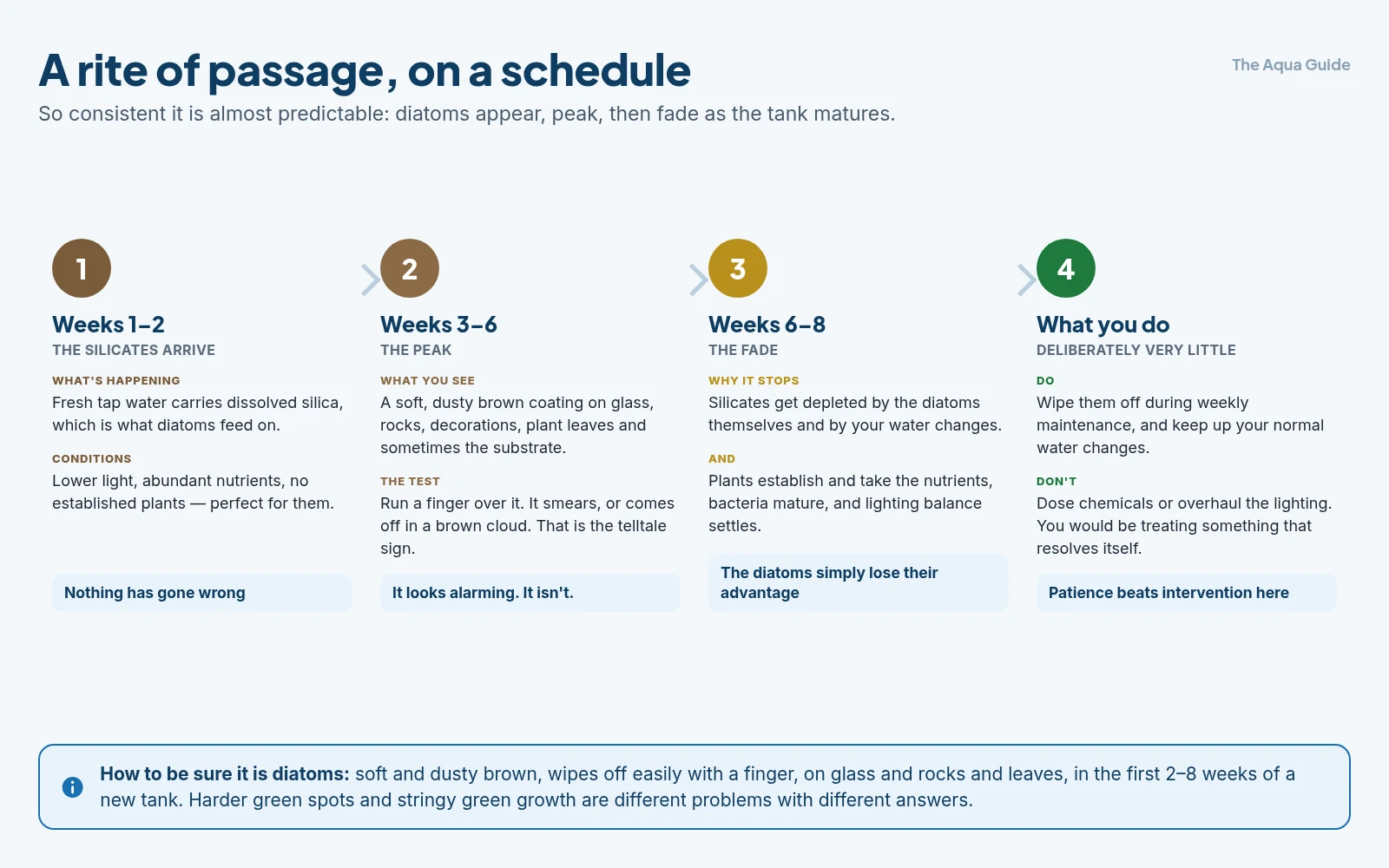
The Patient Approach: Often Best
For most new tanks, the right response is patience plus modest management:
Wipe off accumulating diatoms during your regular maintenance. Easy and satisfying — they come off in seconds with an algae pad on glass, or by gently brushing leaves. Don't go crazy doing this multiple times a week; let your regular weekly maintenance handle it.
Continue normal water changes (20–30% weekly). Water changes gradually remove silicates and accumulated nutrients.
Don't reduce lighting drastically — the diatoms aren't being driven by excess light. Your plants need light to grow and outcompete future algae.
Don't dose chemicals. Algaecides aren't necessary for diatoms and can stress fish and plants.
Wait. Most new-tank diatom outbreaks resolve in 4–8 weeks without any special intervention.
This patient approach works because the underlying conditions are naturally shifting against diatoms over time. Pushing too hard with extreme measures often just disrupts the maturing tank ecosystem.
When to Intervene More Actively
If diatoms are particularly heavy, smothering plants, or lasting beyond about 8 weeks, more active intervention helps:
Add diatom-eating species. A few otocinclus catfish are excellent at eating diatoms off plant leaves and glass without harming plants. Nerite snails also eat diatoms and most other films on hard surfaces. A small group of otos plus 2–3 nerites can clear diatom outbreaks within days.
Increase plant biomass. Healthy growing plants compete with diatoms for nutrients. Adding fast-growing plants (anacharis, hornwort, water sprite) speeds the transition out of diatom phase.
Reduce silicates if possible. If your tap water is high in silicates, using RO water (reverse osmosis) for water changes can reduce input. This is more advanced and usually unnecessary — most tanks resolve without water-source changes.
Adjust lighting slightly upward (longer photoperiod within the 6–8 hour range) IF your tank is genuinely underlit — this favors plant growth that competes with diatoms. But don't go overboard; excess light creates other problems.
Check for trapped silicates from substrate. Some substrates (sand, certain gravels) leach silicates slowly. If diatoms persist for months in a new tank, the substrate may be the source.
Otocinclus: The Classic Diatom Solution
A small group of otocinclus catfish — typically 4–6 in a beginner tank — is the most widely-recommended biological solution to diatoms. These small peaceful catfish actively graze diatoms off plants and surfaces, can be kept in modest community tanks, and quickly clear a diatom outbreak.
Two important caveats:
- Otos need an established tank with algae available — they don't take well to bare new tanks with no diatom food. Ideally add otos when diatoms are present, not before.
- They're sensitive to poor water conditions — make sure your tank is properly cycled and stable before adding them.
When conditions are right, otos are the ideal diatom solution and remain useful long-term as gentle algae grazers.
Why Diatoms Are Almost Good News
Counterintuitively, brown diatoms in a new tank are often a sign of normal tank development. They appear during the maturation phase, signal that the tank ecosystem is actively transitioning, and typically resolve as the tank matures — which it will, given proper maintenance.
The keepers who panic at diatoms and intervene aggressively (chemicals, drastic lighting changes, removing substrate) often disrupt the natural maturation and create worse problems. The keepers who recognize "ah, classic new-tank diatoms, this is fine" and let the tank work through it typically end up with thriving mature tanks within a few months.
After the Diatom Phase
Once diatoms fade — usually around weeks 6–10 of a new tank — your tank has moved into a more mature, balanced ecosystem. Going forward, the algae problems you encounter (if any) tend to shift toward green types (green spot, hair, etc.) which signal different imbalances. The diatom phase is a one-time event in a tank's life, not a recurring problem in mature tanks.
If diatoms return in a mature tank months or years later, something has reset the conditions — usually new substrate added, a deep gravel vacuum that released silicates, an extended period without water changes, or major lighting/stocking changes.
The Bottom Line
Brown diatoms in new tanks are extremely common, almost universal, and almost always resolve on their own as the tank matures. They're caused by silicates from fresh tap water combined with the unbalanced conditions of a new ecosystem — both of which fade over weeks. The right response is patience plus modest management: wipe them off during weekly maintenance, continue normal water changes, and wait 4–8 weeks for them to fade. For heavy or persistent outbreaks, otocinclus catfish (in groups of 4–6) and nerite snails are the classic biological solutions; adding fast-growing plants also helps. Avoid drastic interventions like algaecide chemicals or major lighting changes — they're unnecessary and can disrupt natural tank maturation. Diatoms in a new tank are essentially a sign that the tank is doing what new tanks do; recognize them, manage them mildly, and let the tank mature past them.
Related guides
- The beginner's guide to aquarium algae
- Why algae keeps coming back: the root-cause framework
- Algae eaters: which actually work
- First aquarium setup: a day-by-day beginner's guide
- Aquarium lighting basics: brightness and photoperiod
- How do I know if my tank is fully cycled?
- The easiest fast-growing plants for beginners
- How often should you do a water change — and how much?
Got questions about your specific setup? Drop them in our Community Forum — we love helping new fishkeepers get started right.