You walk past your tank and notice fine green strands growing on a plant, then more on the substrate, then on the filter intake. Within weeks, what started as a few wispy threads has wrapped around half your plants and made the tank look unkempt. This is hair algae (also called thread or string algae) — fast-growing, fast-spreading, and a common frustration in tanks with active plant growth and abundant light. Here's how to recognize it, what causes it, and the response that actually works.
How do I get rid of hair algae?
Wind the strands off onto a chopstick or toothbrush — unlike black beard algae, hair algae physically removes well — then cut the photoperiod to 6 hours, reduce feeding and fertilizer dosing, and add fast-growing plants. Amano shrimp are the most effective biological control and will clear a significant infestation over a few weeks.
At a glance: what feeds it
| Driver | What's happening |
|---|---|
| Strong light, not enough plant biomass | The classic profile. A new planted tank with bright lights but not yet enough established plant mass to consume what the lights are powering — so algae gets the surplus |
| Nutrient imbalance, especially phosphate or nitrate excess | Higher dissolved nitrogen and phosphorus favour fast filamentous growth. In a tank dosing fertilisers, too much — or imbalanced — creates exactly that surplus |
| Inconsistent CO₂ in high-tech tanks | When CO₂ fluctuates, plants stop and start. Algae adapts more readily than they do |
| Long or intense lighting | 10+ hour photoperiods, or strong lights without dimming, frequently trigger a bloom |
Unlike black beard algae, hair algae physically removes well. Wind the strands onto a chopstick or an old toothbrush and they come away — which makes manual removal a real part of the answer here rather than a token gesture.
What Hair Algae Looks Like
Hair algae appears as fine green strands or filaments, typically:
- Color: bright to medium green, sometimes slightly yellowish (different from BBA, which is dark/black)
- Texture: soft, hair-like or thread-like, often 1–10 cm long when established
- Attachment: anchored at a point (on a leaf edge, on hardscape, on equipment) with strands flowing in the current
- Tendency: spreads quickly across plants, décor, and substrate when conditions favor it
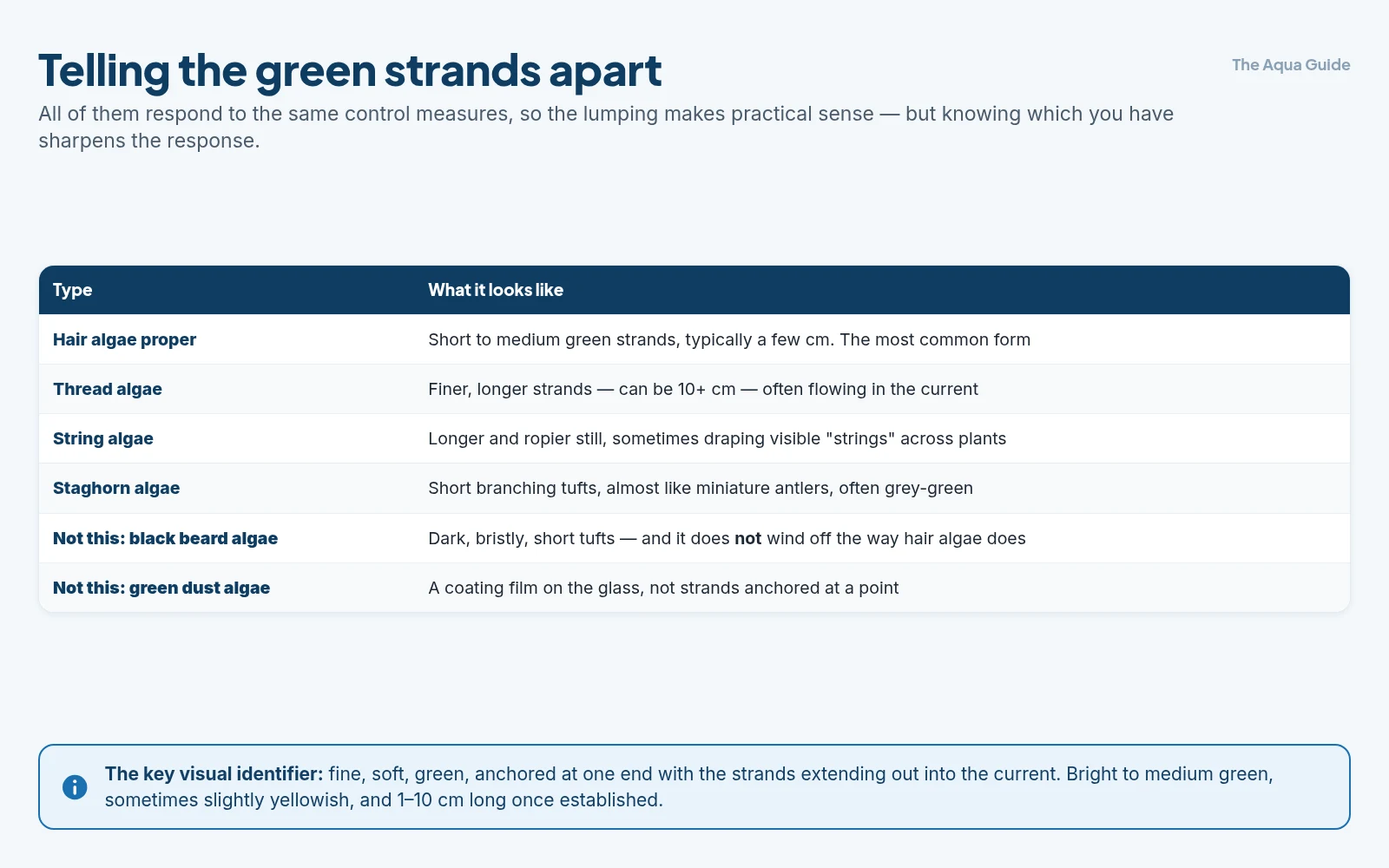
There are several related types collectively called "hair algae":
- Hair algae proper — short to medium green strands (typically a few cm), the most common form
- Thread algae — finer, longer strands (can be 10+ cm), often flowing in current
- String algae — even longer and ropier, sometimes forming visible "strings" that drape across plants
- Staghorn algae — short branching tufts that look almost like miniature antlers, often grey-green
All respond to similar control measures, so the lumping makes sense for practical purposes.
The key visual identifier: fine, soft, green, anchored at one end with strands extending out. This distinguishes it from BBA (dark, bristly, short tufts) and green dust algae (a coating film, not strands).
What Causes Hair Algae
Hair algae's classic profile is the planted tank with strong light but insufficient plant uptake — meaning the lighting is intense enough to drive heavy growth, but the plants aren't fully consuming the available nutrients, leaving them for hair algae.
Specific drivers:
Strong light, insufficient plant biomass. A common pattern: new planted tank with bright lights but not yet enough established plant mass to consume what the lights are powering. Algae gets the surplus.
Nutrient imbalance, especially phosphate or nitrate excess. Higher levels of dissolved nitrogen and phosphorus favor fast filamentous growth. In planted tanks dosing fertilizers, dosing too much (or imbalanced) creates exactly this surplus.
Inconsistent CO₂ in high-tech tanks. When CO₂ levels fluctuate, plants stop and start, while algae adapts more readily.
High lighting duration or intensity. 10+ hour photoperiods, or strong lights without dimming, frequently trigger hair algae blooms.
Direct sunlight. The classic trigger of many algae types, hair algae included.
New tank or recently-rescaped tank. When plants haven't fully established, hair algae can dominate the period before plants take over.
Common pattern: someone sets up a planted tank with strong lighting, plants are still establishing, the lighting is too long, and hair algae appears within weeks. The same tank a few months later, with mature plant growth and a shorter photoperiod, no longer has hair algae.
The Response: Multi-Pronged Approach
Hair algae responds well to a combination of physical removal, nutrient management, and biological control.
1. Manual Removal (Essential)
Unlike some algae types, hair algae is fairly easy to physically remove and manual removal is genuinely effective as part of the response.
Twist around a stick. Wind hair algae around a chopstick, toothbrush, or aquascaping tool — the strands wrap around it like cotton candy and lift away in clumps. Surprisingly satisfying and removes a lot quickly.
Pluck by hand. Wear an aquarium glove if you don't want fishy hands. Pull off what you can grab; small clumps come off easily.
Trim affected leaves. If a plant leaf is heavily covered, often easier to remove the whole leaf than save it. The plant will regrow healthier replacements.
Take out and clean décor. Wood, rocks, and decorations can be removed and scrubbed under tap water with a brush. Soak in 1:20 bleach for 2 minutes followed by thorough rinse and dechlorinator soak for very stubborn coverage.
Manual removal alone, repeated over 2–3 weeks, can significantly reduce hair algae populations even before other interventions take effect.
2. Reduce Light
Hair algae loves strong light. Adjustments:
- Shorten the photoperiod to 6 hours per day for 2–3 weeks during the outbreak
- Dim lights if your fixture has the option (some LEDs have intensity control)
- Lift the light higher above the tank temporarily
- Block any direct sunlight completely
Cutting light is one of the most effective hair-algae interventions — algae starves while you're still working on the other fronts.
3. Address Nutrient Excess
If you're dosing fertilizers, reduce dosage temporarily (often by half) for a few weeks. Watch which nutrient might be in excess — phosphate tests are particularly useful since high phosphate often correlates with hair algae.
Even if you're not actively dosing, the standard interventions apply:
- Increase water changes to 30% twice a week during the outbreak — dilutes accumulated nutrients
- Reduce feeding by 25–50% temporarily
- Vacuum substrate more thoroughly to remove trapped detritus
4. Improve Plant Performance
Better plant uptake means less for algae. Practical steps:
Add fast-growing plants. Hornwort, water sprite, anacharis, water wisteria, and similar fast-growers consume nutrients rapidly. A bundle of hornwort floating in a tank during an algae outbreak is a strong control measure.
Ensure existing plants are healthy. Trim dead leaves, replant anything dislodged, address nutrient deficiencies in plants (yellowing, holes in leaves) so they can grow at full capacity.
Don't over-fertilize. Especially in newer planted tanks, less is more — dose conservatively and adjust upward only as plants demand it.
5. Biological Control
Several creatures eat hair algae effectively:
Amano shrimp are the gold standard for hair algae. They actively graze on filamentous algae and can clear significant infestations within weeks. Get a group of 4–6+ depending on tank size. They're peaceful, won't harm plants, and stay focused on algae once they discover it.
Florida flagfish (Jordanella floridae) are aggressive hair-algae eaters, almost too efficient — they'll strip a tank of hair algae quickly. Caveats: can be nippy with fancy-finned tankmates.
Rosy barbs also eat hair algae but require larger tanks and may not suit all communities.
Some snail species (nerites, some pond snails) graze algae but don't focus heavily on filamentous types.
Amano shrimp are the most universally useful biological control for hair algae and worth adding to any planted community tank, both for outbreak management and ongoing prevention.
6. Hydrogen Peroxide Spot Treatment (Use Carefully)
For stubborn hair algae on hardscape that resists other methods, a 3% household hydrogen peroxide spot treatment can work:
- Turn off filters/pumps
- Use a syringe to apply peroxide directly to affected algae (a few mL per spot)
- Wait 10–15 minutes (algae will turn white/bubbly as it dies)
- Turn pumps back on
- Maximum dose roughly 1mL per gallon for whole-tank, but spot treatments are gentler
Hydrogen peroxide kills algae but degrades quickly in water (becoming water + oxygen), so it doesn't accumulate. Cautions: Some plants and inverts are sensitive — test on a small area first; avoid applying directly to fish or shrimp; don't exceed reasonable doses.
This is a stronger tool, useful for resistant patches, not a routine measure.
Hair Algae in Different Tank Types
Low-tech tank (no added CO₂, modest lighting): Hair algae is less common but does occur with light excess or new-tank instability. The lighting fix and water changes usually solve it.
High-tech planted tank (added CO₂, strong lighting): Most common case. CO₂ stability becomes important; check delivery and timing. Often requires the full multi-pronged approach.
Shrimp tank: Hair algae is less of a worry — shrimp themselves help control it, and outright treatment with chemicals may not be safe. Lean on manual removal and lighting adjustments.
New tank (under 6 months): Hair algae often comes and goes during the establishing period. Patient management plus the standard responses works; tanks usually settle into balance.
When Hair Algae Persists
If the standard response doesn't clear hair algae after 4–6 weeks of consistent effort, possible factors:
- A nutrient is in excess that you haven't tested — get a more complete water test panel including phosphate
- Source water is rich in nutrients — consider using RO water for water changes if your tap is high in phosphate
- Substrate is leaching — old or nutrient-rich substrate can release ongoing nutrients
- Hidden food sources — uneaten food trapped under décor, decay you haven't noticed
In rare cases, completely tearing down the tank and restarting is the most efficient solution — but this should be a last resort, not an early step.
The Bottom Line
Hair, thread, and string algae are caused by strong light combined with surplus nutrients and insufficient plant uptake — typical of new or under-planted high-light tanks. The response combines several actions: manually remove what you can (it's effective, unlike with BBA), reduce lighting to 6 hours and block any sunlight, increase water changes and reduce feeding, improve plant health and add fast-growing plants like hornwort, and add amano shrimp as biological control (the most useful single addition for hair algae). For stubborn patches, hydrogen peroxide spot treatments can help. Most hair algae outbreaks resolve within a few weeks of consistent multi-front effort. The keepers who beat hair algae permanently are those who address both the visible algae and the underlying conditions (lighting, nutrients, plant balance) that allowed it to thrive — fixing one without the other leads to recurrence.
Related guides
- Black beard algae: what it is and how to beat it
- The beginner's guide to aquarium algae
- Algae eaters: which actually work
- Freshwater shrimp: cherry, amano and more
- Advanced fertilisation: dosing methods for planted tanks
- CO₂ injection: pressurised systems and alternatives
- Aquarium lighting basics: brightness and photoperiod
- Preventing algae long term: the balanced tank
Got questions about your specific setup? Drop them in our Community Forum — we love helping new fishkeepers get started right.