The keepers whose tanks always look pristine aren't lucky and they don't have magic equipment. They've found a stable balance — the tank's lighting, nutrients, plant growth, fish load, and maintenance routine all work together so that algae never gets a foothold. This balance isn't dramatic or expensive to maintain; it's a set of simple habits that, once in place, keep algae managed almost automatically. Here's how to set up and maintain a long-term balanced tank where algae stops being a fight.
How do I stop algae growing in my aquarium?
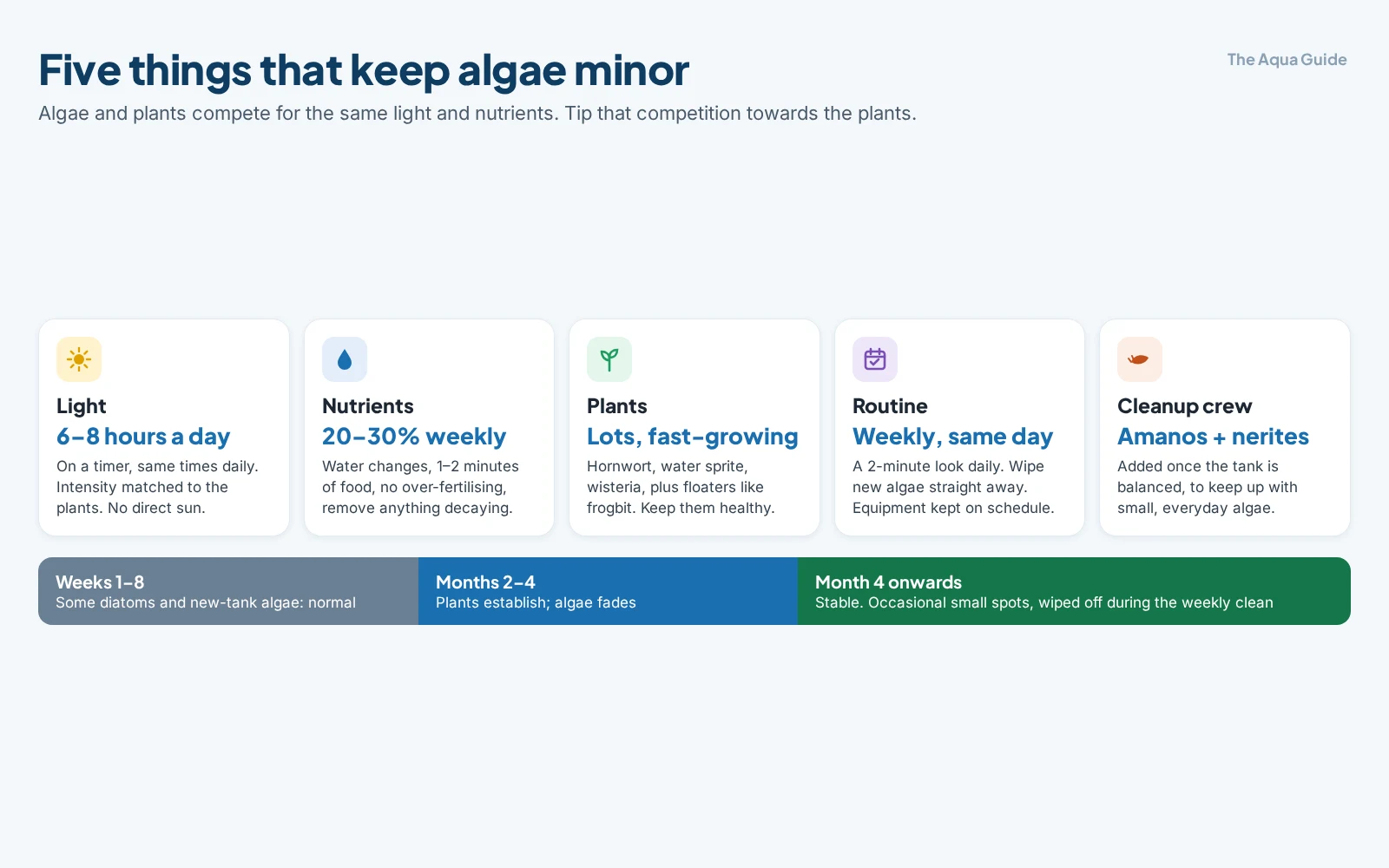
Keep five things in balance: 6–8 hours of light a day on a timer with no direct sunlight, modest feeding with weekly 20–30% water changes, enough healthy fast-growing plants to consume the surplus, a maintenance routine you actually keep to, and a small maintenance crew such as amano shrimp and nerite snails. Prevention is far cheaper than cure — a tank set up this way rarely has a serious algae outbreak at all.
The Balanced-Tank Mindset
Most algae advice focuses on what to do when algae appears. The balanced-tank approach is different — it asks: how do I set up my tank so algae never has a chance to become a problem?
The principles are simple:
- Algae and plants compete for the same resources (light, nitrogen, phosphorus, carbon).
- Whichever wins the competition dominates the tank.
- A balanced tank tips that competition strongly in favor of plants so algae stays minor.
Three factors keep that balance:
- Lighting that matches your plant load — not more, not less
- Nutrient input that matches what plants and bacteria can absorb — not the excess that algae feeds on
- Plant biomass that's strong enough to outcompete algae — healthy, fast-growing, established
Get all three right and algae becomes a minor occasional thing rather than a chronic battle.
Element 1: Lighting in Balance
Light drives both plant growth and algae growth. The trick is to provide enough that plants thrive but not so much that they can't keep up.
Photoperiod: 6–8 hours per day. The single most consistent finding in aquarium algae control. Less than 5 hours and plants struggle; more than 8 hours and algae gains. Set it on a timer so it's identical every day — consistency matters as much as the duration.
Intensity matched to plant type.
- Low-tech tanks (hardy plants, no CO₂): standard kit lighting is plenty. Don't upgrade to high-output fixtures.
- Mid-tech planted tanks (mixed plant load): moderate lighting works. Avoid both the dimmest and brightest extremes.
- High-tech planted tanks (carpet plants, demanding species, CO₂ added): high-intensity lighting works only when matched with CO₂ and fertilization. Otherwise creates algae.
No direct sunlight. Even an hour of sun on the tank can shift everything toward algae. Block it. (Tank placement, Part 1.)
Consistent on/off times. Lights coming on whenever you remember confuses plants and favors algae. Same time on, same time off, every day.
A balanced-light tank is one where plants are thriving and algae growth is minor — not pristine glass but no green water, no spreading hair algae, no taking-over BBA.
Element 2: Nutrient Balance
Excess nutrients feed algae. Insufficient nutrients starve plants. The middle ground keeps both in check.
Feeding modest, consistent portions. The 1–2 minute rule (Part 8). Overfeeding is the largest beginner source of algae-feeding nutrients.
Weekly water changes of 20–30%. Keeps dissolved nutrients (especially nitrate, the long-term builder) at levels that fish tolerate well and algae tolerates poorly. Higher frequency or volume during active outbreaks, but the steady weekly habit is the foundation.
Vacuum substrate appropriately. Light vacuum during weekly water changes prevents detritus accumulation that releases nutrients gradually. In planted tanks, don't vacuum too deep (disturbs roots) — but the top layer of substrate gets a quick pass.
Don't over-fertilize. In planted tanks, more fertilizer doesn't always equal better plant growth — beyond what plants can absorb, the excess fertilizer feeds algae. Start with the recommended dose, observe plant response, adjust upward only if plants show clear deficiencies.
Avoid feeding excessively rich foods. Some foods (especially high-protein feeders for predatory fish) leave more residual nutrients than basic flakes/pellets. Use them sparingly.
Don't ignore decay. Dead fish, dead plant leaves, and stuck uneaten food are concentrated nutrient sources. Find and remove them during maintenance.
A balanced nutrient profile lets plants thrive without leaving surplus for algae.
Element 3: Strong Plant Competition
Live plants are the most effective algae-prevention tool — they directly consume the same resources algae would use, leaving algae starved. A well-planted tank with healthy growing plants almost never has serious algae problems.
Have enough plant biomass. A tank with one struggling anubias has nothing competing with algae. A tank with multiple healthy species filling space — including some fast-growers — has serious competition.
Include fast-growing plants. Hornwort, water sprite, water wisteria, anacharis, ludwigia, and other fast growers are the heavy lifters of nutrient absorption. Even one good bunch of hornwort or water sprite makes a major difference. They're algae's nutritional rivals.
Floating plants are particularly effective. Plants like water lettuce, frogbit, salvinia, and duckweed grow at the surface where light is strongest, shading the water column below while voraciously consuming nutrients. They're algae-prevention machines. Trim regularly so they don't completely cover the surface.
Keep plants healthy. Dying plants don't compete — they release nutrients back into the water. Trim dead leaves, address yellowing or melting, replace failing plants. Active plant health = active algae prevention.
Plant density that fills the tank. A heavily planted tank with most surfaces covered by plant growth gives algae almost no foothold. Aim for vegetation across the back wall, in the midground, and ideally some in the foreground.
The ideal goal isn't a perfectly designed aquascape — it's significant plant biomass actively growing across the tank.
Element 4: Stable Maintenance Rhythm
The above elements only work if maintained consistently. The keepers who battle algae chronically aren't usually lacking knowledge — they're inconsistent.
Weekly water change, same day. Pick a day (Sunday morning works well — combines with the weekly fast day) and protect it.
Daily observation. The 2-minute look from Part 8. Catches new algae early when it's easy to manage.
Manual algae removal when it appears. Don't wait for outbreaks. A 30-second wipe of a glass film prevents a week-long battle later.
Equipment maintenance on schedule. Filter cleaned when flow reduces; lights on timers; heater verified working. Equipment failures often correlate with algae blooms.
Annual deep checks. Once a year (or twice), really audit everything — substrate condition, equipment age, plant health overall, anything you've stopped noticing because it became normal. This catches gradual drifts before they become problems.
The boring weekly-and-daily habits, done consistently, do more for long-term algae prevention than any single intervention.
Element 5: The Right Algae Eaters as Maintenance
Algae eaters work best as ongoing maintenance in a balanced tank — not as panic interventions when things have gone wrong.
A balanced tank with a few amano shrimp and nerite snails stays clean of most casual algae growth without effort. They eat the small amounts of algae that naturally appear on glass and surfaces, before it becomes visible to you. Result: a tank that looks consistently pristine.
Add algae eaters when your tank is already balanced. They're the finishing touch that keeps things looking sharp, not a fix for a poorly-set-up tank.
At a glance: what an algae-resistant tank looks like
| Element | In a 30-gallon planted community tank |
|---|---|
| Light | A standard aquarium light on a timer: 7 hours a day, exactly the same every day, and no direct sunlight reaching the tank |
| Stocking | Moderate — a school of small tetras, a small group of cories, a few livebearers. Not pushing the limits |
| Feeding | Modest and daily: 1–2 minutes' worth, once a day, with an occasional fast day |
| Plants | Several, mixing fast-growers like hornwort and water wisteria with slower types like anubias and java fern |
| Surface | A handful of floating plants — frogbit or water lettuce |
Every element is unremarkable on its own. The resistance comes from all five holding together at once, which is why prevention is a setup rather than a treatment.
Putting It Together: The Algae-Resistant Tank Setup
A practical example of how the elements combine in a single tank:
A 30-gallon planted community tank with:
- Standard aquarium light on a timer: 7 hours per day, exactly the same every day
- No direct sunlight reaching the tank
- Moderate stocking: a school of small tetras, a small group of cories, a few livebearers — not pushing the limits
- Modest daily feeding: 1–2 minutes' worth, once a day, occasional fast day
- Several plants including fast-growers (hornwort, water wisteria) plus slower types (anubias, java fern)
- A handful of floating plants (frogbit or water lettuce) on the surface
- 4 amano shrimp + 2 nerite snails as maintenance crew
- Weekly 25% water change with substrate vacuum, every Sunday morning
- Filter cleaned monthly (in tank water, never tap)
- Daily 2-minute observation
This tank rarely develops algae problems. The plants are absorbing the nutrients, the photoperiod is right, the lighting is matched to the plant load, the maintenance is consistent, and the algae eaters mop up minor growth before it spreads. It's not a high-tech showcase — it's a balanced everyday setup.
What Long-Term Algae Prevention Looks Like
Six months of balanced-tank management looks like this:
- Weeks 1–8 (new tank): Some diatoms typical, occasional new-tank algae, manageable. Otos and shrimp help. Don't panic — this is normal.
- Months 2–4: Tank settling into mature balance. Plants establishing, beneficial bacteria mature, algae fading naturally. Maintenance routine becomes familiar.
- Months 4+: Stable, balanced tank. Occasional minor algae (a small spot on the glass, a tiny tuft on an ornament) — easily wiped during weekly cleaning. No major battles, no dramatic outbreaks.
This pattern — a few months of settling followed by long-term stability — is what successful long-term keepers experience. The first few months require attention; after that, the tank essentially maintains itself with weekly habits.
Recovery from Imbalance
If your tank has gone out of balance (chronic algae fights, multiple outbreaks, struggling plants), you can return to balance with a deliberate reset:
Week 1: Identify everything that's out of balance using the root-cause framework (light, nutrients, plant health). Make corrections — shorter photoperiod, less feeding, more water changes, add plants.
Weeks 2–6: Maintain the corrections rigorously. Watch the tank gradually improve.
Weeks 6+: Add algae eaters once conditions are stable and food is available for them.
Long-term: Maintain the new habits permanently. The tank now operates at the balanced equilibrium where algae stays minor.
Most chronic-algae tanks can return to balance within 2–3 months of deliberate effort. The tank's biology heals when given the right conditions.
The Bottom Line
Long-term algae prevention isn't about killing algae over and over — it's about setting up a balanced tank where algae can't gain a foothold. Five elements: appropriate lighting (6–8 hours daily, intensity matched to plants), nutrients in balance (modest feeding, weekly water changes, no over-fertilizing), strong plant competition (multiple healthy fast-growing plants, ideally including floaters), consistent maintenance rhythm (same day each week, daily observation), and the right algae eaters as ongoing maintenance crew. Get all five working together and algae becomes a minor occasional thing rather than a chronic problem. The pattern emerges over the first few months: an initial settling-in period with normal new-tank algae, then a long stable phase where the tank essentially maintains itself with weekly habits. That's the equilibrium successful keepers reach, and it's available to any tank set up and maintained with these principles in mind.
Related guides
- Why algae keeps coming back
- Algae eaters: which actually work
- Aquarium lighting basics
- Floating and carpeting plants for beginners
- How often should you do a water change?
- The beginner's guide to aquarium algae
Got questions about your specific setup? Drop them in our Community Forum — we love helping new fishkeepers get started right.