If the nitrogen cycle is the most important concept in fishkeeping, the water change is the most important habit. It's the single most powerful thing you can do for your tank, and yet it's also the chore beginners most often skip, do wrong, or agonize over. How much should you change? How often? Can you do too much? Let's settle all of it with clear, practical guidance you can actually follow.
How often should you do a water change, and how much?
Change 10–25% of the water once a week for a typical, moderately stocked community tank, with a weekly 20% change as the sound default. Nothing in the tank removes nitrate — only you do.
At a glance: how much, how often
| Your tank | Change | Why |
|---|---|---|
| Typical, moderately stocked community tank | 10–25% once a week — a weekly 20% is the sound default | Keeps nitrate in check and chemistry stable |
| Heavily stocked, large or messy fish, heavy feeding, no live plants | More — a larger percentage, or more often | All of these produce more waste |
| Lightly stocked and planted | Less | Less waste to dilute |
| Nitrate dangerously high, or a cycle problem | A big change, even 50% or more | Safe and sometimes necessary, provided the new water matches the tank's temperature and is treated |
The target is the reading, not the routine: keep nitrate under roughly 20–40 ppm. Your test kit decides, not a calendar.
Why Water Changes Are Non-Negotiable
First, understand what a water change actually does, because once you do, you'll never skip one again. Your nitrogen cycle converts toxic ammonia into far-less-toxic nitrate — but the chain ends there. Nothing in your tank removes nitrate. No filter, no bacteria, and only partially any plants. So nitrate accumulates, continuously, forever, until you remove it. The only reliable way to remove it is to take out some old water and replace it with fresh.
But water changes do more than remove nitrate. They also replenish the minerals and buffering capacity (KH) that keep your pH stable, dilute other dissolved organics and pheromones that build up and stunt fish, and refresh the overall water chemistry. A tank without water changes slowly drifts toward high nitrate, depleted buffering, unstable pH, and accumulated gunk — a condition sometimes called "old tank syndrome," where fish quietly decline for no obvious reason. Regular water changes prevent all of it. This is the routine that keeps everything else in balance.
The Standard Recommendation
For a typical, moderately-stocked community aquarium, the widely-recommended routine is:
Change 10–25% of the water, once a week.
That's the baseline that works for most tanks. A weekly 20% change is a sound default that keeps nitrate in check, maintains stable chemistry, and rarely causes problems. If you remember one rule, that's it: roughly 20%, roughly weekly.
But the "right" amount isn't truly fixed — it depends on your tank, and the honest answer is that your test kit decides, not a calendar. The purpose of a water change is to keep nitrate low and chemistry stable, so the correct frequency and volume are whatever achieves that for your specific tank.
Let Your Nitrate Be the Guide
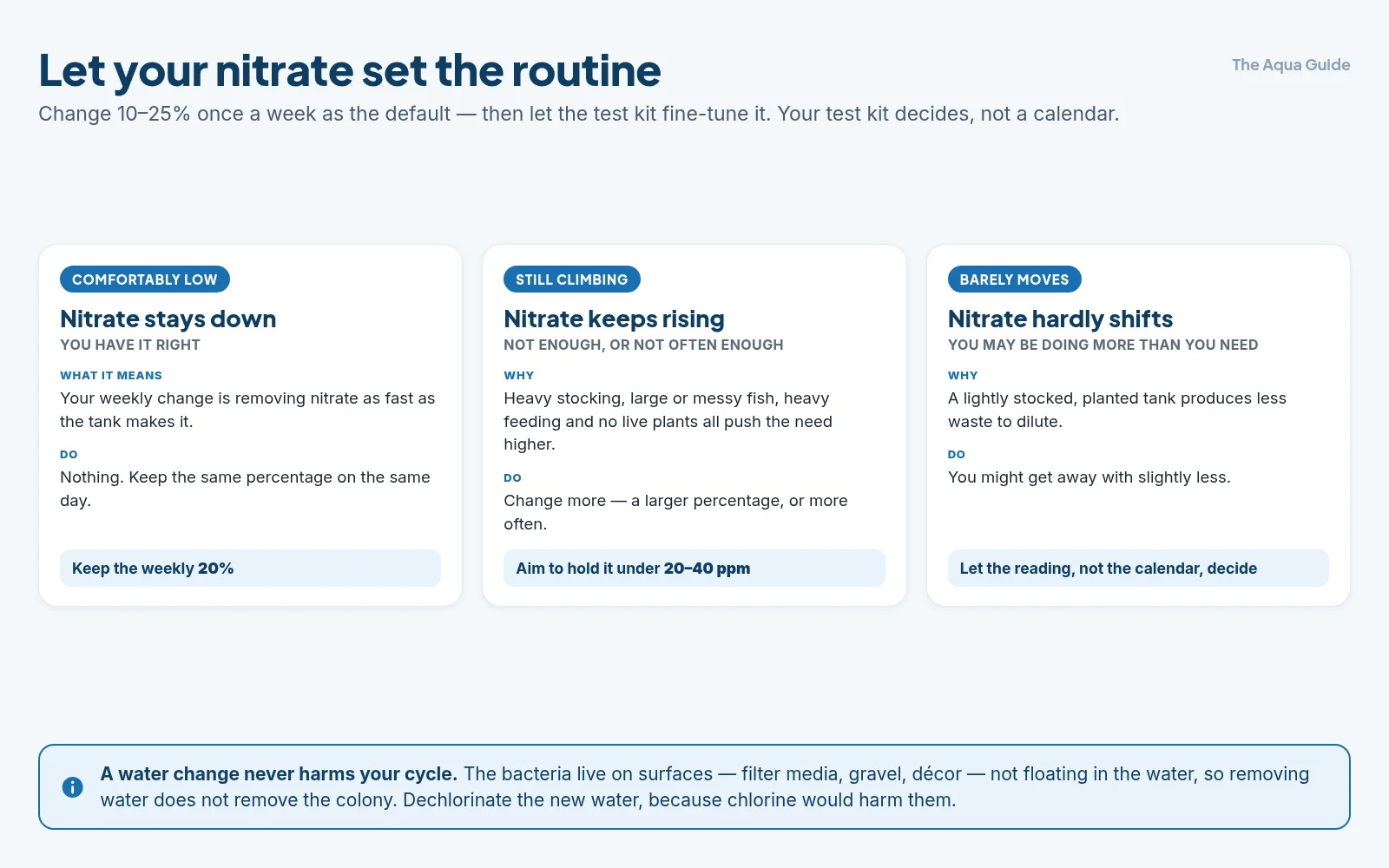
Here's the more precise approach once you're comfortable: test your nitrate regularly and use it to dial in your routine. The goal is keeping nitrate under roughly 20–40 ppm. If your weekly 20% change keeps nitrate comfortably low, you're doing the right amount. If nitrate is still climbing high despite weekly changes, you need to change more — either a larger percentage, or more frequently. If your nitrate barely moves, you might get away with slightly less.
Several factors push your needs higher: a heavily-stocked tank, large or messy fish, heavy feeding, and the absence of live plants all produce more waste and demand more frequent or larger changes. A lightly-stocked, planted tank needs less. Rather than memorizing a number, watch your nitrate and let it tell you — that's the reading that reflects exactly what your tank is doing.
Can You Change Too Much?
This worries a lot of beginners, and the nuance is worth getting right. Large water changes are generally safe and beneficial if the new water matches the old in temperature and chemistry. The risk isn't the volume itself — it's sudden change. If you swap a large amount of water that's a different temperature or significantly different pH/hardness from the tank, you can shock your fish.
So big changes (even 50% or more) are fine and sometimes necessary — for example, to rescue a tank with dangerously high nitrate or during a cycle problem — provided you match the new water's temperature and treat it properly. What you want to avoid is large, careless changes with mismatched water. For routine maintenance, modest regular changes (the 20% weekly habit) are easiest and safest because they keep everything stable with minimal disruption.
One thing a water change does not do: it doesn't harm your cycle. Your beneficial bacteria live on surfaces (filter media, gravel, décor), not floating in the water, so removing water doesn't remove your colony. You can change water freely without fear of "resetting" your cycle — as long as you dechlorinate the new water, because chlorine would harm the bacteria.
The Essentials of Doing It Right
The mechanics get their own detailed guide, but the core principles are: always dechlorinate the replacement water before it reaches your fish (chlorine kills both fish and bacteria), match the new water's temperature to the tank to avoid shock, and use the opportunity to gently vacuum the substrate, since that's where a lot of waste collects. Do those three things and a water change is genuinely simple.
Building the Habit
The biggest predictor of success isn't the perfect percentage — it's consistency. A reliable weekly 20% change beats an occasional heroic 75% change every couple of months. Pick a day, make it routine, and your tank will reward you with stable, healthy water. Many keepers tie it to a weekly ritual (Sunday morning, say) so it never gets forgotten. Skipping weeks is how nitrate creeps up and chemistry drifts; steady rhythm is how you avoid every slow-decline problem in the hobby.
The Bottom Line
Change roughly 10–25% of your water about once a week as a solid default — but let your nitrate reading fine-tune it, since the real goal is keeping nitrate low (under ~20–40 ppm) and chemistry stable. Heavier stocking and feeding mean more frequent or larger changes; planted, lightly-stocked tanks need less. You can safely do large changes when needed, as long as the new water matches the tank's temperature and is dechlorinated — and water changes never harm your cycle, since bacteria live on surfaces, not in the water. Above all, be consistent: a steady weekly rhythm is the habit that keeps your whole tank healthy.
Related guides
- The correct step-by-step water change
- What are safe ammonia, nitrite and nitrate levels?
- How to use a liquid test kit (and why strips fail)
- How to clean your filter without crashing the cycle
- How do plants help process ammonia and nitrates?
- The daily, weekly and monthly maintenance checklist
- Tap, RO and remineralised water explained
- The nitrogen cycle, explained
Got questions about your specific setup? Drop them in our Community Forum — we love helping new fishkeepers get started right.