When you start testing your water, you get numbers — but numbers mean nothing without context. Is 0.25 ppm of ammonia fine or an emergency? Is 40 ppm of nitrate okay? Knowing what's safe, what's a warning, and what's a crisis turns your test kit from a source of confusion into a genuinely useful tool. Here's exactly what each reading should be, and what to do when it isn't.
The Quick Answer
In a healthy, established aquarium:
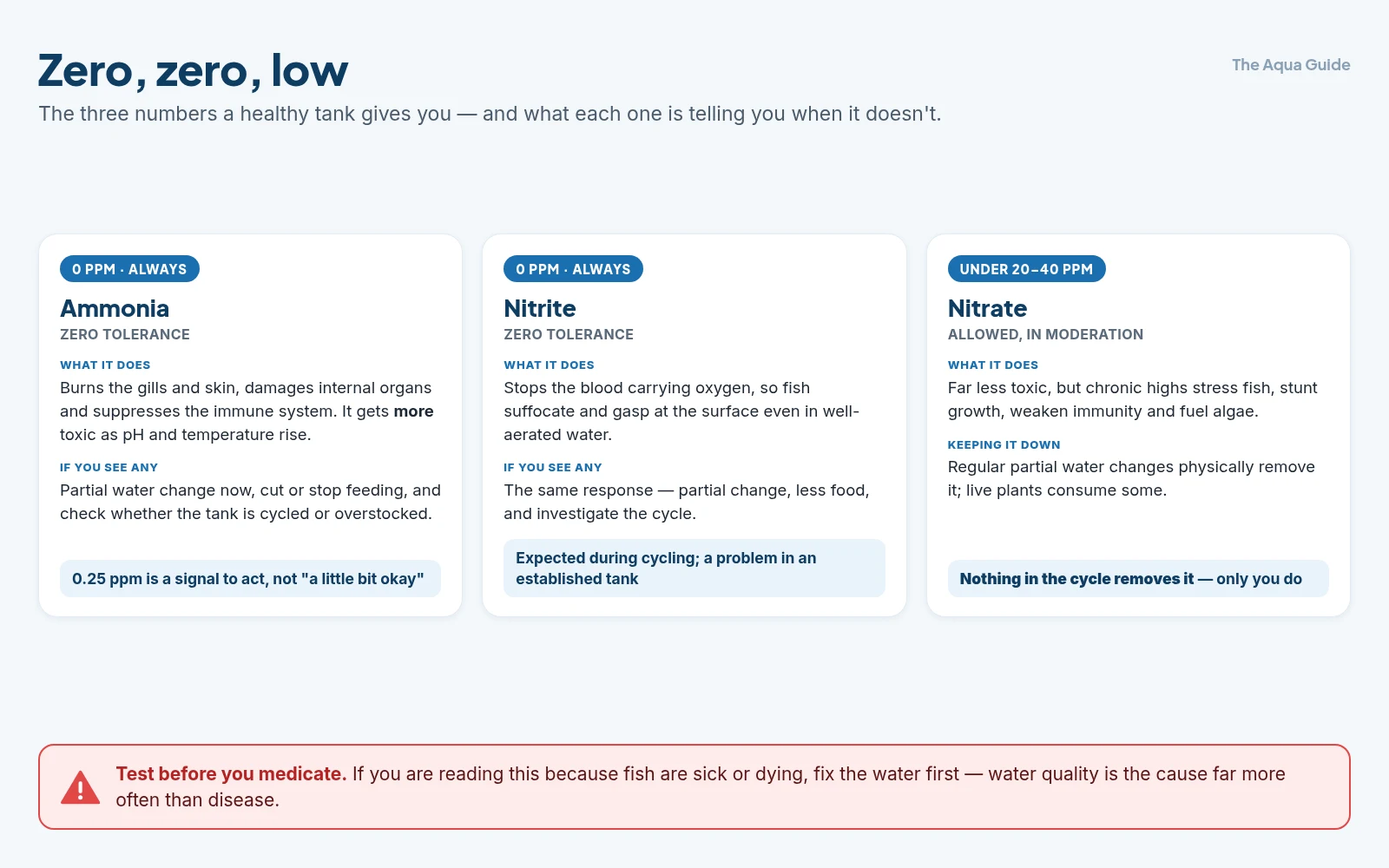
Ammonia: 0 ppm. Always. Nitrite: 0 ppm. Always. Nitrate: low — ideally under 20–40 ppm, kept down with water changes.
That's the whole target in three lines. Ammonia and nitrite have zero tolerance; nitrate is allowed but should be kept modest. Now let's understand why, and what the in-between readings mean.
At a glance: what each reading should be
| Reading | Safe level | What it does to fish | If it isn't safe |
|---|---|---|---|
| Ammonia | 0 ppm, always | Burns gills and skin, damages organs, suppresses immunity — and grows more toxic as pH and temperature rise | Partial water change now, cut feeding, check the cycle and stocking |
| Nitrite | 0 ppm, always | Stops the blood carrying oxygen, so fish gasp even in well-aerated water | The same: partial change, less food, investigate the cycle |
| Nitrate | Under about 20–40 ppm | Chronic highs stress fish, stunt growth, weaken immunity and fuel algae | Regular water changes; live plants consume some |
A healthy tank reads zero, zero, low. pH is deliberately not in this list — it is about stability and matching your fish, not a zero target.
Ammonia — Zero Tolerance
Ammonia is the first and most toxic waste product in your tank, produced by fish waste, uneaten food, and decay. The safe level is simple: zero. Any detectable ammonia is a problem.
Even small amounts do real harm. Ammonia burns the gills and skin, damages internal organs, stresses fish, and suppresses their immune systems, leaving them open to disease. A reading as low as 0.25 ppm is not "a little bit okay" — it's a signal to act. At higher levels it kills outright, and its toxicity actually increases as pH and temperature rise, so the same reading is more dangerous in warm, alkaline water.
If you see any ammonia: do an immediate partial water change to dilute it, reduce or stop feeding, and check whether your tank is fully cycled, overstocked, or has a damaged bacterial colony. A water conditioner that detoxifies ammonia can buy your fish a temporary safety window while you address the cause.
Nitrite — Also Zero Tolerance
Nitrite is the second step in the nitrogen cycle — what beneficial bacteria produce when they consume ammonia. It's less notorious than ammonia but still genuinely dangerous, and the safe level is again zero.
Nitrite's particular danger is that it interferes with fish blood's ability to carry oxygen. Even when there's plenty of oxygen in the water, fish suffering nitrite poisoning effectively suffocate — you may see them gasping at the surface despite good aeration. As with ammonia, any detectable nitrite means something is wrong, and any reading above zero calls for action.
If you see nitrite: the response is the same as ammonia — partial water change, cut back feeding, and investigate your cycle. Seeing nitrite during cycling is normal and expected (it's a sign the cycle is progressing). Seeing it in an established tank means a problem has developed, like a cycle crash or overstocking.
Nitrate — The Allowed One (in Moderation)
Nitrate is the end product of the cycle — what's left after both bacterial crews have done their work. It's far less toxic than ammonia or nitrite, which is why some nitrate is acceptable and even expected. In fact, a small nitrate reading alongside zero ammonia and zero nitrite is the signature of a healthy, cycled tank.
But "less toxic" isn't "harmless." Nitrate accumulates continuously, and chronically high levels stress fish, stunt growth, weaken immune systems, and fuel algae. As a general guideline, keeping nitrate under about 20–40 ppm is a sound target for a community tank — lower is better, and sensitive species, shrimp, and fry prefer it kept toward the low end. Some hardy fish tolerate higher, but high nitrate is never good; it's just survivable.
Crucially, nothing in your bacterial cycle removes nitrate — the chain ends there. So nitrate is the reading that you are responsible for controlling, through regular partial water changes (which physically remove it) and live plants (which consume some of it). Rising nitrate over weeks is normal; your water-change routine is what keeps it in check. If your nitrate climbs high quickly, it usually means you're overstocked, overfeeding, or not changing water often enough.
Putting It Together
When you read your test results, here's the mental model:
Ammonia or nitrite above zero is always an alarm — act now, because both are actively toxic and signal a cycle or stocking problem. Nitrate is your routine housekeeping number — it's allowed to be present, it naturally rises over time, and your job is simply to keep it modest with water changes. A perfectly healthy tank reads zero / zero / low, and seeing that combination is the reassurance that your biological filter is working exactly as it should.
A Note on pH (the Other Number on Your Kit)
Your test kit also reads pH, but pH isn't a "safe vs. unsafe" number in the same way — it's about stability and matching your fish, not a zero target. A steady pH in a reasonable range is fine even if it's not "ideal." (pH, and the hardness values that keep it stable, are covered fully in their own guide.) Don't lump pH in with the toxin readings; it's a different kind of measurement.
The Bottom Line
Safe levels are simple to memorize: ammonia and nitrite must always be zero, because both are toxic even in trace amounts and any reading signals a real problem to fix immediately. Nitrate is the forgiving one — present is normal, but keep it under roughly 20–40 ppm with regular water changes, since nothing in the cycle removes it for you. A healthy tank reads zero ammonia, zero nitrite, and low nitrate. When you see those three numbers line up, your water is doing right by your fish.
If you're researching these levels because fish are sick or dying, test first and address the water before reaching for medications — water quality is the cause far more often than disease.
Related guides
- How does the aquarium nitrogen cycle work?
- How to use a liquid test kit (and why strips fail)
- How often should you do a water change — and how much?
- How do I know if my tank is fully cycled?
- What causes a nitrogen cycle crash?
- Understanding pH, KH and GH
- How do plants help process ammonia and nitrates?
- The nitrogen cycle, explained
Got questions about your specific setup? Drop them in our Community Forum — we love helping new fishkeepers get started right.