Short answer: not only can you, you absolutely must. A dechlorinator (also called water conditioner) isn't an optional extra during cycling — it's essential, and skipping it is one of the quickest ways to kill the very bacteria you're trying to grow. But there's nuance worth understanding, because some conditioners do more than remove chlorine, and that extra function can interact with your cycle in ways you should know about. Let's clear it all up.
Why Dechlorinator Is Non-Negotiable
Tap water in most places is treated with chlorine or chloramine to make it safe for humans to drink. Those same chemicals are designed to kill microorganisms — which is great for your drinking glass and disastrous for your aquarium. The beneficial bacteria you're cultivating during a cycle are exactly the kind of microorganisms chlorine destroys.
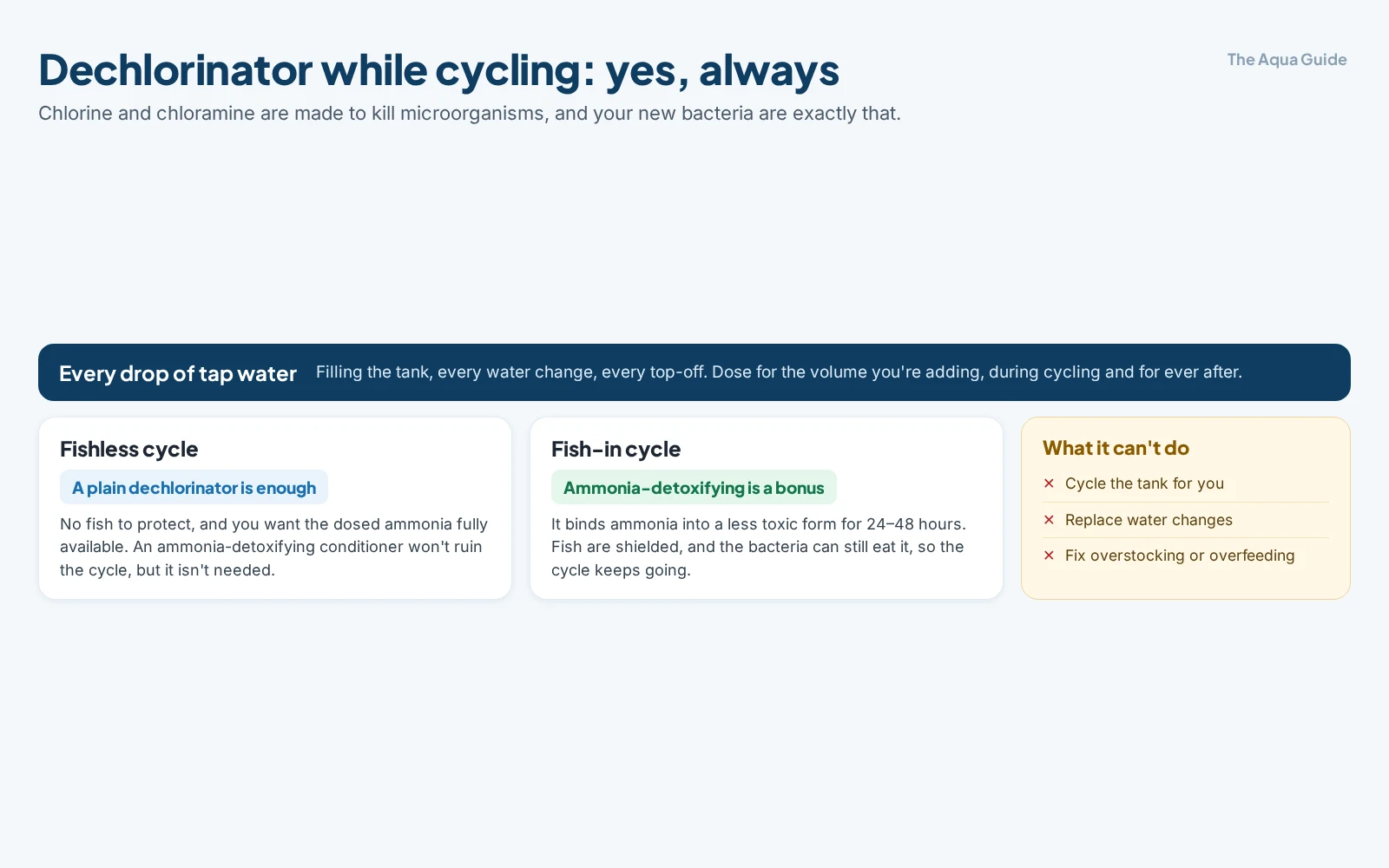
Every time you add untreated tap water to your tank, you're pouring in a bacteria-killing chemical. During cycling, when your colonies are still small and fragile, this can wipe out your progress and reset the cycle. After cycling, it can crash an established tank. So a dechlorinator, which neutralizes chlorine and chloramine on contact, is mandatory any time tap water enters the tank — whether you're filling a new tank, doing a water change, or topping off evaporation.
This is true throughout the cycle and forever after. There's no point at which it becomes safe to skip.
How to Use It During Cycling
Using dechlorinator is simple. When you add tap water to the tank, dose the conditioner according to the bottle's instructions for the volume of water you're adding. Most modern conditioners work almost instantly, neutralizing chlorine within a minute or two. You can either treat the water in a bucket before adding it, or add the conditioner directly to the tank as you fill — both work, though treating beforehand is slightly safer if your tap water is heavily chlorinated.
That's genuinely all there is to the core job: dose for your water volume, every time tap water goes in. Doing this protects your developing bacteria from chlorine throughout the entire cycling period.
At a glance: plain, or ammonia-detoxifying?
| Your situation | Which conditioner | Why |
|---|---|---|
| Fish-in cycle | One that detoxifies ammonia | It converts ammonia to a far less toxic form that your bacteria can still eat — a genuine safety buffer while the colony catches up |
| Fishless cycle | A plain dechlorinator | There are no fish to protect, and you actually want the ammonia fully available and toxic, because that is what drives bacterial growth |
| Established tank, routine water change | Either | Plain is enough; the detoxifying feature simply has nothing to do |
The detoxifying effect is temporary — typically 24–48 hours — after which the ammonia reverts to its toxic form if the bacteria have not processed it. That is why a conditioner is a safety buffer, never a substitute for an actual cycle or for water changes.
The Nuance: Conditioners That "Detoxify Ammonia"
Here's where it gets interesting. Many popular water conditioners advertise that they don't just remove chlorine — they also "detoxify" or "neutralize" ammonia and sometimes nitrite. This is a genuinely useful feature, especially during a fish-in cycle, but it raises a fair question: if my conditioner is neutralizing ammonia, am I starving my bacteria and stalling my cycle?
The reassuring answer is generally no. These conditioners don't destroy the ammonia — they temporarily convert it into a form (often called ammonium or a bound complex) that's far less toxic to fish but still available as food for your beneficial bacteria. The bacteria can still consume it and grow. So your cycle continues, while your fish get protected from the toxic effects in the meantime. It's the best of both worlds during a fish-in cycle: the fish are shielded, but the colony still gets fed.
The temporary nature matters, though. This detoxifying effect typically lasts only 24–48 hours, after which the ammonia reverts to its normal toxic form if the bacteria haven't yet processed it. That's why a conditioner is a safety buffer, not a substitute for an actual cycle or for water changes. It buys time; it doesn't replace the bacteria's work.
During a Fishless Cycle: A Subtle Point
If you're doing a fishless cycle and dosing pure ammonia to feed your bacteria, you don't need the ammonia-detoxifying feature at all — there are no fish to protect, and you actually want the ammonia fully available and toxic so it drives bacterial growth. A plain dechlorinator (one that only removes chlorine/chloramine) is all you need for treating your top-off and water-change water. Using an ammonia-detoxifying conditioner won't ruin a fishless cycle, but it's unnecessary, and in theory could slightly slow your readings by binding some of the ammonia you're deliberately adding. For fishless cycling, simpler is fine.
What Dechlorinator Can't Do
It's worth being clear about the limits, so you don't over-trust the bottle. A dechlorinator does not cycle your tank — it removes chlorine and (in some products) temporarily detoxifies ammonia, but it doesn't grow bacteria or replace the cycling process. It also doesn't let you skip water changes; a fish-in cycle still needs them. And it won't fix an overstocked or overfed tank. Think of it as a protective tool that makes tap water safe and buys you a short grace period on ammonia — valuable, but not magic.
A Quick Note on Dosing
Follow the label, and when in doubt, the standard recommended dose is the right call. A modest overdose of most conditioners is generally harmless (they have a wide safety margin), so if you're slightly heavy-handed when treating a fish-in cycle during an ammonia spike, that's usually fine. But there's no benefit to wildly overdosing, and it wastes product. Dose for your water volume and move on.
The Bottom Line
Yes — use a dechlorinator during cycling, every single time tap water enters the tank. It protects your developing bacteria from chlorine, which would otherwise reset your cycle. If you're doing a fish-in cycle, a conditioner that also detoxifies ammonia is a genuine bonus: it shields your fish while still leaving the ammonia available for your bacteria to consume, so the cycle keeps progressing. If you're cycling fishless with dosed ammonia, a basic dechlorinator is all you need. In every case, conditioner is a protective buffer — essential, but not a replacement for the cycle itself or for regular water changes.
Related guides
- Fish-in vs fishless cycling
- How the nitrogen cycle works
- How to fix a stalled or stuck cycle
- Can I use chemical clarifiers during the cycle?
- Do I need bottled bacteria?
- How often should you do a water change?
Got questions about your specific setup? Drop them in our Community Forum — we love helping new fishkeepers get started right.