Every new aquarium has to be cycled — there's no skipping it. But there are two fundamentally different ways to get there, and which one you choose shapes your first month of fishkeeping. One method is kinder to fish and more controlled; the other is faster to "start" but harder and riskier. Let's break down both honestly, so you can pick the right path for your situation.
At a glance: which one, and when
| Fish-less | Fish-in | |
|---|---|---|
| Who is at risk | Nobody — the tank is empty | Your fish, until the cycle completes |
| Where the ammonia comes from | Dosed bottled ammonia, or ghost feeding | The fish themselves |
| Your workload | Test at your leisure | Daily testing and frequent partial water changes |
| How fast the colony grows | Faster — you can push ammonia to ideal levels | Slower — ammonia must be kept low to protect the fish |
| When it's finished | You can often add a decent group at once | Add the rest slowly |
| Choose it when | You are setting up and haven't bought fish yet | You already have fish and cannot undo that |
Both end in the same place: ammonia and nitrite at zero, nitrate present, and a stable tank.
First, a Reminder of What Cycling Is
Cycling means growing the beneficial bacteria that convert toxic fish waste (ammonia) into nitrite, and then into far less harmful nitrate. Until those bacterial colonies are established, ammonia and nitrite can build up to levels that poison fish. The whole question of "fish-in vs. fish-less" is really just: do you grow those bacteria with fish already in the tank, or with the tank empty?
Fish-less Cycling
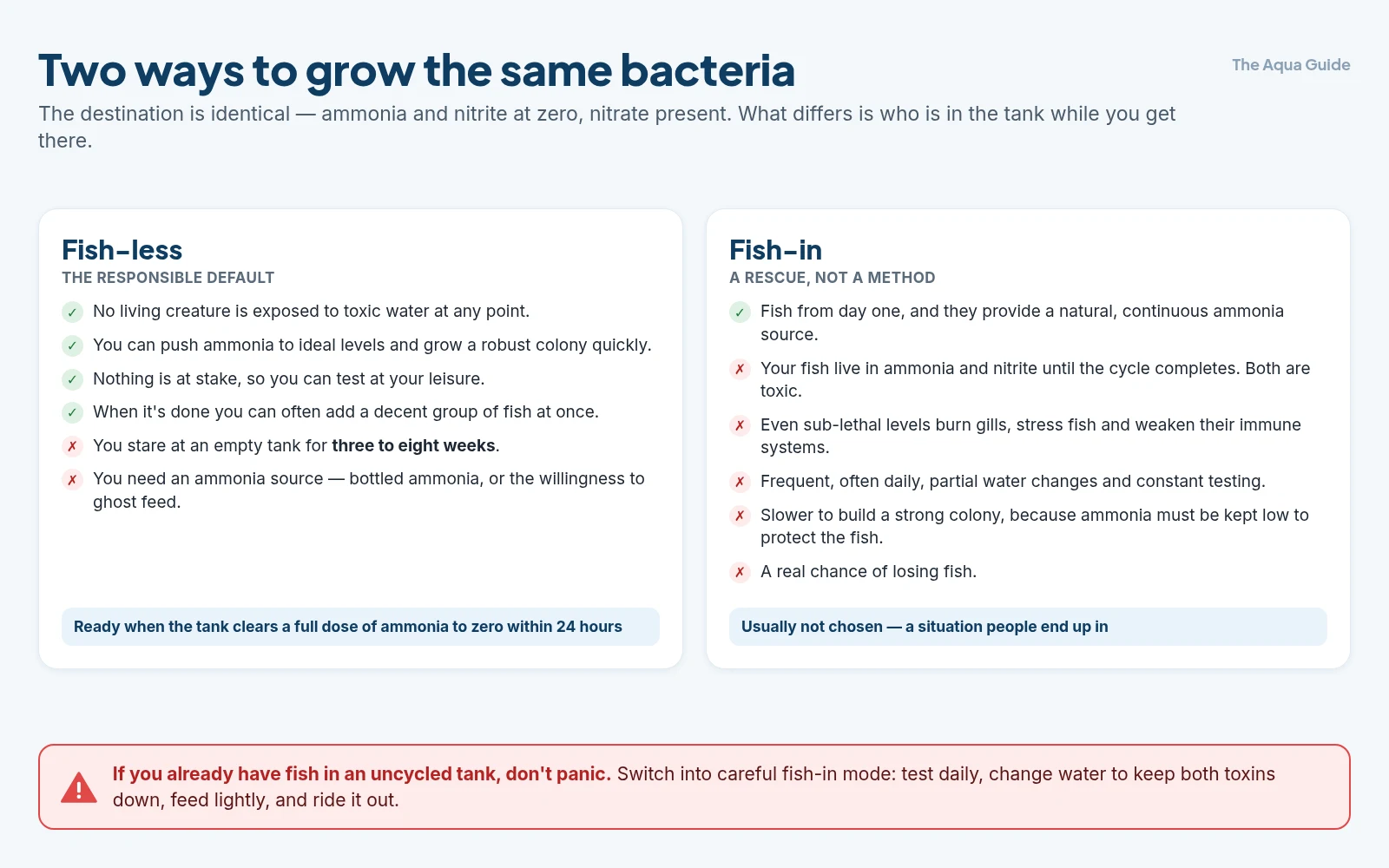
In a fish-less cycle, you establish the bacteria in an empty tank before adding any fish. You supply ammonia artificially — either by dosing pure bottled ammonia or by ghost feeding (letting fish food rot) — and let the bacteria grow until the tank can process a full dose of ammonia to zero within 24 hours. Only then do you add fish.
The advantages are significant. No living creature is exposed to toxic water at any point — this is the humane, no-risk approach. You can push the ammonia to ideal levels to grow a robust colony quickly, without worrying about harming anything. And because nothing's at stake, you can be relaxed and patient, testing at your leisure. When you finally add fish, you can often add a decent group at once, because the bacteria are already strong enough to handle the bioload.
The drawbacks are minor by comparison. It requires patience — you're staring at an empty tank for three to eight weeks, which tests the enthusiasm of an excited beginner. And you need an ammonia source (a bottle of pure ammonia, or the willingness to ghost feed). That's really the whole downside: waiting, and a small bit of setup.
For almost everyone starting fresh, fish-less cycling is the recommended method. It's the responsible default.
Fish-In Cycling
In a fish-in cycle, fish are already living in the tank while the bacteria establish. The fish themselves produce the ammonia that feeds the growing colonies. This is often not a method people choose so much as a situation they end up in — a beginner buys a tank and fish the same day, not knowing cycling exists, and now has to cycle a tank that's already stocked.
The one advantage is that you've got fish in your tank from day one, which is emotionally satisfying, and the fish provide a natural, continuous ammonia source.
The drawbacks are serious, and you should not gloss over them. Your fish are living in water that contains ammonia and nitrite until the cycle completes — both of which are toxic. Even at sub-lethal levels, these chemicals burn gills, stress the fish, weaken their immune systems, and can cause lasting damage or death. To keep the fish alive, you're committed to frequent, often daily, partial water changes and constant testing to keep the toxins as low as possible. It's labor-intensive, stressful, and there's a real chance of losing fish. It's also slower to build a strong colony, because you must keep ammonia low (to protect the fish), which means the bacteria have less to eat and grow more slowly.
If You Must Do a Fish-In Cycle
Sometimes it's unavoidable — you already have the fish. If so, here's how to give them the best chance:
Choose hardy fish if you have any say in it; delicate species rarely survive a fish-in cycle. Test ammonia and nitrite daily with a liquid kit. Do a partial water change whenever either climbs toward harmful levels — keeping both as close to zero as you can manage is the entire game. Feed very sparingly, since every bit of food becomes more ammonia. Add only a tiny number of fish to start, never a full stocking. And consider using a quality water conditioner that detoxifies ammonia temporarily, plus seeding the tank with mature filter media from an established aquarium to speed things along and reduce the danger window.
Done carefully, a fish-in cycle can succeed without losses — but it demands far more work and attention than fish-less, and the margin for error is thin.
Side by Side
To make the choice plain:
Fish-less cycling is safer (no fish at risk), more controlled, lets you stock more fish at once when done, and asks only for patience and an ammonia source. It's the right choice if you're setting up a new tank and haven't bought fish yet.
Fish-in cycling puts fish at risk, demands daily maintenance and testing, builds the colony more slowly, and carries a real chance of fish loss. It's only the right choice when you already have fish and can't undo that — at which point it becomes a careful rescue operation rather than a preferred method.
The Honest Recommendation
If you have the choice, cycle fish-less. Set the tank up, grow your bacteria with dosed ammonia or ghost feeding, confirm with the 24-hour test, and add fish to a tank that's genuinely ready. The wait is the only cost, and it's a small price for not subjecting living animals to toxic water.
If you've already got fish in an uncycled tank, don't panic — switch into careful fish-in mode: test daily, change water to keep toxins down, feed lightly, and ride it out. Either way, the destination is identical: ammonia and nitrite at zero, nitrate present, and a stable tank that's safe for the long haul.
Related guides
- What is ghost feeding, and how does it help cycling?
- Do I need bottled bacteria, and which kinds work?
- How to speed up the nitrogen cycle
- How do I know if my tank is fully cycled?
- What are safe ammonia, nitrite and nitrate levels?
- How does the aquarium nitrogen cycle work?
- Can I use chemical clarifiers during the cycle?
- The nitrogen cycle, explained