When your new tank turns cloudy during cycling, the temptation to reach for a bottle of "water clarifier" is strong — it promises to clear the haze in hours. But should you use one while your tank is still cycling? The honest answer is: usually you shouldn't, and more importantly, you usually don't need to. Let's unpack what clarifiers do, why cloudiness during cycling is normal, and when (if ever) a clarifier makes sense.
At a glance: what to do instead
| Do | Why |
|---|---|
| Nothing dramatic — let it run its course | A bacterial bloom clears on its own as the cycle establishes, usually within days to a couple of weeks |
| Dechlorinate any water you add | Chlorine kills the bacteria you are trying to grow |
| Avoid overfeeding — if ghost feeding, keep it light | Excess food fuels blooms |
| Let the filter run | Developing bacteria need good water movement and oxygen |
| Track the cycle by testing, not by clarity | Clear water and a finished cycle are two different things |
The bloom will fade as the bacteria find their balance, and you will have a clear, properly cycled tank without having added anything.
What Chemical Clarifiers Actually Do
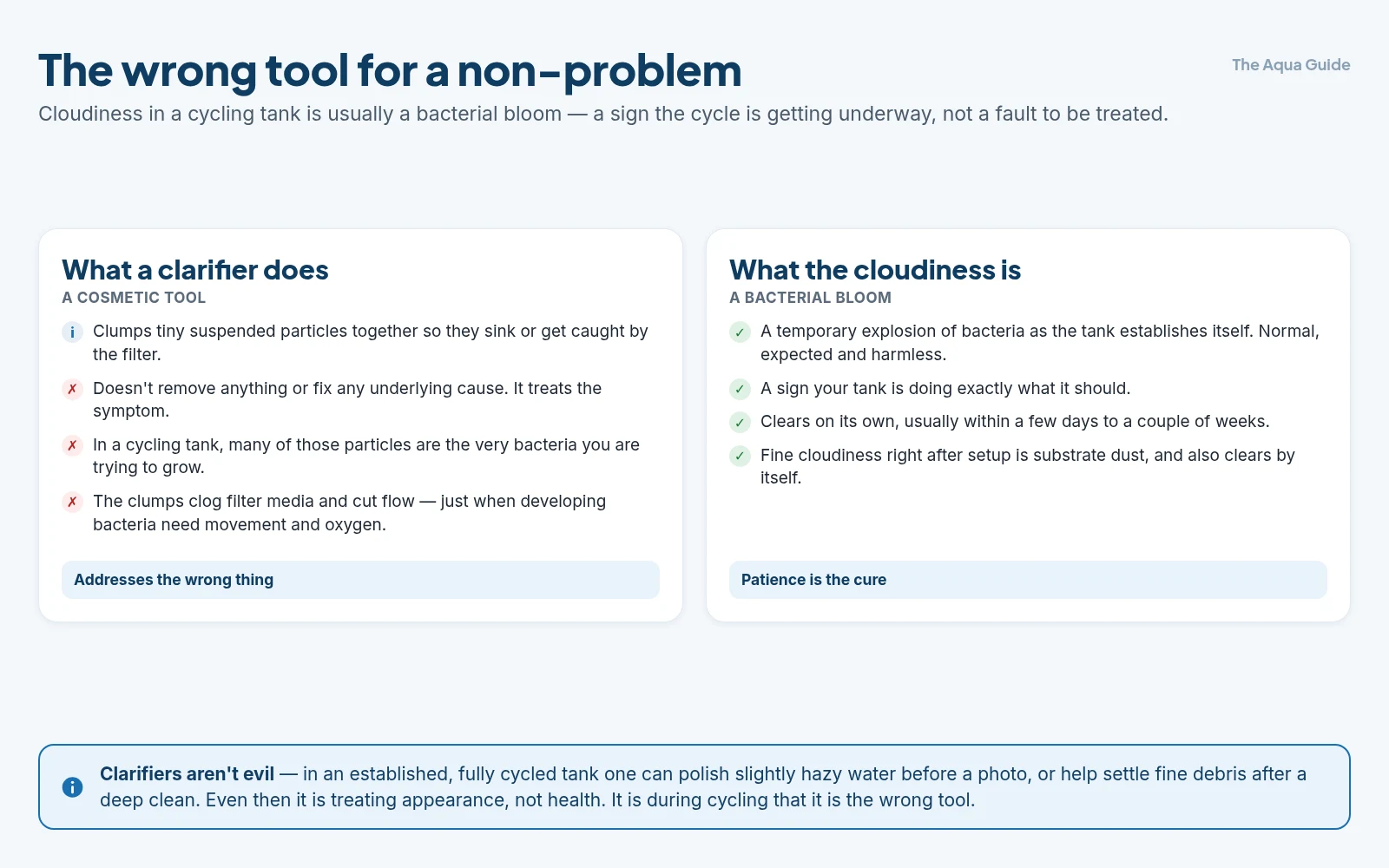
Water clarifiers (also called flocculants) work by clumping together the tiny suspended particles that make water look cloudy. Individually, those particles are too small to settle or get caught by your filter, so they stay suspended and haze the water. The clarifier makes them bind into larger clumps that either sink or get trapped in your filter media, clearing the water.
Notice what that means: a clarifier doesn't remove anything or fix any underlying cause. It just makes existing particles bigger so they can be filtered out. It's a cosmetic tool that treats the symptom (visible cloudiness), not the cause.
Why Tanks Go Cloudy During Cycling — and Why It's Normal
Here's the crucial context. A new tank very commonly goes cloudy during cycling, and this cloudiness is usually a bacterial bloom — a temporary explosion of beneficial and other bacteria as the tank establishes itself. The water looks milky or hazy.
This is normal, expected, and harmless. It's actually a sign that your tank is doing exactly what it should: bacteria are multiplying as the nitrogen cycle gets underway. A bacterial bloom clears on its own, usually within a few days to a couple of weeks, as the bacterial population balances out and settles onto surfaces. You don't need to do anything — patience is the cure.
This is the heart of why clarifiers during cycling are usually a mistake: you'd be using a chemical to treat something that isn't a problem and would resolve itself anyway.
Why Clarifiers During Cycling Are Usually a Bad Idea
A few reasons to keep the clarifier on the shelf while your tank is cycling.
First, as above, the cloudiness is typically a harmless bacterial bloom that clears by itself — so the clarifier is unnecessary. Second, clarifiers work by clumping suspended particles, and in a cycling tank a lot of those "particles" are the very bacteria you're trying to grow. Clumping them out can interfere with the bloom settling naturally and may not actually help your cycle. Third, those clumps get trapped in your filter, which can clog filter media and reduce flow right when your developing bacteria need good water movement and oxygen. And fourth, reaching for a chemical fix trains you to treat symptoms rather than understand your tank — during cycling especially, the goal is to let the biological process complete, not to keep intervening.
In short: the cloudiness during cycling is a feature, not a bug, and a clarifier addresses the wrong thing.
What to Do Instead
When your cycling tank goes cloudy, the right response is almost always to do nothing dramatic and let it run its course. Be patient — a bacterial bloom clears on its own as the cycle establishes. Keep up your normal routine: dechlorinate any water you add, avoid overfeeding (if you're ghost feeding, keep it light, since excess food fuels blooms), and let your filter run. Test your water to track your cycle's progress rather than judging by clarity, since clear water and a finished cycle are two different things. The bloom will fade as the bacteria find their balance, and you'll have a clear, properly cycled tank without having added anything.
If the cloudiness is the other common type — a fine cloudiness right after setup from dust in the substrate — that also clears on its own as it settles and your filter catches it, again without need for a clarifier.
When Might a Clarifier Be Justified?
To be fair, clarifiers aren't evil — they have legitimate uses, just not really during cycling. In an established, fully-cycled tank, a clarifier can occasionally be useful as a quick cosmetic fix — say, to polish up slightly hazy water before a photo or event, or to help settle fine debris stirred up after a deep clean. Even then, it's treating appearance, not health, and the better long-term answer is good filtration and maintenance. But the key point stands: during cycling, when cloudiness is a normal bacterial bloom that resolves itself, a clarifier is the wrong tool for a non-problem.
The Bottom Line
You can use a chemical clarifier during cycling, but you generally shouldn't — and you almost never need to. Cloudiness in a cycling tank is usually a harmless bacterial bloom that's a normal sign of the cycle establishing, and it clears on its own within days to a couple of weeks. A clarifier only clumps particles for filtering; it doesn't fix any cause, it can interfere with the bloom settling naturally, and it can clog your filter when your bacteria need good flow. The right move is patience: keep up normal care, don't overfeed, track your cycle by testing rather than by clarity, and let the bloom resolve itself. Save clarifiers for the rare cosmetic touch-up in an established tank — not as a crutch during cycling.
Related guides
- What is ghost feeding, and how does it help cycling?
- Can I use chemical dechlorinators during cycling?
- Why is my water still cloudy after a water change?
- The best live plants for clearing cloudy water
- How does the aquarium nitrogen cycle work?
- How do I know if my tank is fully cycled?
- The beginner's guide to aquarium algae
- The nitrogen cycle, explained
Got questions about your specific setup? Drop them in our Community Forum — we love helping new fishkeepers get started right.