You've done everything right — the water is clear, not cloudy — and yet it's taken on a yellow or brownish-orange tint, like weak tea. Before you panic, here's the reassuring news: in the vast majority of cases, this is completely harmless, and many experienced aquarists actually create this look on purpose. Let's go through what causes the tint, whether it's a problem, and how to clear it if you'd rather have crystal-clear water.
At a glance
| What the water looks like | Most likely cause | What to do |
|---|---|---|
| Clear, yellow to brown tint | Tannins from driftwood, leaves or peat | Nothing needed. Activated carbon clears it in a few days if you prefer clear water |
| Tinted and cloudy or hazy | A bacterial bloom or dissolved waste | Treat it as a water-quality issue: feeding, waste and maintenance |
| Rusty orange, with particles | Iron in source water, or rust from metal (uncommon) | Check your source water and anything metal touching the tank |
| Tinted after dosing something | Some medications and additives | Usually temporary |
The Usual Culprit: Tannins
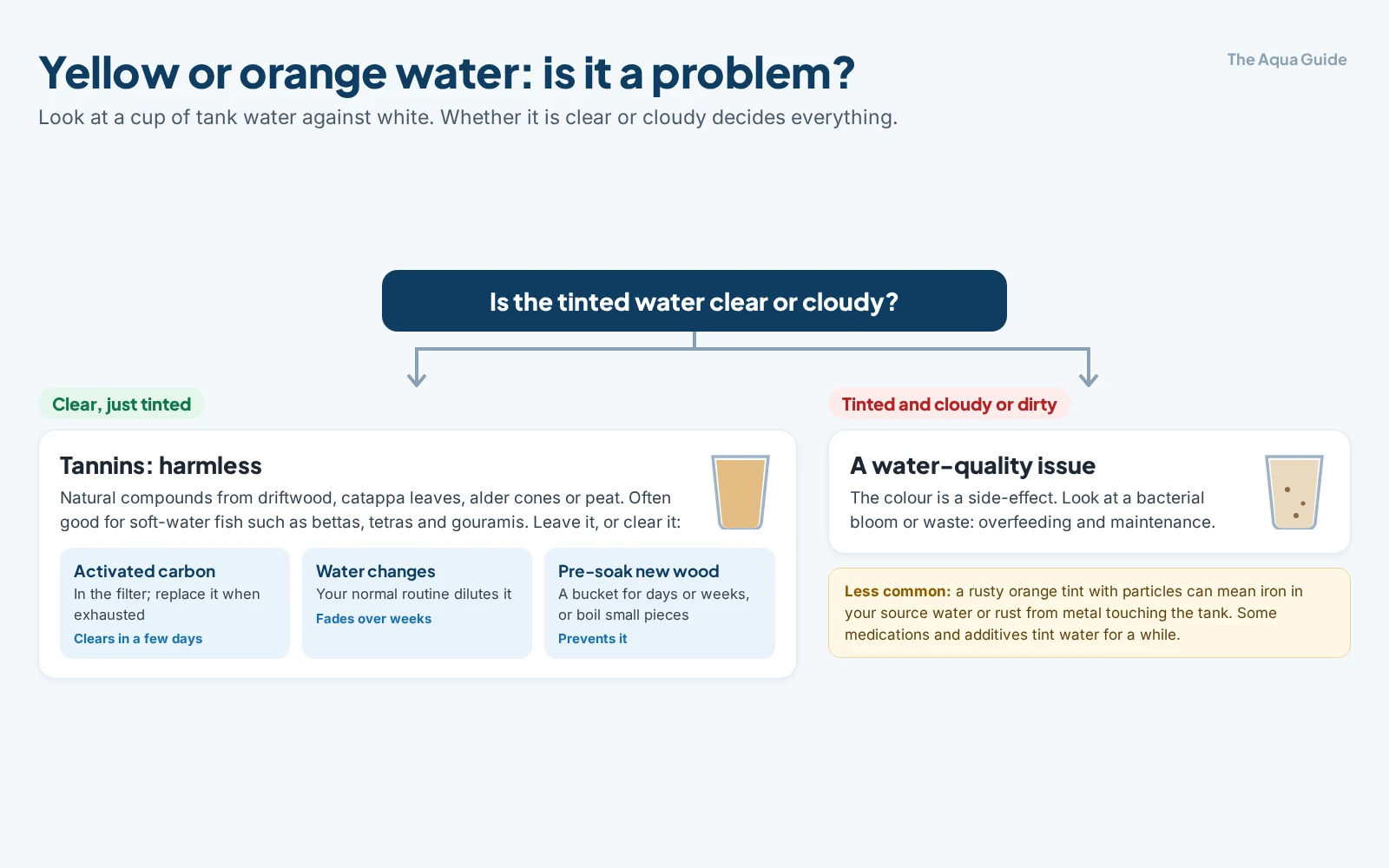
If your water is yellow to brown but still clear (you can see straight through it, it's just tinted), the cause is almost always tannins. Tannins are natural compounds that leach out of wood and certain plant materials, staining the water the same way a tea bag colors hot water. The effect even has a name in the hobby: "blackwater," after the tea-colored rivers of places like the Amazon.
The most common sources are driftwood (freshly added wood releases a lot of tannins as it soaks), botanicals like catappa (Indian almond) leaves, alder cones, and other dried leaves, and peat-based substrates or filtration. If you recently added a piece of driftwood and the water started yellowing a few days later, you've found your answer.
Is It Harmful? Almost Always No
Here's the key point: tannin-stained water is not harmful to fish. In fact, it's beneficial for many species. Tannins gently lower pH and have mild antibacterial and antifungal properties, and they recreate the natural conditions that many popular fish — bettas, many tetras, gouramis, and lots of soft-water species — actually evolved in. Far from being a problem, a tannin tint is something blackwater enthusiasts deliberately cultivate to keep their fish healthier and more comfortable, and to bring out richer colors.
So if your water is tinted but otherwise clear and your test readings are normal, you can simply leave it alone with a clear conscience. The color is cosmetic, and many would consider it an upgrade.
When Yellow or Orange Water Might Signal Something Else
Tannins explain the overwhelming majority of cases, but a couple of other possibilities are worth ruling out.
If the water is yellow and cloudy or hazy (not clear), the tint might be accompanied by a separate issue like a bacterial bloom or dissolved organic waste from overfeeding or poor maintenance. In that case the color is a secondary symptom and the real fix is addressing the cloudiness and the waste behind it. A genuinely orange or rusty tint, especially with particles, can occasionally point to high iron in source water or rust from metal in contact with the tank, though this is uncommon. And if you recently dosed a medication or additive, some of those can temporarily color the water.
The simple test: if the water is clear but tinted, it's tannins and it's fine. If it's tinted and cloudy or dirty, treat it as a water-quality issue and look at feeding, waste, and maintenance.
How to Clear It (If You Want To)
If you'd prefer crystal-clear water for the look, removing tannins is straightforward — it just takes a little patience.
Activated carbon is the classic fix. Placing fresh activated carbon in your filter adsorbs tannins and clears the tint over a few days. It's the fastest and easiest method; just replace it periodically since it becomes exhausted.
Regular water changes gradually dilute and remove tannins. If you keep up with your normal routine, the tint will fade over weeks as the wood's tannin output naturally declines.
Pre-soaking new driftwood prevents the problem in the first place. Soaking a new piece of wood in a bucket for days or weeks (changing the water periodically), or boiling smaller pieces, leaches out most of the tannins before the wood goes in the tank. This is the best approach if you know you don't want any tint.
Over time, driftwood releases fewer and fewer tannins on its own, so even untreated wood will stop staining the water eventually — the effect is strongest when the wood is new and fades as it ages in the tank.
A Quick Note on Purpose vs. Problem
The mindset shift worth making is this: yellow or orange water from tannins isn't a malfunction to be fixed — it's an aesthetic choice. Some keepers love the natural, golden blackwater look and the benefits it brings their fish; others prefer the sparkle of clear water. Neither is wrong. So the real question isn't "how do I fix this," it's "do I actually want to?" If your fish are healthy and your parameters are good, the color is entirely up to your taste.
The Bottom Line
Yellow or orange water that's still clear is almost always caused by tannins leaching from driftwood, leaves, or peat — and it's harmless, often even beneficial, recreating the natural blackwater conditions many fish prefer. If you like the look, leave it. If you want it clear, use activated carbon for a quick fix, keep up with water changes for a gradual one, or pre-soak driftwood to prevent it. The only time to treat yellow water as a real problem is when it's also cloudy or dirty, which points to a waste or maintenance issue rather than harmless tannins. Check whether your water is clear-but-tinted or cloudy-and-dirty, and you'll know exactly which situation you're in.
Related guides
- Fish tank water cloudy? What's wrong and how to fix it
- Why is my water still cloudy after a water change?
- Filter media explained: mechanical, biological, chemical
- Understanding pH, KH and GH
- Smelly aquarium water: causes and fixes
- How often should you do a water change, and how much?
Got questions about your specific setup? Drop them in our Community Forum — we love helping new fishkeepers get started right.