A blackout — covering your tank in total darkness for several days — is one of the most effective free tools for beating an algae bloom, especially green water. But it raises an obvious anxiety: how long is long enough to kill the algae, and how long is too long before you start harming your fish and plants? Let's get the timing exactly right, and cover how to do a blackout safely from start to finish.
The Short Answer
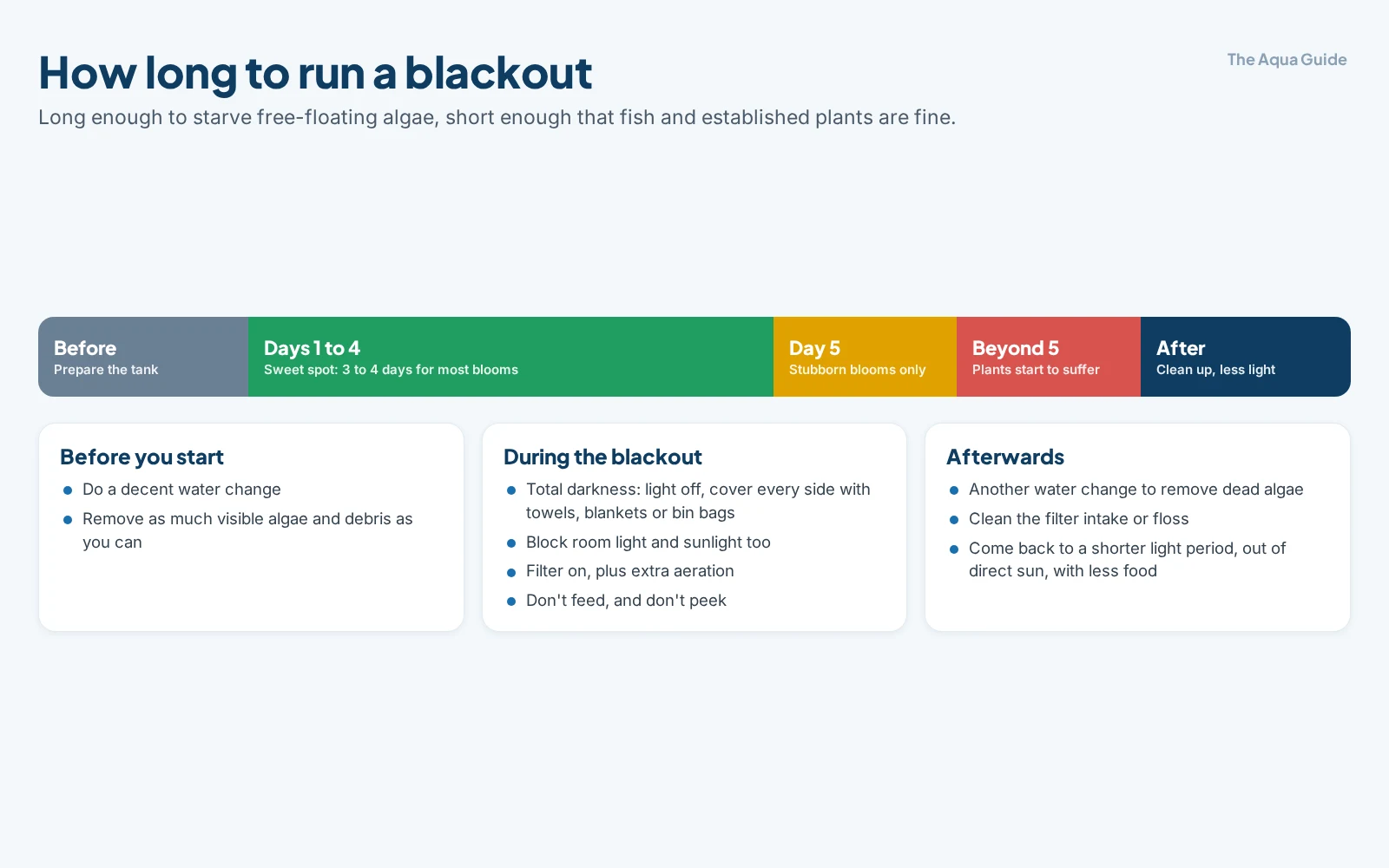
For a typical green-water bloom, a blackout of three to four days is the sweet spot. That's long enough to starve and collapse the floating algae, but short enough that your fish and established plants come through unharmed. Some stubborn blooms warrant stretching to five days, but you rarely need longer, and going much beyond that starts to risk your plants.
So the working range is three to five days, with three to four being right for most situations.
At a glance
| Your situation | Blackout length |
|---|---|
| Typical green-water bloom | 3 to 4 days |
| Stubborn bloom | Up to 5 days |
| Thinking of going longer | Don't: much beyond 5 days starts to stress plants |
| Algae on glass, décor or leaves | A blackout isn't the right tool. Reduce light and nutrients, remove it by hand, add a cleanup crew |
Why a Blackout Works
A quick reminder of the mechanism, because it explains the timing. Green water is a bloom of free-floating algae that needs light to photosynthesize and survive. When you put the tank in complete darkness, the algae can't produce energy and rapidly dies off. The reason a few days does the job is that this microscopic algae has a short life cycle and no light reserves — cut its light and it collapses quickly. Your fish, by contrast, don't need light to survive a few days, and established plants can draw on stored energy to coast through a short dark period. That difference in tolerance is exactly what makes the blackout work: it kills the algae well before it troubles the tank's other inhabitants.
How to Do a Blackout Properly
Getting the technique right matters as much as the timing. Here's the full method.
First, do a water change and clean up. Before you start, do a decent water change and remove as much visible algae and debris as you can. This reduces the algae load going in and removes excess nutrients, so the blackout has less to overcome.
Make it truly total. A blackout only works if it's genuinely complete — even a little light lets the algae limp along. Turn off the aquarium light, then cover the entire tank with thick towels, blankets, or black bin bags so no light enters from any side. Don't forget ambient room light and especially any sunlight, which is often what caused the bloom in the first place. The tank should be in full, uninterrupted darkness.
Keep the filter running and aeration up. Leave your filter on throughout — the biological filtration must keep working. It's also wise to add extra surface agitation or an airstone, because as the algae dies it can reduce oxygen levels, and you want to keep the water well-oxygenated for your fish.
Don't feed (or feed minimally). Going a few days without food is completely fine for fish and means less waste and fewer nutrients during the blackout. Lightly feeding once is acceptable for a longer blackout, but keep it minimal.
Resist peeking. It's tempting to lift the cover to check progress, but every peek lets in light and sets the algae back on track. Leave it sealed for the full duration.
After the Blackout
When your time is up, uncover the tank. The water should be noticeably clearer — sometimes dramatically so. Do another water change to remove the dead algae and any released nutrients, and clean your filter intake or floss if it's caught a lot of debris. Then ease back into your normal lighting, but reduced — because if you go straight back to the same long light period that caused the bloom, it'll return.
This is the crucial follow-through: a blackout clears the current bloom, but it doesn't fix what caused it. To prevent a repeat, cut your daily light period, move the tank out of any direct sunlight, reduce feeding, and consider adding fast-growing plants to out-compete the algae. The blackout buys you a clean slate; the changes afterward keep it clean.
Safety: Will It Hurt My Fish or Plants?
This is the most common worry, and the answer is reassuring. A three-to-five-day blackout is safe for fish — they're unbothered by darkness for that length of time, as long as the water stays oxygenated (hence keeping the filter running and adding aeration). Established plants tolerate a short blackout too, drawing on stored energy; you may see a little wilting, but they bounce back once light returns. The main caution is simply not to overextend — blackouts much longer than five days start to genuinely stress plants, and that's when the cost begins to outweigh the benefit. Stay in the three-to-five-day window and both fish and plants come through fine.
When a Blackout Isn't the Right Tool
Worth noting: a blackout is specifically effective against light-dependent blooms like green water. It's less useful against algae growing on surfaces (glass, décor, plant leaves), which is better tackled by reducing light and nutrients over the longer term, manual removal, and algae-eating cleanup crews. If your problem is film or spot algae on surfaces rather than a free-floating green-water bloom, a blackout isn't the targeted fix — adjust your expectations accordingly.
The Bottom Line
Run a blackout for three to four days for most algae blooms, stretching to five for stubborn cases, but no longer — that window kills light-dependent green-water algae while keeping fish and established plants safe. Do it properly: water-change first, cover the tank completely (no light at all), keep the filter and aeration running, don't feed, and don't peek. Afterward, water-change again and reduce your lighting so the bloom doesn't return. Done right, a blackout is a free, reliable reset for green water — just keep it within the safe few-day window and follow up by fixing the light and nutrient levels that caused it.
Related guides
- Green water and free-floating algae blooms
- How to clear green water without a UV sterilizer
- Do I need a UV sterilizer, and what wattage?
- Aquarium lighting basics: brightness and photoperiod
- Why algae keeps coming back
- Algae eaters: which actually work
Got questions about your specific setup? Drop them in our Community Forum — we love helping new fishkeepers get started right.