Green water is one of the most frustrating things a fishkeeper can face. Overnight, your tank turns into pea soup — a cloudy green that you can barely see through. A UV sterilizer will clear it fast, but they cost money and not everyone has one. The good news is that you can absolutely beat green water without one, using methods that are cheaper and address the root cause. Here's how.
At a glance: why it happened
| Trigger | Where it comes from |
|---|---|
| Too much light | A tank in direct sunlight, or lights running too many hours a day |
| Excess nutrients | Usually nitrate and phosphate, from overfeeding, overstocking, or infrequent water changes |
| A new tank | Especially prone, because the system isn't balanced yet |
Fix the bloom without addressing these and it simply comes back. Every effective treatment works by removing one of the two things the algae needs — light, or nutrients. Starve it of either and the bloom collapses.
What Green Water Actually Is
Green water is a bloom of free-floating microscopic algae (single-celled phytoplankton) suspended throughout the water column. It's different from the algae that grows on glass and decorations — this algae floats, multiplies explosively when conditions favor it, and tints the entire body of water green.
Understanding what fuels it is the key to beating it, because every effective treatment works by removing one of the two things the algae needs: light and nutrients. Starve it of either, and the bloom collapses. A UV sterilizer simply kills the floating algae as water passes through it — but you can deny the algae what it needs instead, which fixes the underlying cause rather than just zapping the symptom.
Why It Happened (So You Can Prevent a Repeat)
Green water blooms when there's an excess of light and nutrients at the same time. The common triggers are too much light — a tank in direct sunlight, or lights running too many hours a day — combined with excess nutrients, usually nitrate and phosphate from overfeeding, overstocking, or infrequent water changes. New tanks are especially prone because the system isn't balanced yet. If you fix the bloom but don't address these triggers, it'll just come back, so keep them in mind as you treat it.
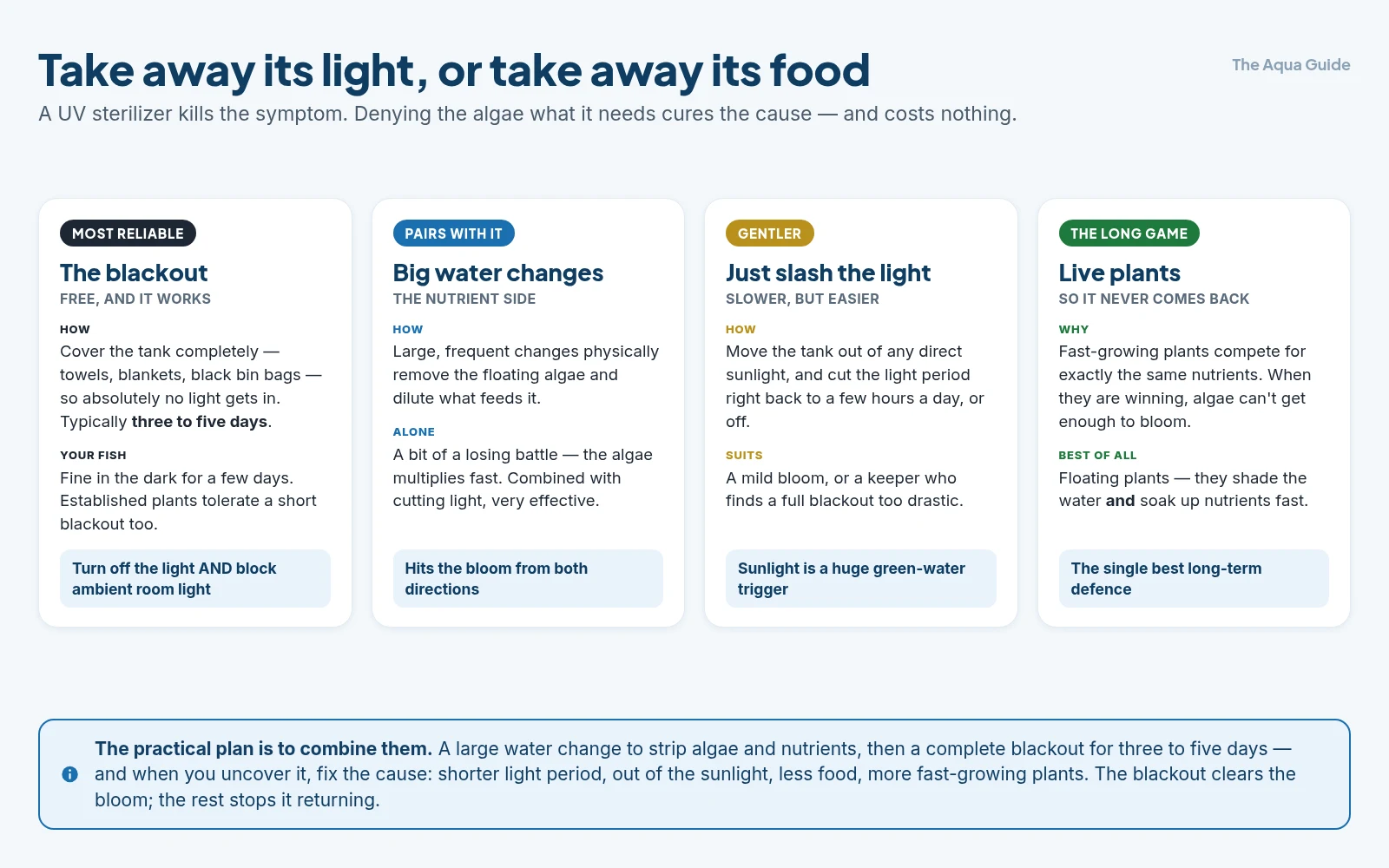
Method 1: The Blackout
This is the most reliable no-equipment fix, and it's free. Since the floating algae needs light to survive, you simply take all of it away.
Cover the tank completely — wrap it in towels, blankets, or black bin bags so that absolutely no light gets in — and leave it in total darkness for several days (typically three to five). Turn off the aquarium light and block any ambient room light or sunlight. The algae, starved of light, dies off and the water clears. Your fish will be fine in the dark for a few days (they don't need light the way the algae does), and established plants will tolerate a short blackout too.
A blackout is remarkably effective and costs nothing. (Because timing and fish safety matter, the full details of how long to black out and how to do it safely are worth covering on their own — but a few days of total darkness is the core of it.)
Method 2: Big Water Changes
Large, frequent water changes physically remove the floating algae and dilute the nutrients feeding it. On their own, water changes can be a bit of a losing battle (the algae multiplies fast), but combined with reducing light they're very effective — and they directly tackle the nutrient side of the equation. Doing sizable water changes over several days, paired with cutting back light, hits the bloom from both directions.
Method 3: Reduce Light Dramatically
If a full blackout feels too drastic, simply slashing the light works more gradually. Move the tank out of any direct sunlight (sunlight is a huge green-water trigger), cut your light period right back to a few hours a day or off entirely for a while, and the algae loses its energy source. This is slower than a blackout but gentler and often enough for a mild bloom.
Method 4: Live Plants (The Long-Term Fix)
This is the method that prevents green water from ever coming back. Fast-growing live plants compete directly with the floating algae for the same nutrients — and when healthy plants are winning that competition, algae simply can't get the nutrients to bloom. Floating plants in particular are excellent, because they also shade the water, cutting the light the algae needs while soaking up nutrients fast.
A well-planted tank is the single best long-term defense against green water. If you keep getting blooms, adding more fast-growing plants addresses the root cause permanently in a way no gadget does.
Method 5: A Daphnia "Cleanup Crew" (Optional)
A more niche but genuinely effective trick: daphnia (tiny water fleas) eat free-floating algae. Adding a culture of daphnia to green water lets them feast on the bloom and clear it — and as a bonus, they become live food for your fish. It's a natural, biological solution, though it requires getting hold of daphnia and works best in a tank where fish won't immediately eat them all first.
Putting It Together: The Practical Plan
For the fastest no-UV result, combine methods. The proven approach is: do a large water change to remove algae and nutrients, then black out the tank completely for three to five days, and when you uncover it, address the root cause — reduce your light period, move the tank out of sunlight, cut back feeding, and add fast-growing plants. The blackout clears the current bloom; the rest stops it returning.
The Bottom Line
You don't need a UV sterilizer to beat green water — you just need to deny the floating algae its light and nutrients. A complete blackout for three to five days is the most reliable free fix, especially paired with large water changes. For the long term, reduce your lighting, keep the tank out of direct sunlight, don't overfeed, and add fast-growing live plants to out-compete the algae for good. A UV sterilizer kills the symptom; removing light and nutrients cures the cause — and costs nothing.
Related guides
- Green water and free-floating algae blooms
- How long should you run a blackout for algae?
- Do I need a UV sterilizer, and what wattage?
- The best live plants for clearing cloudy water
- Floating and carpeting plants for beginners
- Where to place your aquarium at home
- The beginner's guide to aquarium algae
- Live and cultured foods for fry
Got questions about your specific setup? Drop them in our Community Forum — we love helping new fishkeepers get started right.