Every aquarium gets algae. Not some aquariums — every single one, sooner or later, in some form. The keepers whose tanks always look algae-free aren't lucky; they understand what algae is, why it appears, and how to manage it before it takes over. This is the hub for everything algae-related. Each topic below opens into a more detailed guide, but by the end of this page you'll have the whole framework for managing algae in any tank.
How do I get rid of algae in a fish tank?
Cut the photoperiod to 6–7 hours a day, block any direct sunlight, increase water changes, feed less, scrub off what you can and add healthy fast-growing plants. The goal is algae in balance rather than zero algae — every aquarium grows some, and a faint film between cleanings is normal.
At a glance: the universal first response
| Do | Why |
|---|---|
| Cut the photoperiod to 6–7 hours | Many algae problems resolve once the lighting schedule alone is fixed |
| Increase water changes temporarily | 30–40% twice a week for a few weeks reduces the dissolved nutrients algae feeds on |
| Reduce feeding | Cut portions by 25–50% for a few weeks. Less waste means less nutrient excess |
| Check for direct sunlight, and block it | The single biggest uncontrolled algae driver |
| Remove what you can by hand | Algae you scrub off physically doesn't come back as fast |
| Audit your plants | Few plants? Add more. Struggling plants? Fix that — healthy plants outcompete algae |
This usually moves a tank in the right direction within 2–4 weeks, even before you have identified which algae you actually have.
Algae Is Normal — and That's the First Mental Shift
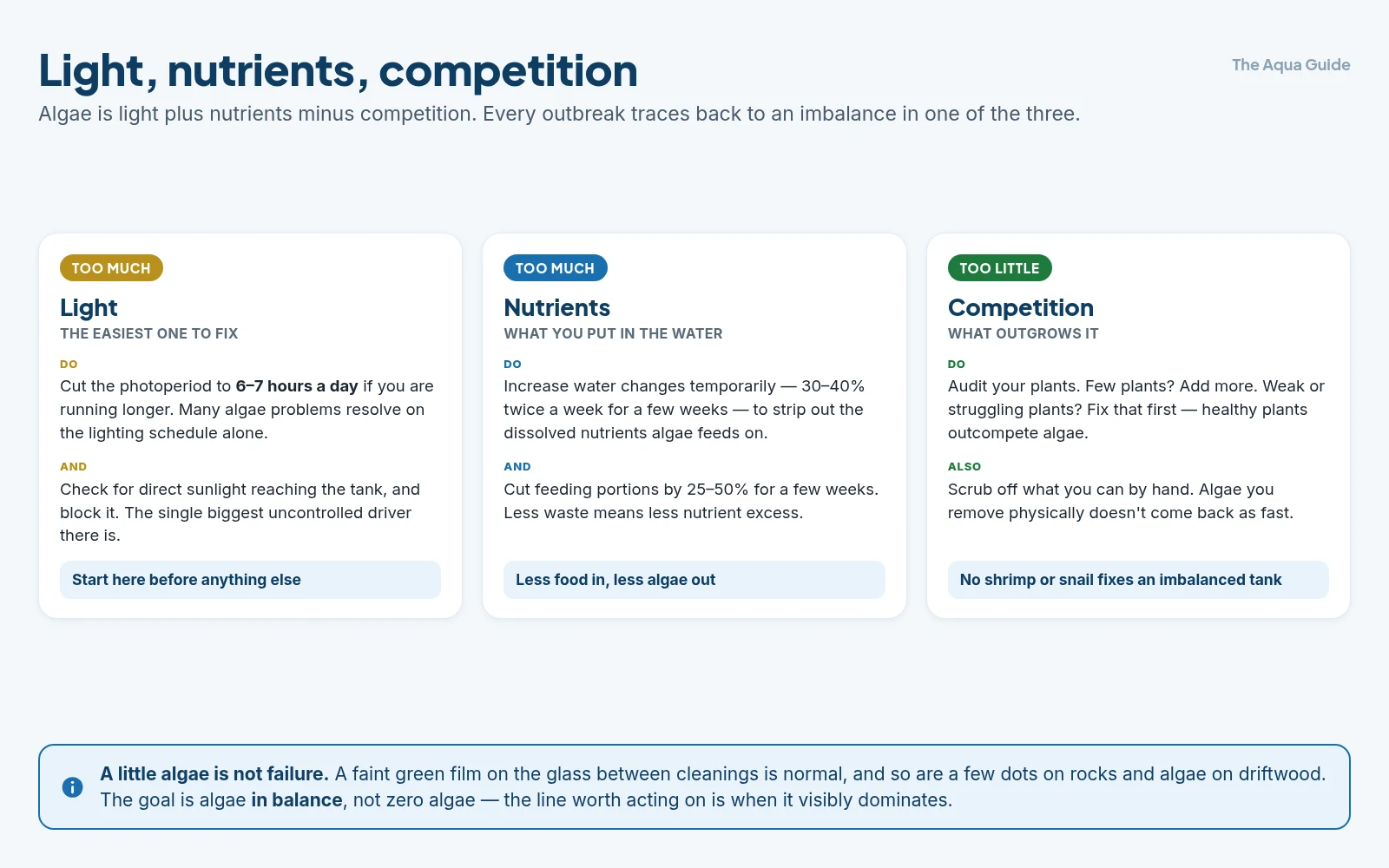
The single most useful mindset change for new keepers is this: a little algae is not failure. Algae is a natural part of any healthy tank. A glass that develops a faint green film between cleanings is normal. A few dots on rocks is normal. Algae on driftwood is normal. The goal isn't zero algae — it's algae in balance, where it never takes over.
What actually counts as a problem is when algae visibly dominates the tank: glass you can barely see through, plants smothered, surfaces taken over, water tinted green or brown. That's the line where action is needed. Below that line, occasional cleaning during your weekly maintenance handles it.
This shift matters because beginners who panic at the first speck of algae often over-react — dosing chemicals, scrubbing everything constantly, adding algae eaters before they've identified the actual cause. Calm management beats panic.
The Root Cause Framework
Algae is light plus nutrients minus competition, and every outbreak traces back to an imbalance in one of the three. Why algae keeps coming back sets out the framework properly, and the balanced tank approach covers holding the balance once you have it.
The Common Algae Types You'll Meet
Each type points at a different imbalance, which is why identifying it matters more than scrubbing it: black beard algae, green water, hair and thread algae, brown diatoms.
The Universal First Response
Whatever algae type you have, several actions help in nearly every case:
Cut the photoperiod. Reduce light duration to 6–7 hours per day if you're currently running longer. Many algae problems resolve once you fix the lighting schedule alone.
Increase water changes temporarily. 30–40% twice a week for a few weeks reduces dissolved nutrients algae feeds on.
Reduce feeding. Cut portions by 25–50% for a few weeks. Less waste = less nutrient excess.
Check for direct sunlight. Block it if any reaches the tank. The single biggest uncontrolled algae driver.
Manual removal. Scrub off what you can — algae you remove physically doesn't come back as fast.
Audit your plants. If you have few plants, consider adding more. If you have weak/struggling plants, fix that — healthy plants outcompete algae.
This universal first-response usually moves a tank in the right direction within 2–4 weeks, even before identifying the specific algae type.
When Algae Eaters Help (and When They Don't)
They graze what is already there; they do not fix the cause, and the wrong species eats nothing you wanted removed. Algae eaters: which actually work covers which species eat which algae, and helpful vs pest snails the ones that arrive uninvited.
Prevention vs. Cure
Prevention is a balanced tank; cure is a blackout, a manual removal or a treatment aimed at the specific type. Preventing algae long term covers the first, and how long to run a blackout the most misapplied of the second.
The Bottom Line
Algae is a normal part of any aquarium, not a sign of failure — the goal is to keep it in balance, not eliminate it entirely. Every algae problem reduces to the same root causes: excess light, excess nutrients, and insufficient plant competition. The universal first response (cut photoperiod, increase water changes, reduce feeding, block sunlight, scrub physically, add healthy plants) helps almost any algae situation. Identifying the type of algae you have (diatoms, green spot, green water, hair, BBA, cyanobacteria) sharpens the response, and the right algae eaters can help with certain types — but no shrimp or snail fixes a fundamentally imbalanced tank. Set up well, maintain steadily, and watch for the early signs — algae stays manageable forever. The detailed guides in this section take each piece further.
Related guides
- Why algae keeps coming back: the root-cause framework
- Preventing algae long term: the balanced tank
- Brown diatoms in new tanks
- Green water and free-floating algae blooms
- Hair, thread and string algae control
- Black beard algae: what it is and how to beat it
- Algae eaters: which actually work
- Aquarium lighting basics: brightness and photoperiod
Got questions about your specific setup? Drop them in our Community Forum — we love helping new fishkeepers get started right.
Algae, type by type
The mental shift above is the part that matters most. Identification and treatment for each type are below.
- Why algae keeps coming back — the root-cause framework
- Preventing algae long term — the balanced tank approach
- Black beard algae — what it indicates, and how to beat it
- Green water — free-floating blooms
- Clearing green water without UV — the alternatives that work
- Hair and thread algae — control and removal
- Brown diatoms — the new-tank phase that passes
- Algae eaters — which species eat which algae
- Snails: helpful vs pest — the ones that arrive uninvited
- Blackouts — how long, and when they work
- Lighting and photoperiod — the lever most often set wrong
- Plants as competition — outcompeting algae for nutrients