Snails are the most polarizing inhabitants of the aquarium hobby. Some keepers consider them essential cleanup workers; others fight constant battles against population explosions. The truth is both views are correct — depending on which species, in which tank, and how the keeper manages them. Here's the complete guide to common aquarium snails: which are helpful, which can become pests, and how to manage either.
Snails as Tank Members
A few honest things to know upfront:
Snails arrive whether you invite them or not. Hitchhiker eggs on plants are a common source. Pond and bladder snails frequently appear in tanks that never intentionally got snails.
Most snails are beneficial. They eat algae, clean up uneaten food, consume decaying plant matter, and aerate substrate.
A few species become problems. Not because they're inherently bad, but because they reproduce rapidly in over-fed tanks and become visually unmanageable.
The keeper has more control than they think. Snail populations respond to feeding levels — overfeeding causes explosions; modest feeding keeps numbers stable.
The right mental model: snails are partners, not pests. Good ones help; "pest" ones signal that something else (usually overfeeding) needs adjustment.
The Helpful Snails
Nerite Snails (Various Neritina species)
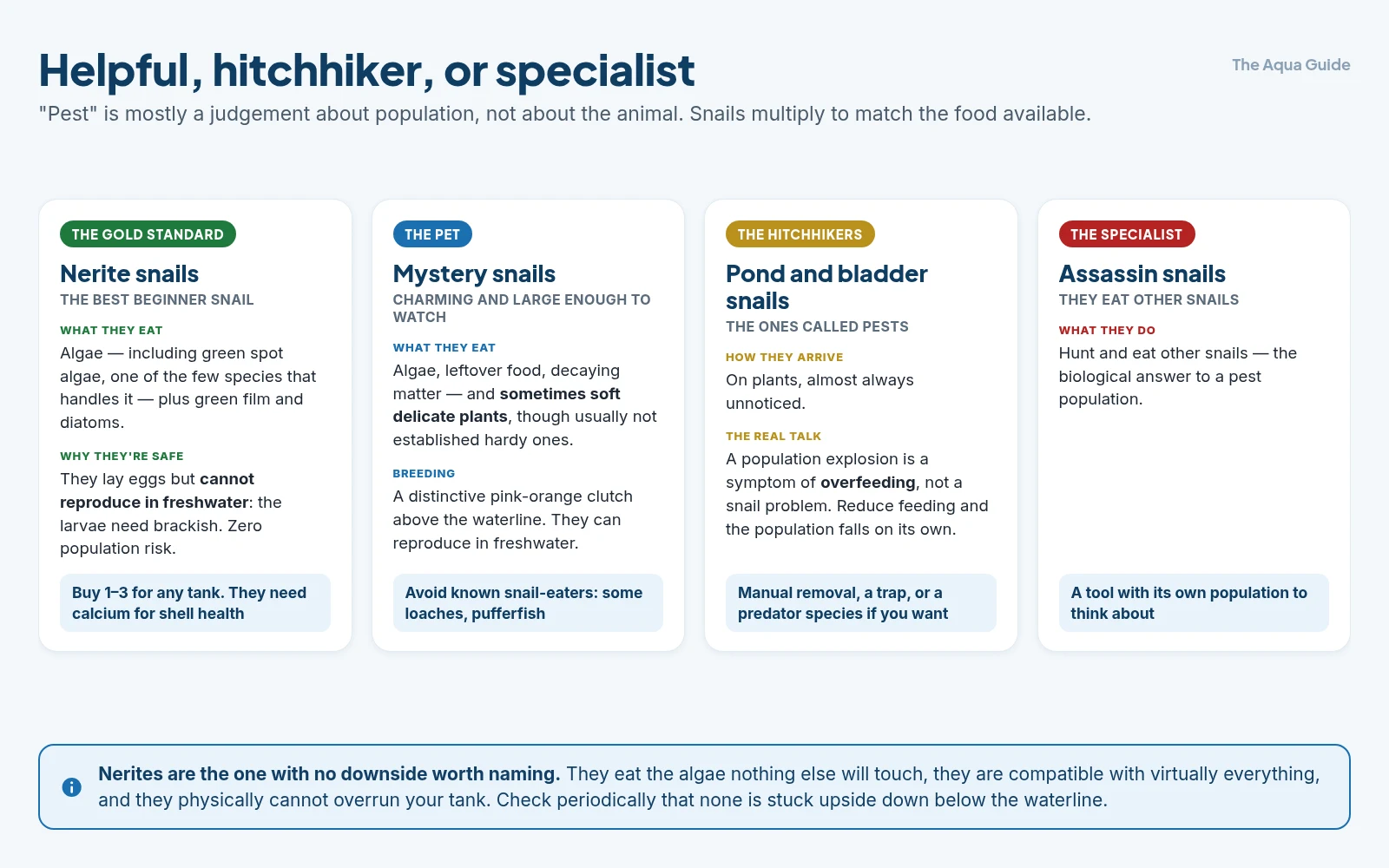
The gold standard cleaner. Multiple varieties available: zebra, tiger, olive, horned, racer. All share key traits.
Size: 1 inch.
What they eat: Algae — especially green spot algae (one of the few species that handles it), green film algae, diatoms, and some soft general algae. Won't touch live plants.
Breeding: Lay eggs but don't reproduce in freshwater — larvae require brackish water. So they're zero-population-risk. Eggs visible on hardscape as small white dots are aesthetic-only.
Tankmates: Compatible with virtually everything. Fish ignore them; they ignore fish.
Tank requirements: Any reasonably stable tank. Need calcium for shell health (hard water or supplements).
Cautions: Can right themselves if flipped over, but sometimes get stuck on glass below the waterline — check periodically.
Verdict: The best beginner snail. Buy 1–3 for any tank; they work continuously and never multiply uncontrollably.
Mystery Snails (Pomacea diffusa)
The pet snail. Charming, personable, large enough to watch from across the room.
Size: Up to 2 inches.
What they eat: Algae, leftover food, decaying matter. Will sometimes eat plants (especially soft delicate ones); usually leaves established hardy plants alone.
Breeding: Lay eggs above the waterline (a distinctive pink-orange clutch). Can reproduce in freshwater but eggs need to be above water (hence laying above the surface). Manageable population if you remove unwanted egg clutches.
Tankmates: Generally compatible. Avoid known snail-eaters (some loaches, pufferfish).
Tank requirements: Need air access (they breathe atmospheric air through a siphon). Tank lid with sufficient air gap. Hard water for shell strength.
Cautions: Get big — plan accordingly. Will die quickly without atmospheric access.
Verdict: Great pets in their own right. Each has personality. Good for keepers who like watching snail behavior.
Malaysian Trumpet Snails (MTS — Melanoides tuberculata)
The substrate worker. Small, cone-shaped, live in the substrate during daylight and emerge at night.
Size: 0.5–1 inch.
What they eat: Detritus and decaying matter buried in substrate. Excellent substrate aerators — burrowing prevents anaerobic pockets and gas buildup.
Breeding: Reproduce via livebearing (no eggs). Can become very numerous — visible at night, hidden by day. "Pest" reputation but actually mostly invisible.
Tankmates: Compatible with most. Avoid snail-eaters.
Tank requirements: Substrate they can burrow into (sand or fine gravel works best).
Verdict: Underrated workers. The "pest" reputation overstates how visible they are. Population usually self-regulates based on available food.
Ramshorn Snails (Planorbella sp.)
The community helper. Flat, coiled shells like miniature ram horns. Various colors — brown, red, blue (color variants bred for the hobby).
Size: 0.5–1 inch.
What they eat: Algae, biofilm, leftover food, decaying matter. Generally leave healthy plants alone but will eat dying plant material.
Breeding: Lay eggs on hardscape and plants; reproduce readily in freshwater. Can explode in population in overfed tanks — most common "pest snail" along with pond snails.
Tankmates: Compatible with most. Pufferfish, assassins snails, some loaches eat them.
Tank requirements: Any reasonable freshwater tank.
Verdict: Helpful when populations are modest; problematic when overfed. Color variants (red ramshorn) are pretty additions to peaceful tanks.
The "Pest" Snails
These species often arrive uninvited and reproduce rapidly. Whether they're truly pests depends on the keeper.
Pond Snails (Lymnaea sp.) and Bladder Snails (Physa sp.)
The hitchhikers. Almost always arrive on plants. Small, with thin coiled shells.
Size: 0.25–0.5 inch.
What they eat: Algae, biofilm, decaying matter, sometimes plants.
Breeding: Reproduce rapidly in freshwater. Capable of population explosions in overfed tanks.
Why considered pests: Visible, numerous, and can overrun tanks. Crawl on glass and plants.
Real talk: They're not actually harmful. They eat detritus and algae just like helpful snails. The "pest" label is mostly aesthetic. Many experienced keepers tolerate them as part of the tank ecosystem.
Control if desired:
- Reduce feeding — biggest single factor in population control
- Manual removal — squish or pluck visible ones during maintenance
- Snail trap — a piece of vegetable left overnight attracts them; remove the next morning
- Predator species — assassin snails (specialist snail-eater), some loaches (clown loaches, yoyo loaches), pufferfish
Snails to Approach With Caution
Assassin Snails (Clea helena)
The snail-eating specialist. Looks like a normal small snail but is a predator of other snails.
Size: 0.5–1 inch.
What they eat: Other snails. Will consume pond snails, bladder snails, ramshorns, sometimes even MTS.
Breeding: Lay distinctive square eggs; reproduce slowly in freshwater.
Use: Population control of pest snails. A few assassin snails can eliminate a problem snail population over weeks to months.
Cautions: Will also eat your nice snails. Don't add assassins if you want to keep nerites, mystery snails, or any other valued snail species in the same tank. Also, when pest snails are eliminated, assassins need supplementary food (frozen bloodworms, fish food).
Verdict: Useful for solving specific problems; not a general tank addition.
Apple Snails (Pomacea bridgesii and others)
Larger relatives of mystery snails, but often confused. Some species are aggressive plant eaters; illegal to keep in many countries due to their invasive potential in waterways. Check local laws before considering.
Setting Up for Healthy Snails
Snails generally do well in any reasonable freshwater tank, but a few considerations:
Calcium availability. Snails need calcium for shell growth. Soft acidic water can cause shell erosion. Provide:
- Hard water (GH 6+)
- Cuttlebone (cuttlefish bone) floating in the tank
- Crushed coral or seashells in the filter
- Calcium supplements
Stable water parameters. Snails are sensitive to ammonia and nitrite. Established cycled tank only.
No copper. Copper-based medications and some fertilizers kill snails. Avoid.
Tank lid. Some species (mystery snails) need air access; others (most) just need a lid to prevent escape.
Calm flow. Snails struggle in very high-flow tanks.
At a glance: managing a population
| Do | Why it works |
|---|---|
| Reduce feeding | This is the actual lever. Snails multiply to match the food available, so a population explosion is a symptom of overfeeding |
| Manual removal | Pick them out as you see them. Slow, but it costs nothing and harms nothing |
| A snail trap | Bait overnight and lift out what gathers |
| A predator species | Assassin snails, or a snail-eating fish — effective, and it gives you a second population to think about |
Nerites cannot contribute to this problem at all, because their larvae need brackish water and so they never reproduce in a freshwater tank.
Managing Snail Populations
If snails are reproducing faster than you'd like:
1. Reduce feeding — the #1 lever. Snails reproduce in proportion to available food. Less food = fewer snails.
2. Remove uneaten food promptly — don't let it sit and feed snails.
3. Vacuum substrate during water changes — removes detritus that snails feed on.
4. Manual removal during maintenance — pluck or squish visible snails, especially in problem areas.
5. Snail traps — vegetable pieces left overnight attract snails; remove next morning.
6. Add an assassin snail or two — specialist snail-eater, slow but effective. Or compatible snail-eating fish (loaches, pufferfish — but check tank size and compatibility).
7. Reset if overwhelmed — in extreme cases, tear down the tank, clean everything, restart. Rare but sometimes necessary.
The hidden lesson in pest snail problems: they signal overfeeding. A tank with no spare food has stable snail populations.
Are Snails Good or Bad?
The honest answer: neither. They're tank inhabitants with specific roles. The good ones (nerite, mystery, MTS, ramshorn at controlled numbers) are helpful workers. The "pest" ones (pond, bladder) are also helpful — they just signal something else is off (usually overfeeding). They don't damage healthy plants, don't attack fish, and contribute to tank ecology.
The keepers who hate snails are usually fighting their own overfeeding habits. The keepers who love snails are usually keeping appropriate numbers in well-fed but not overfed tanks.
Snail Compatibility
Most fish are fine with snails. The notable exceptions that will hunt them:
Loaches — clown loaches, yoyo loaches, kuhli loaches all eat snails Pufferfish — dedicated snail-hunters (often kept specifically for snail control) Some cichlids — angelfish, severums occasionally eat smaller snails Goldfish — eat anything that fits in their mouths
If you want to keep snails, avoid these tankmates. If you want pest snail control, deliberately add them.
The Bottom Line
Aquarium snails range from genuinely useful (nerite for algae control, mystery as personable pets, MTS for substrate work, ramshorn as community helpers) to "pest" species (pond, bladder) that are actually still beneficial — just numerically prolific when keepers overfeed. Nerite snails are the best universal beginner choice: zero-population-risk, excellent algae cleaners, compatible with everything. Mystery snails add personality and are charming pets in their own right. Malaysian trumpet snails work invisibly in the substrate. Ramshorn snails help when numbers are modest. The infamous "pest snails" (pond and bladder) aren't actually harmful — population control comes from reducing feeding, not from dramatic interventions. Assassin snails can eliminate problem populations but will also eat valued snails. The best mental model: snails are partners that respond to how you feed your tank. Modest feeding = manageable populations of helpful workers. Overfeeding = population explosions and the "pest" reputation. Keep them, manage them, learn from them.
Related guides
- Freshwater shrimp: cherry, amano and more
- Algae eaters: which actually work
- The beginner's guide to aquarium algae
- Why overfeeding is the #1 beginner mistake
- Understanding pH, KH and GH
- Community tank compatibility: what gets along
- The beginner's guide to breeding invertebrates
- How to plant and anchor aquarium plants
Got questions about your specific setup? Drop them in our Community Forum — we love helping new fishkeepers get started right.