After livebearers, egg-layers are the next step in fish breeding — more demanding, more variety, and often more rewarding. Unlike livebearers that simply produce fry, egg-layers require recognizing spawning behavior, managing eggs, raising tiny larvae through their fragile first days, and handling the species-specific requirements of each fish. Here's the guide to breeding the beginner-friendly egg-layers: corydoras, tetras, danios, white clouds, and bristlenose plecos.
At a glance: the three patterns
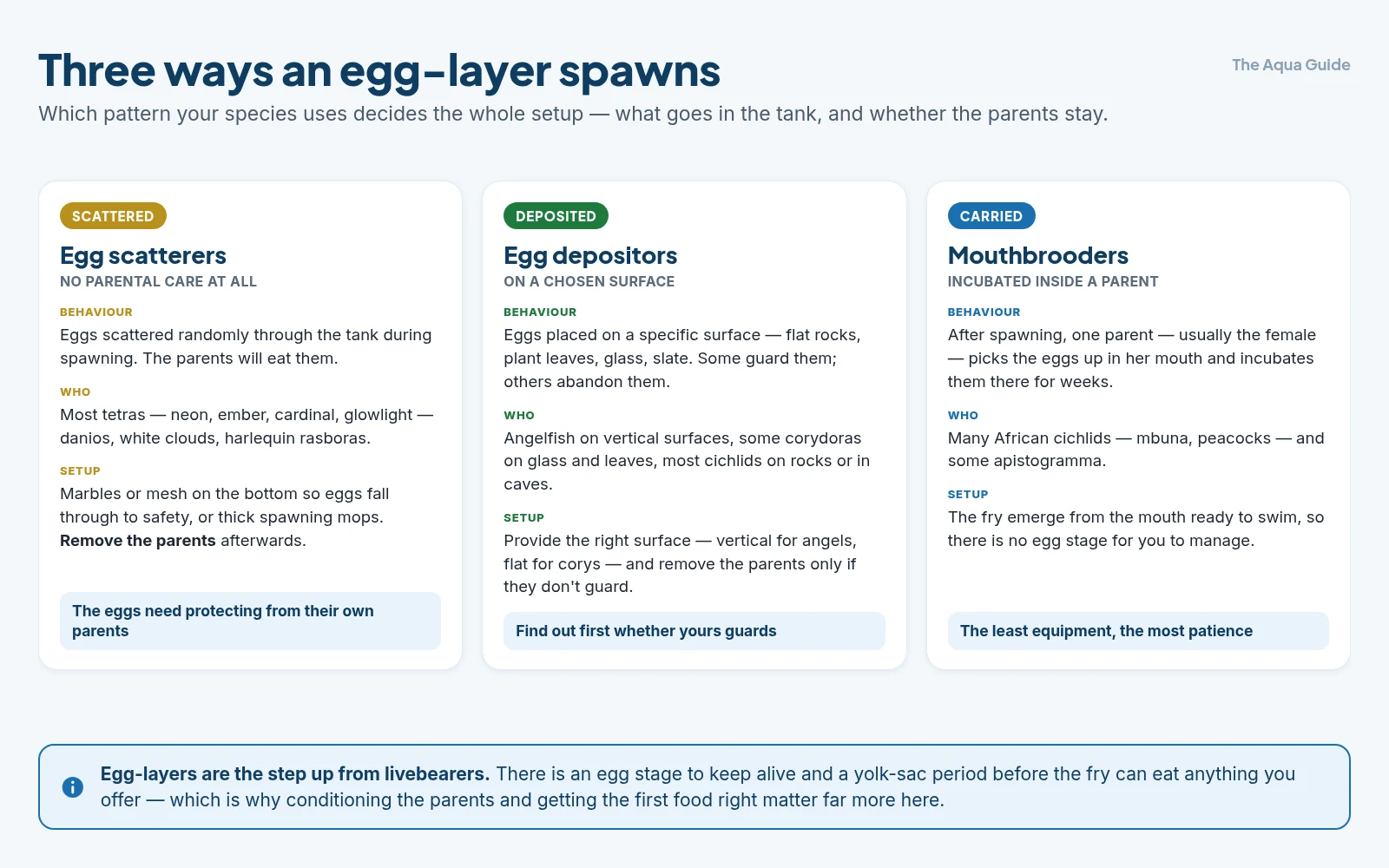
| Pattern | Who does it | What the tank needs |
|---|---|---|
| Egg scatterers | Most tetras, danios, white clouds, harlequin rasboras | Marbles or mesh for eggs to fall through, or thick spawning mops — then remove the parents |
| Egg depositors | Angelfish, some corydoras, most cichlids | The right surface: vertical for angels, flat for corys, caves for cichlids |
| Mouthbrooders | Many African cichlids, some apistogramma | Very little — the eggs are carried in a parent's mouth until the fry swim |
Identify which pattern your species uses before setting anything up, because all three want a different tank and a different decision about whether the parents stay.
Egg-Layers vs. Livebearers
The fundamental difference:
Livebearers carry eggs internally, fertilize internally, and release fully-formed swimming fry. The keeper just needs to save the fry from being eaten.
Egg-layers release eggs into the water (or onto surfaces), males fertilize them externally, eggs develop over hours to days, hatch into tiny larvae with yolk sacs, and only become "free-swimming" fry days later. The keeper has to:
- Recognize spawning is about to happen (or has happened)
- Protect eggs from being eaten (parents often eat their own)
- Wait through hatching with the right conditions
- Manage the yolk-sac period (no feeding yet)
- Feed first foods to free-swimming fry
It's more involved than livebearer breeding, but covers the vast majority of aquarium fish species.
Egg-Layer Spawning Patterns
Different species have different spawning behaviors. The main patterns:
Egg Scatterers
Behavior: Eggs scattered randomly through the tank during spawning. No parental care; parents will eat the eggs.
Examples: Most tetras (neon, ember, cardinal, glowlight), danios (zebra, leopard, pearl), white clouds, harlequin rasboras.
Breeding approach: Separate breeding tank with marbles or mesh on the bottom (eggs fall through to safety), or thick spawning mops. Remove parents after spawning.
Egg Depositors
Behavior: Eggs deposited on a specific surface — flat rocks, plant leaves, glass, slate. Some species (some cichlids) guard the eggs; others abandon them.
Examples: Angelfish (deposit on plant leaves or vertical surfaces), some corydoras (lay eggs on glass and plant leaves), most cichlids (rocks, caves, or surfaces).
Breeding approach: Provide appropriate surfaces (vertical for angels, flat for corys), remove parents if they don't guard, or leave them if they do.
Mouth Brooders
Behavior: After spawning, one parent (usually female) picks up eggs in her mouth and incubates them there for weeks. Fry emerge from the mouth ready to swim.
Examples: Many African cichlids (mbuna, peacock cichlids), some apistogramma.
Breeding approach: Often happens in display tanks naturally; can isolate the brooding parent to a separate tank for higher fry survival.
Bubble Nest Builders
Behavior: Male builds a nest of bubbles at the surface; female deposits eggs which male carries to the nest. Male guards eggs/fry until free-swimming.
Examples: Bettas (most famously), gouramis (some species), paradise fish.
Breeding approach: Specific setup with shallow water, floating cover for the nest, careful introduction of male/female, separation after spawning.
Cave Spawners
Behavior: Eggs laid inside a cave or enclosed space; parents guard.
Examples: Many catfish (bristlenose plecos), some dwarf cichlids, kribensis.
Breeding approach: Provide caves (PVC pipe, coconut shells, clay caves). Parents often guard fry; can usually be left in.
Common Beginner Egg-Layers
Corydoras Catfish
Why they're great beginners: Hardy, social, often breed willingly in well-conditioned tanks. The "T-position" spawning behavior is fascinating to watch.
Breeding triggers: Large water change with cooler water (mimicking rainy season). Often spawn in early morning after a major water change the previous evening.
Setup: Group of 6+ (corys need company), well-conditioned with frozen/live foods for a week, large cool water change, then watch.
Spawning behavior: Multiple females form a T-position with a male, eggs released and caught in female's pelvic fin "pouch," then attached to glass, plants, or equipment. Sticky eggs, individually placed.
Egg care: Eggs are sticky and stuck to surfaces. Adults sometimes eat them, sometimes ignore them. Move eggs to a separate hatching container (a small breeder net or hatching jar) for maximum survival. Eggs hatch in 4–5 days.
Fry care: Hatchlings have yolk sacs — wait 2–3 days before first feeding. First food: baby brine shrimp or fine powdered food. Grow out for 6–8 weeks.
Zebra Danios and White Cloud Minnows
Why they're great beginners: Tolerate a wide range of conditions, spawn easily, eggs and fry are robust.
Breeding triggers: Conditioning with live/frozen foods, slight temperature drop, increased lighting.
Setup: A pair or small group in a small breeding tank (5–10 gallons), bottom covered with marbles or mesh (eggs fall through, safe from parents).
Spawning behavior: Active scattering of eggs while males chase females. Most eggs scattered in early morning. Parents will eat eggs if accessible.
Egg care: Remove parents within hours of spawning. Eggs hatch in 24–48 hours.
Fry care: Yolk sacs for 2–3 days. First feeding: vinegar eels or microworms (very tiny), or baby brine shrimp after a few days.
Most Tetras (Neon, Cardinal, Ember, Glowlight)
Why they're suitable: Common, beautiful, well-documented breeding processes.
Breeding triggers: Soft acidic water (pH 5.5–6.5), dim lighting (or even darkness), temperature around 78–80°F. Most tetras are highly sensitive to spawning conditions.
Setup: Dedicated soft-water breeding tank (RO water + minimal mineralization), mesh bottom, very dim lighting, conditioned pair.
Spawning behavior: Eggs scattered while pairs swim together. Eggs are tiny and often sensitive to light.
Egg care: Critical: eggs are extremely light-sensitive. Cover the tank with black plastic or dark fabric. Remove parents after spawning. Hatching takes 24–36 hours.
Fry care: Wait through yolk-sac period (3–5 days). First food: infusoria or vinegar eels (very tiny fry). Difficult species — many beginner attempts fail.
Honestly: Tetras are not the easiest beginner egg-layers despite their availability. Start with corydoras or danios first.
Bristlenose Plecos (Ancistrus species)
Why they're great beginners: Will breed in standard community tanks, fascinating male parental care.
Breeding triggers: Cool water changes, established pair, cave provided.
Setup: Provide a cave (PVC pipe, ceramic breeding cave) sized for the species. Male claims it.
Spawning behavior: Female enters cave, lays cluster of eggs on the wall, male fertilizes and guards. Male fans eggs continuously, eats white (unfertilized) eggs, attacks intruders.
Egg care: Leave male in the cave — he handles it. Eggs hatch in 4–5 days. Fry stick to the cave for another 3–5 days as yolk sacs absorb.
Fry care: When free-swimming, fry leave the cave to graze. Feed sinking pellets, blanched zucchini, biofilm. Grow slowly but reliably.
Highly recommended beginner cave-spawner.
Angelfish (Pterophyllum scalare)
Why they're moderate-difficulty beginners: Sometimes spawn willingly; some pairs are excellent parents.
Breeding triggers: Established pair (they pair-bond), conditioning, suitable vertical surface (broad leaf, slate, even tank glass).
Setup: Mature pair, well-conditioned. Provide a piece of slate or large leaf as a spawning surface.
Spawning behavior: Pair cleans the spawning surface, female deposits rows of eggs, male follows fertilizing. Highly organized.
Egg care: Some pairs guard eggs and fry beautifully — leave them alone if they do. Other pairs eat their eggs (especially young inexperienced pairs); remove eggs to a separate hatching setup if so.
Fry care: Hatch in 2–3 days, yolk sac for several days, then free-swimming. Initial feeding: BBS. Grow out for 6–8 weeks.
The Conditioning Routine
Almost all egg-layer breeding requires conditioning — bringing parents into peak breeding state.
Duration: 1–2 weeks before introducing to breeding tank.
Diet: Vary intensely. Live or frozen foods (bloodworms, brine shrimp, daphnia, mosquito larvae, blackworms) several times daily. The richest diet you can provide.
Conditions: Stable, clean, comfortable. Reduce stress through stable parameters and modest tank density.
Identifying readiness: Female plumps up with eggs (visible roundness in lower abdomen). Male shows peak color and breeding behavior (displaying, chasing).
After 1–2 weeks of intense conditioning, fish are typically ready to spawn within days of being placed in the right conditions.
Triggering Spawning
Each species responds to different triggers:
Water change with cooler water — corydoras, danios, white clouds (mimics rain). 30% water change with water 5°F cooler than tank.
Temperature change — some species spawn after temperature drops; others after rises.
Soft acidic water — tetras, dwarf cichlids, discus. Use RO water remineralized lightly.
Specific surface provision — angels need vertical surfaces; cichlids need caves; killifish need spawning mops.
Lighting changes — some species spawn in dim conditions; others need bright morning light.
Live food — the conditioning itself often triggers spawning regardless of water changes.
Increased current — some species need flowing water.
Research the specific species before breeding. Most beginner egg-layers respond to the conditioning-plus-cool-water-change pattern.
Egg Handling
Once spawning has occurred:
Identify whether eggs are visible — sometimes obvious (scattered, on surfaces), sometimes hidden (in caves, under leaves).
Decide on egg care strategy:
- Remove parents — most common approach for egg-scatterers and species that don't guard
- Leave guarding parents — for species like bristlenose plecos, some cichlids
- Remove eggs to separate hatching setup — for sticky eggs (corys, angels) where parents would eat them
Hatching setup (if separating eggs): Small container, methylene blue at low concentration (prevents fungal infection on eggs), gentle aeration, temperature-matched water. Eggs hatch in 1–5 days depending on species.
Watch for white (unfertilized) eggs — they go fuzzy with fungus and need removal before they affect viable eggs.
The Yolk-Sac Period
Critical: don't feed fry while they still have yolk sacs visible.
After hatching, fry have a small attached yolk sac that sustains them for 1–5 days depending on species. During this time:
- Fry typically lie on the bottom or attach to surfaces
- They don't swim or hunt
- Feeding now adds food they won't eat — pollution risk
- Wait until you see them swimming freely AND looking for food
When fry are clearly free-swimming and showing hunting behavior, start first feeding.
First Feedings
The right first food depends on fry size (see live foods guide for details):
- Very tiny fry (most tetras): vinegar eels, infusoria, greenwater
- Small fry (corys, danios, white clouds): microworms, baby brine shrimp
- Larger fry (angelfish, plecos): baby brine shrimp, finely-crushed flake
Feed 4–6 times daily, tiny amounts each time. The first 1–2 weeks are the most critical for survival.
Grow-Out and Beyond
After the first weeks (see raising fry guide):
- Continue frequent feeding with progressively larger foods
- Daily small water changes
- Watch growth and adjust food size accordingly
- Move to display tank when too big to be eaten and eating community food
Most beginner egg-layer fry are ready for display tanks in 8–16 weeks depending on species.
When First Attempts Fail
Egg-layer breeding has a learning curve. First attempts often fail. Common reasons:
Parents ate the eggs — not enough hiding/separation Eggs went moldy — water quality or too many unfertilized eggs Fry died at hatching — yolk sacs unhealthy (parent diet?) Fry died at first feeding — food too big, food unavailable, or feeding started too early Conditioning incomplete — small brood of low-quality eggs
Each failure teaches something. By the third or fourth attempt, most keepers are succeeding regularly.
The Bottom Line
Egg-layer breeding opens up the entire range of aquarium fish beyond livebearers — corydoras, tetras, danios, white clouds, angelfish, bristlenose plecos, and many more. The added work over livebearers (recognizing spawning, protecting eggs, managing the yolk-sac period, providing tiny first foods) is rewarded with enormous species variety. Start with corydoras (easy spawning behavior after cool water changes), danios and white clouds (forgiving, robust eggs), or bristlenose plecos (cave spawners with parental care). Save tetras for later — they're more demanding than their popularity suggests. Always condition parents intensely with live/frozen foods for 1–2 weeks before breeding attempts. Match the trigger to your species (cool water change for many; soft water for tetras; caves for plecos; vertical surfaces for angels). Handle eggs appropriately for the species — remove parents, leave guarding parents, or transfer eggs to safety. Wait for yolk-sac absorption before feeding, then deliver appropriately tiny first foods (BBS, microworms, vinegar eels). First attempts often fail; persistence pays off. After a few successful broods, you'll have built the foundational skills to tackle any egg-layer in the hobby.
Related guides
- Setting up a breeding tank
- Raising fry: the first weeks
- Live and cultured foods for fry
- The easiest fish to breed: livebearers
- Fungal infections: cotton-like growth
- Choosing the right food: flakes, pellets, frozen, live
- The beginner's guide to breeding invertebrates
- Community tank compatibility: what gets along
Got questions about your specific setup? Drop them in our Community Forum — we love helping new fishkeepers get started right.