You've got your plants and you're ready to put them in — but how, exactly? Do you bury them? Tie them to something? Why do some keep floating up? Planting aquarium plants correctly matters more than beginners expect: do it wrong and plants float loose, rot, or fail to establish; do it right and they anchor, settle, and grow. The good news is that the techniques are simple once you know which method each plant needs. Here's how to plant and anchor everything properly.
At a glance: which method for which plant
| Type | Examples | Method |
|---|---|---|
| Rooted — stem | Hornwort, wisteria, anacharis | Each stem planted individually into the substrate, spaced out |
| Rooted — rosette | Amazon swords, cryptocorynes, vallisneria | Roots buried, crown left at the surface of the substrate |
| Attached | Java fern, anubias, bucephalandra, mosses | Tied or glued to rock or wood, rhizome exposed — never buried |
| Floating | Duckweed, frogbit, salvinia, water sprite | Placed on the surface. Thinned periodically |
| Carpeting | Foreground lawn species | Small portions, spaced, pressed gently in; they spread by runners |
A couple of general rules: remove plants from their plastic pots and rock wool before planting, use a substrate deep enough to hold roots — a couple of inches at least — and use planting tweezers, which make precise work far easier than fingers.
The Key Insight: Different Plants, Different Methods
The most important thing to understand is that aquarium plants aren't all planted the same way. They fall into a few types, and each has its own correct method:
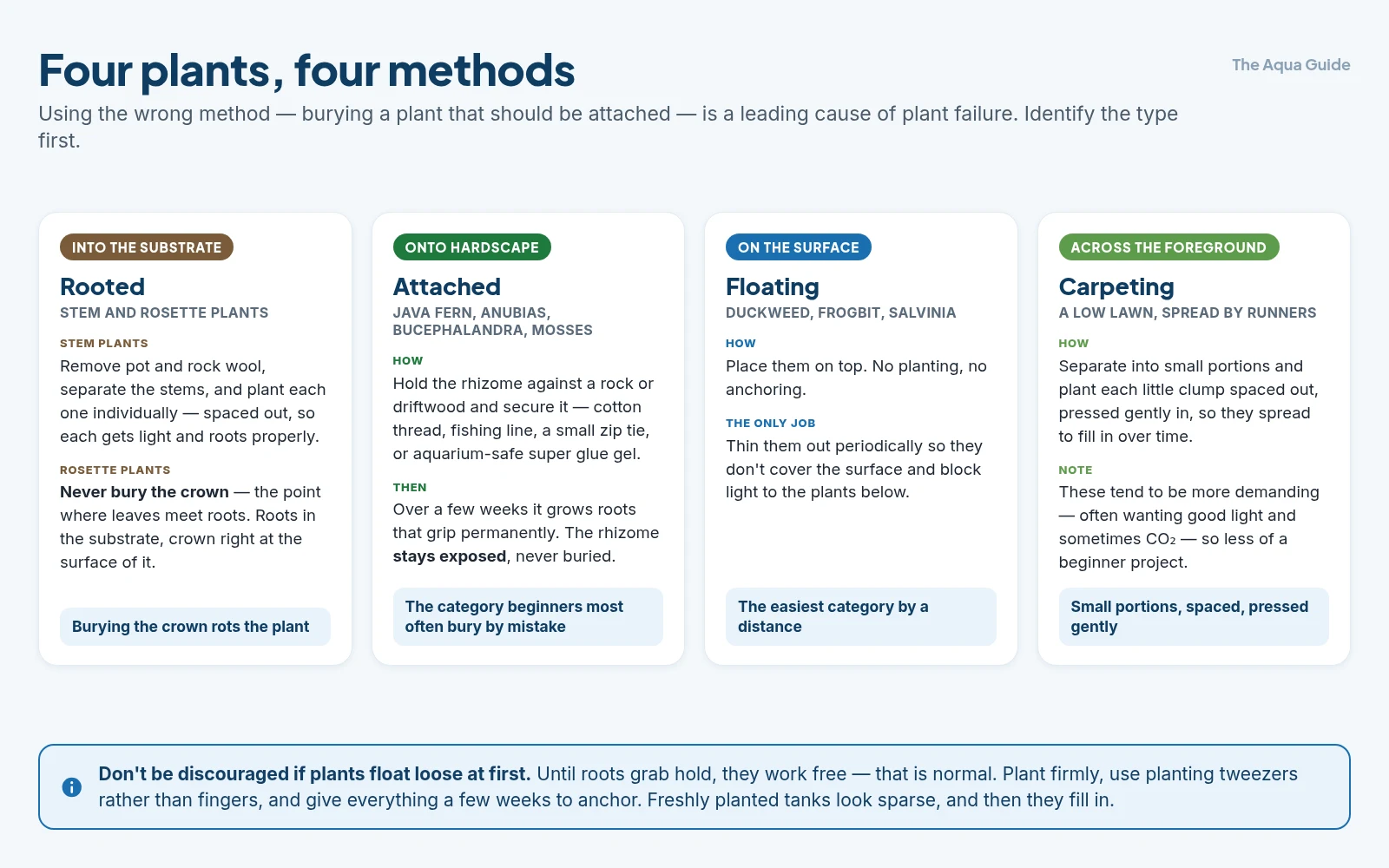
Some plants are rooted in the substrate (like most stem plants and rosette plants such as Amazon swords). Some are attached to hardscape — rocks and driftwood — rather than buried (like java fern, anubias, and moss). Some simply float at the surface. And some carpet the foreground via runners. Using the wrong method — burying a plant that should be attached, for instance — is a leading cause of plant failure. So first identify which type your plant is, then use the matching technique below.
Rooted Plants: Into the Substrate
Stem plants (like hornwort, wisteria, anacharis) and rosette plants (like Amazon swords, cryptocorynes, vallisneria) go into the substrate — but with a couple of important details.
For stem plants, remove them from any pot and rock wool, separate the stems, and plant each stem individually a little way into the substrate, deep enough to hold but not crushing the base. Spacing them out (rather than planting a dense bunch in one hole) lets each stem get light and root properly. Using planting tweezers makes this much easier, especially in fine substrate.
For rosette plants like swords and crypts, the critical rule is don't bury the crown — the crown is the point where the leaves meet the roots, and burying it causes the plant to rot. Plant so the roots are in the substrate but the crown sits right at the surface of it. Spread the roots gently and cover them, leaving the crown exposed.
A common frustration is rooted plants floating back up before they establish. This is normal at first — until roots grab hold, plants can work loose. Planting them firmly enough, using tweezers to push roots in, and giving them time to root usually solves it; some people gently weigh down stubborn stems temporarily.
Attached Plants: Onto Rocks and Wood
This is the category beginners most often get wrong by trying to bury them. Plants like java fern, anubias, bucephalandra, and mosses must not be planted in the substrate — their crowns/rhizomes will rot if buried. Instead, they attach to hardscape.
The method: take the plant and position its rhizome (the thick horizontal stem the leaves and roots grow from) against a rock or piece of driftwood, and secure it there. You can tie it on with cotton thread or fishing line, fasten it with small zip ties, or use a dab of aquarium-safe super glue gel. Over a few weeks, the plant grows its own roots that grip the surface permanently, and you can remove any thread once it's anchored (or leave glue, which becomes hidden). The rhizome stays exposed to the water — never buried. These plants are actually some of the easiest of all, precisely because attaching them is so forgiving and they don't need substrate.
Floating Plants: Just Let Them Float
The easiest category by far. Floating plants (like duckweed, frogbit, water sprite floated, salvinia) simply go on the water surface — no planting, no anchoring. Just place them on top and they drift and grow. The only management needed is thinning them out periodically so they don't completely cover the surface and block light to plants below. (Floating plants have their own dedicated guide.)
Carpeting Plants: Spread Across the Foreground
Carpeting plants (which form a low "lawn" across the substrate) are planted by separating them into small portions and planting each little clump across the foreground, spaced out, so they spread via runners to fill in a carpet over time. These tend to be more demanding (often wanting good light and sometimes CO₂), so they're less of a beginner project, but the planting method is: small portions, spaced, pressed gently into the substrate. (Carpeting plants are covered alongside floating plants in their own guide.)
General Tips for Success
A few things help with any planting. Remove plants from their plastic pots and rock wool before planting (the wool can rot if buried, though some leave it for delicate roots). Plant into a substrate deep enough to hold roots — a couple of inches at least. Use planting tweezers; they make precise planting far easier than fingers, especially for small or delicate plants. Don't be discouraged if some plants float loose at first — anchoring improves as roots establish over the following weeks. And give everything time to settle; freshly-planted tanks look sparse, but they fill in as plants root and grow.
The Bottom Line
Planting aquarium plants correctly comes down to matching the method to the plant type. Rooted stem and rosette plants go into the substrate — but never bury the crown of rosette plants like swords. Attached plants like java fern, anubias, and moss must be tied or glued to rocks and wood, with their rhizomes left exposed, never buried (a mistake that rots them). Floating plants simply float, needing only periodic thinning. Carpeting plants are planted in small spaced portions to spread into a lawn. Identify which type each plant is, use the right technique, plant firmly (tweezers help), and give everything a few weeks to anchor and establish. Get the method right and your plants will settle in and thrive instead of floating loose or rotting away.
Related guides
- The beginner's guide to live aquarium plants
- Floating and carpeting plants for beginners
- The easiest fast-growing plants for beginners
- Why are my plant leaves melting or yellowing?
- Substrate choices for aquascapes
- Aquarium plants quick reference
- Setting up your first aquascape, step by step
- Do I need CO₂, fertiliser and special lighting?
Got questions about your specific setup? Drop them in our Community Forum — we love helping new fishkeepers get started right.