A quick lookup for common aquarium plants — difficulty level, light requirements, CO2 needs, position in tank, and growth characteristics. Use this when planning a planted tank, shopping for plants, or trying to identify what's already in your tank.
At a glance: the three tiers
| Tier | What it means | What you need |
|---|---|---|
| Beginner | Low tech, low light, no CO₂ | A standard aquarium light. Java fern, anubias, mosses, crypts, hornwort, Amazon swords |
| Intermediate | Medium light, CO₂ beneficial | Most stem plants, dwarf hairgrass, monte carlo, dwarf sag — they will grow without CO₂, but denser with it |
| Advanced | High light, CO₂ required | HC Cuba, Glossostigma, Riccia, Macrandra, and most red plants for full colour |
| Floating | Its own category entirely | Frogbit, salvinia, duckweed, water sprite. They take what reaches the surface, which is plenty |
Pick the tier that matches the equipment you already have, rather than buying equipment to match a plant you liked the look of.
How to Use This Reference
For each plant, you'll see:
Difficulty: Beginner / Intermediate / Advanced Light: Low (10-20 PAR) / Medium (20-40 PAR) / High (40+ PAR) CO2: Not required / Beneficial / Required Position: Foreground / Midground / Background / Floating / Attached (epiphyte) Growth: Slow / Medium / Fast
Match plants to your tank's conditions — don't fight your setup. Low-tech tank? Stick to low-light plants. Limited budget? Avoid high-CO2 demanding species.
Beginner Plants (Low Tech, Low Light, No CO2)
The hardy plants every beginner should start with.
Java Fern (Microsorum pteropus)
Difficulty: Beginner Light: Low to medium CO2: Not required Position: Midground/Attached Growth: Slow Notes: Attach to rocks or wood — do NOT bury rhizome (will rot). Tolerates wide parameters. Varieties: standard, narrow leaf, windelov (lace), trident.
Anubias (Various species)
Difficulty: Beginner Light: Low to medium CO2: Not required Position: Midground/Attached Growth: Very slow Notes: Like java fern, attach to hardscape — rhizome must be exposed. Anubias nana, nana 'petite,' coffeefolia, congensis, barteri all popular. Algae prone in high light.
Java Moss (Taxiphyllum barbieri)
Difficulty: Beginner Light: Low to medium CO2: Not required Position: Attached/Anywhere Growth: Medium Notes: Attaches to anything (wood, rocks, mesh). Forms moss mats. Trim regularly to maintain shape. Great hiding cover for fry and shrimp.
Amazon Sword (Echinodorus species)
Difficulty: Beginner Light: Medium CO2: Not required (beneficial) Position: Background/Centerpiece Growth: Medium Notes: Classic background plant. Gets large (12+ inches). Root feeder — use root tabs. Sturdy and forgiving.
Cryptocoryne (Crypts — various species)
Difficulty: Beginner Light: Low to medium CO2: Not required Position: Midground/Background Growth: Slow to medium Notes: Various species: wendtii (green/bronze/red), parva (small), spiralis (tall). May "melt" when first added (lose leaves, recover from rhizome). Root feeder.
Vallisneria
Difficulty: Beginner Light: Low to medium CO2: Not required Position: Background Growth: Medium to fast (spreads via runners) Notes: Grass-like blades. Several varieties (jungle val, corkscrew val). Spreads aggressively — plant where you have room. Sensitive to liquid carbon (Excel kills it).
Hornwort (Ceratophyllum demersum)
Difficulty: Beginner Light: Low CO2: Not required Position: Background/Floating Growth: Fast Notes: Floating or anchored. Excellent nutrient sponge — great for new tanks or algae control. Sheds needles regularly (mild messiness).
Water Sprite (Ceratopteris thalictroides)
Difficulty: Beginner Light: Medium CO2: Not required Position: Background/Floating Growth: Fast Notes: Can grow rooted or floating. Fast-growing nutrient sink. Easy to propagate.
Marsilea Hirsuta (Dwarf 4-Leaf Clover)
Difficulty: Beginner Light: Medium CO2: Beneficial Position: Foreground Growth: Slow to medium Notes: Beginner-friendly carpet plant. Doesn't strictly need CO2 but grows fuller with it. Hardy and forgiving.
Intermediate Plants (Medium Light, CO2 Beneficial)
The next step up. Better growth and color with CO2 but workable without.
Ludwigia (Ludwigia repens, palustris, etc.)
Difficulty: Intermediate Light: Medium to high CO2: Beneficial (required for best color) Position: Background/Stem Growth: Fast Notes: Red plant — needs strong light and iron for color. Easy to propagate from cuttings.
Bacopa (B. monnieri, caroliniana)
Difficulty: Intermediate Light: Medium CO2: Beneficial Position: Midground/Background stem Growth: Medium Notes: Hardy stem plant. Bright green leaves. Cut and replant tops to multiply.
Rotala Rotundifolia
Difficulty: Intermediate Light: Medium to high CO2: Beneficial Position: Background/Stem Growth: Fast Notes: Color varies (green to pink/red with strong light). Bushy growth. Cut and replant.
Pogostemon Helferi (Downoi)
Difficulty: Intermediate Light: Medium to high CO2: Beneficial Position: Midground/Foreground Growth: Slow to medium Notes: Unique zigzag star-like leaves. Demanding but striking.
Dwarf Hairgrass (Eleocharis parvula/acicularis)
Difficulty: Intermediate Light: Medium to high CO2: Beneficial (significantly improves carpeting) Position: Foreground/Carpet Growth: Slow to medium Notes: Classic carpet plant. Plant in small clumps spaced 1-2cm apart for fast carpeting.
Monte Carlo (Micranthemum tweediei)
Difficulty: Intermediate (with CO2) / Advanced (without) Light: Medium to high CO2: Beneficial Position: Foreground/Carpet Growth: Medium Notes: Slightly larger leaves than HC Cuba; easier to grow. Popular carpet plant.
Hygrophila (H. polysperma, corymbosa, difformis)
Difficulty: Intermediate Light: Medium CO2: Beneficial Position: Midground/Background Growth: Fast Notes: Hardy stem plant. Several varieties from green to red. Easy beginner stem plant.
Advanced Plants (High Light, CO2 Required)
For high-tech setups only.
HC Cuba (Hemianthus callitrichoides)
Difficulty: Advanced Light: High CO2: Required Position: Foreground/Carpet Growth: Slow to medium Notes: The classic competition carpet plant. Tiny leaves, dense carpet when established. Demanding.
Glossostigma elatinoides
Difficulty: Advanced Light: High CO2: Required Position: Foreground/Carpet Growth: Medium Notes: Small round leaves. Forms a thin carpet. Demanding light requirements.
Riccia fluitans
Difficulty: Advanced Light: High CO2: Required Position: Attached/Carpet Growth: Fast (when conditions right) Notes: Bright green moss-like plant. Tie to rocks for stunning textured ground cover. Pearls heavily.
Alternanthera reineckii
Difficulty: Intermediate to Advanced Light: High CO2: Beneficial (recommended) Position: Mid/Background stem Growth: Medium Notes: Vivid red/pink plant. Demands iron and good light for color.
Limnophila Aromatica
Difficulty: Intermediate to Advanced Light: High CO2: Recommended Position: Background stem Growth: Fast Notes: Beautiful purple/red coloration. Demanding but stunning.
Rotala Macrandra
Difficulty: Advanced Light: High CO2: Required Position: Background stem Growth: Medium Notes: One of the reddest aquarium plants. Demanding setup needed.
Floating Plants
Reduce light penetration; absorb excess nutrients; great hiding cover.
Frogbit (Limnobium laevigatum)
Difficulty: Beginner Light: Any CO2: Not required Notes: Round flat leaves with hanging roots. Easy beginner floater.
Red Root Floater (Phyllanthus fluitans)
Difficulty: Beginner Light: Medium-high (for red color) CO2: Not required Notes: Beautiful red roots. Excellent in low-tech tanks.
Duckweed (Lemna minor)
Difficulty: Beginner (often unwanted!) Light: Any CO2: Not required Notes: Tiny leaves. Spreads aggressively — often becomes a pest. Hard to remove fully.
Salvinia (S. natans, minima)
Difficulty: Beginner Light: Any CO2: Not required Notes: Larger floating fern-like leaves. Easier to manage than duckweed.
Amazon Frogbit (Limnobium laevigatum)
Difficulty: Beginner Light: Any CO2: Not required Notes: Larger floater with attractive leaves and roots.
Light Requirement Quick Reference
| Light Level | PAR | Plants |
|---|---|---|
| Low | 10-20 | Java fern, anubias, mosses, crypts, hornwort, Amazon swords |
| Medium | 20-40 | Most "beginner" planted tank plants |
| High | 40+ | Carpet plants, demanding stems, red plants for color |
| Very High | 60+ | HC Cuba, Riccia, demanding macrandra |
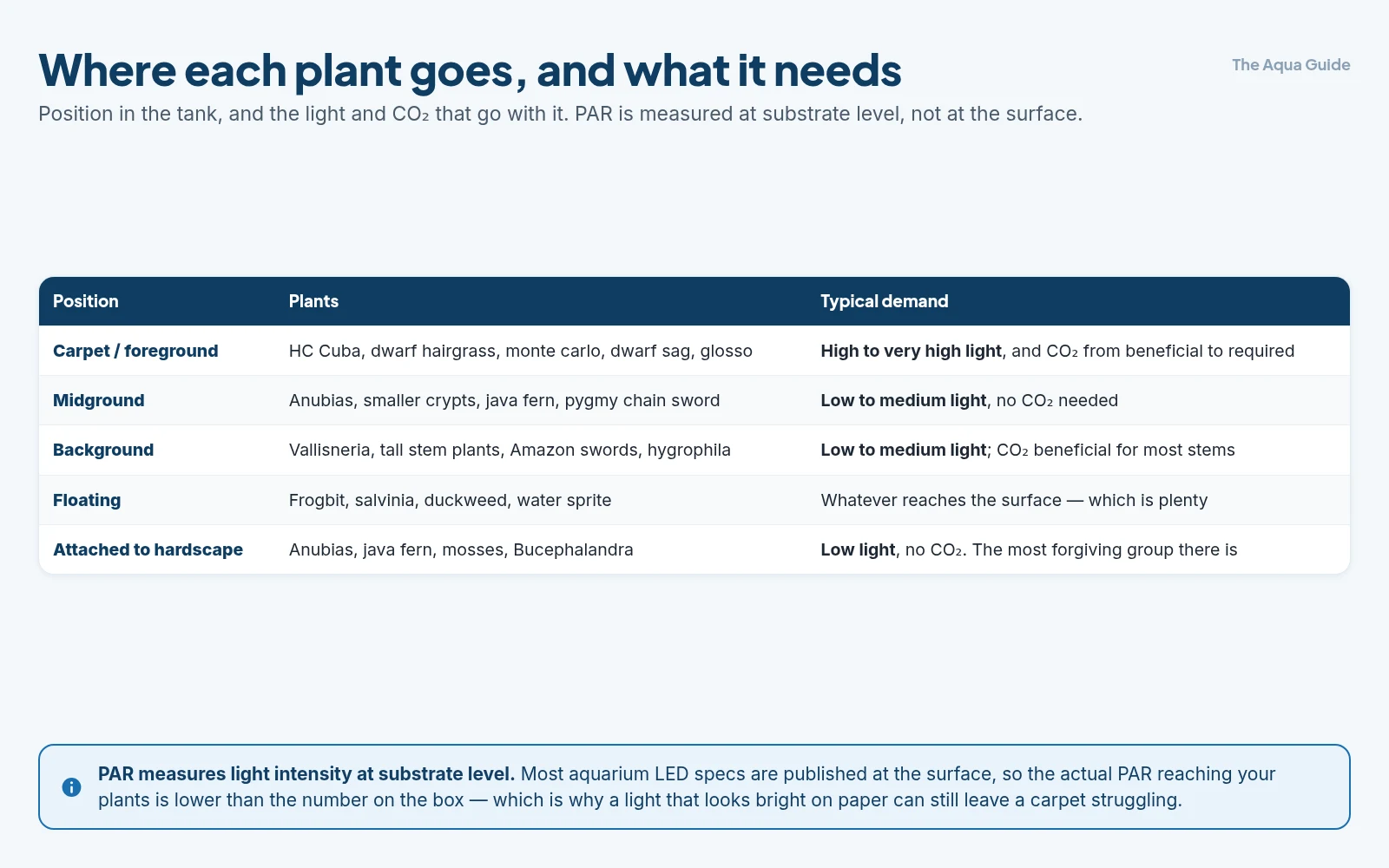
Note: PAR (Photosynthetically Active Radiation) measures light intensity at substrate level. Most aquarium LEDs published specs are at the surface — actual substrate PAR is lower.
CO2 Categories
| Category | Plants |
|---|---|
| CO2 Not Required | Java fern, anubias, mosses, vals, hornwort, Amazon swords, crypts |
| CO2 Beneficial | Most stem plants, dwarf hairgrass, monte carlo, dwarf sag |
| CO2 Required | HC Cuba, Glossostigma, Riccia, Macrandra, most red plants for full color |
Position in Tank
| Position | Examples |
|---|---|
| Carpet/Foreground | HC Cuba, dwarf hairgrass, monte carlo, dwarf sag, glosso |
| Midground | Anubias, smaller crypts, java fern, pygmy chain sword |
| Background | Vallisneria, tall stem plants, Amazon swords, hygrophila |
| Floating | Frogbit, salvinia, duckweed, water sprite |
| Attached to hardscape | Anubias, java fern, mosses, Bucephalandra |
Common Plant Problems
Yellowing leaves → Iron deficiency (most common) or nitrogen deficiency
Holes in leaves → Potassium deficiency
Pale new growth → Iron deficiency
Slow growth, struggling plants → Insufficient light or CO2
Algae on plants → Too much light, not enough plant mass
Plants melting → Adjustment to new tank conditions, especially crypts
Leaves falling off stems → Too much nutrients, parameters off
Plant Compatibility With Fish
Most plants are fine with most fish, but exceptions:
Plant-eaters to watch for:
- Goldfish — eat most plants
- Silver dollars — eat most plants
- Some plecos (rubbernose, others) — graze on plants
- Some cichlids — uproot or chew plants
Plant-safe even with eaters: Anubias, java fern (tough leaves, less palatable).
Burrowing fish that uproot plants:
- Most cichlids
- Goldfish
- Loaches (some)
Tip: Anchor plants well, especially when first planted. Some plants need to be tied to hardscape to survive uprooters.
The Bottom Line
Match plants to your conditions, not the other way around. Beginner low-light low-tech tanks: java fern, anubias, mosses, crypts, vals, swords — all forgiving and rewarding. Intermediate tanks: add some stem plants (bacopa, hygrophila, rotala) and a beginner carpet plant (marsilea, monte carlo with CO2). High-tech CO2 tanks: the full range opens up — HC Cuba, vibrant reds, demanding carpets, Dutch-style colorful stems. Floating plants (frogbit, salvinia, water sprite) work in any tank as nutrient absorbers. Light needs: low (10-20 PAR), medium (20-40), high (40+). CO2 needs: not required (most beginner plants), beneficial (most stems and carpets), required (high-tech demanding species). Most plant problems trace to nutrient deficiencies (iron most common) or light mismatches. Some fish damage plants — check before buying for plant-heavy setups. Match plants to your specific water and lighting conditions for best results.
Related guides
- The beginner's guide to live aquarium plants
- The easiest fast-growing plants for beginners
- How to plant and anchor aquarium plants
- Floating and carpeting plants for beginners
- Do I need CO₂, fertiliser and special lighting?
- Advanced fertilisation: dosing methods for planted tanks
- Why are my plant leaves melting or yellowing?
- Aquarium lighting basics: brightness and photoperiod
Got questions about your specific setup? Drop them in our Community Forum — we love helping new fishkeepers get started right.