The single most-referenced document for any serious fishkeeper. This is the quick lookup for water parameters — target ranges, what they mean, species-specific preferences, and how to troubleshoot when things go off. Bookmark this page; you'll return to it regularly.
At a glance: how often to test
| When | What to test | Why |
|---|---|---|
| While cycling a new tank | Ammonia, nitrite and nitrate, every couple of days | The readings are how you know where the cycle has got to |
| Weekly, in an established tank | Nitrate — and ammonia and nitrite if anything looks off | Nitrate is the one that climbs on its own between water changes |
| After any change | Ammonia and nitrite | New fish, a filter clean, a heater failure or a big water change can all disturb the colony |
| When something looks wrong | Everything, before you treat anything | Many "diseases" are water quality, and a test costs nothing but a few minutes |
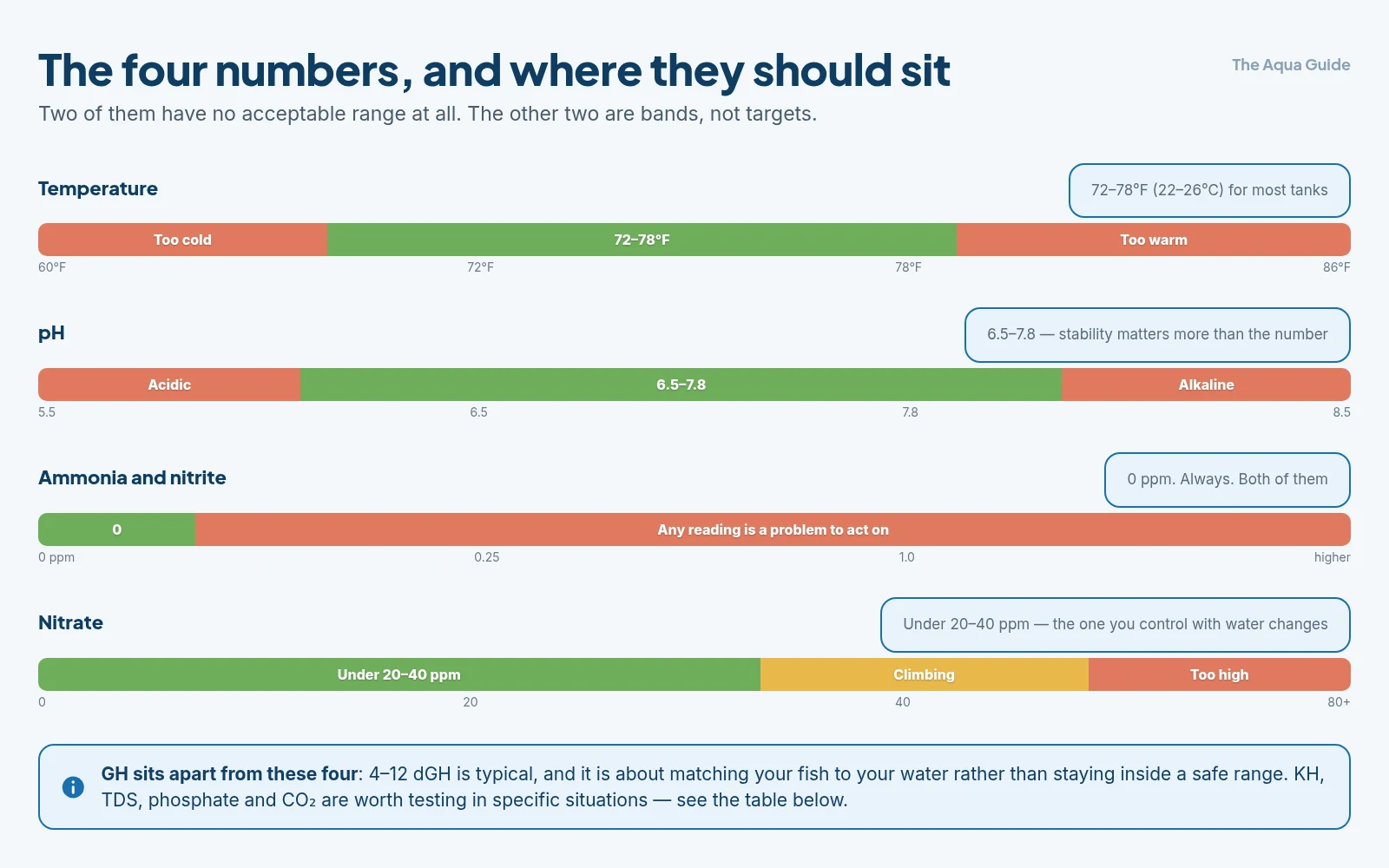
Two of the six have no acceptable range at all. Ammonia and nitrite must read zero — any reading is a signal to act, not a number to tolerate.
The Six Critical Parameters
Every aquarium keeper needs to monitor:
| Parameter | Tests | Healthy Range (Most Tanks) | What It Means |
|---|---|---|---|
| Temperature | Thermometer | 72-78°F (22-26°C) | Heat for tropical fish; affects metabolism |
| pH | Liquid test | 6.5-7.8 | Acidity/alkalinity; matters for species choice |
| Ammonia (NH₃) | Liquid test | 0 ppm | Toxic waste from fish/decay; must be zero |
| Nitrite (NO₂) | Liquid test | 0 ppm | Intermediate cycle product; must be zero |
| Nitrate (NO₃) | Liquid test | <20-40 ppm | End cycle product; can build up |
| GH (general hardness) | Liquid test | 4-12 dGH typical | Dissolved Ca/Mg minerals |
Other parameters matter sometimes:
| Parameter | When to Test | Healthy Range |
|---|---|---|
| KH (carbonate hardness) | If pH unstable, planted tanks | 3-10 dKH |
| TDS (total dissolved solids) | RO water, shrimp keeping | 150-250 ppm typical |
| Phosphate (PO₄) | Planted tanks, algae issues | 0.5-2 ppm |
| CO₂ | High-tech planted tanks | 20-30 ppm |
Quick Species Reference
Target parameters by species group:
Hardy Beginner Fish (Wide Tolerance)
Guppies, platies, mollies, swordtails (Livebearers):
- Temp: 72-82°F
- pH: 7.0-8.2 (prefer slightly alkaline)
- GH: 8-20 (prefer hard water)
- Nitrate: <40 ppm
Goldfish:
- Temp: 65-75°F (cool water!)
- pH: 7.0-8.0
- GH: 6-20
- Nitrate: <40 ppm
Danios (zebra, leopard, pearl):
- Temp: 68-78°F
- pH: 6.5-7.5
- GH: 5-15
- Nitrate: <30 ppm
Tropical Community Fish
Tetras (neon, cardinal, ember, glowlight):
- Temp: 74-80°F
- pH: 5.5-7.0 (prefer soft acidic)
- GH: 1-8 (prefer soft)
- Nitrate: <20 ppm
Corydoras catfish:
- Temp: 72-78°F
- pH: 6.0-7.5
- GH: 2-12
- Nitrate: <30 ppm
Rasboras (harlequin, chili, ember):
- Temp: 73-80°F
- pH: 6.0-7.5
- GH: 2-10
- Nitrate: <20 ppm
Gouramis:
- Temp: 74-82°F
- pH: 6.0-7.5
- GH: 4-10
- Nitrate: <30 ppm
Demanding Species
Discus:
- Temp: 82-86°F (warm!)
- pH: 5.5-6.5 (acidic)
- GH: 1-5 (very soft)
- TDS: <200 ppm
- Nitrate: <10 ppm
Wild-caught tetras and apistogramma:
- Temp: 76-82°F
- pH: 5.0-6.5
- GH: 1-5
- TDS: <150 ppm
Crystal shrimp (Caridina):
- Temp: 68-76°F (cool)
- pH: 5.8-6.8
- GH: 4-6
- KH: 0-2
- TDS: 100-150 ppm
Cherry shrimp (Neocaridina):
- Temp: 65-80°F (very wide)
- pH: 6.5-8.0
- GH: 6-12
- KH: 2-5
- TDS: 150-250 ppm
African Cichlids
Lake Malawi (mbuna, peacock):
- Temp: 76-82°F
- pH: 7.8-8.6 (alkaline!)
- GH: 12-20 (very hard)
- KH: 10-18
Lake Tanganyika:
- Temp: 76-82°F
- pH: 8.0-9.0
- GH: 15-25
- KH: 12-20
Parameter-by-Parameter Detail
Temperature
Most tropical fish: 72-78°F (22-26°C) Cool water (goldfish, hillstream loaches): 65-72°F Warm water (discus, some gouramis): 80-84°F Brackish: 75-82°F Saltwater (reef): 75-78°F (stable!)
Tip: Stability matters more than the exact number within range. Fluctuations of 4°F+ stress fish.
pH (Acidity/Alkalinity)
- Below 6.0: Very acidic — only specialty soft-water species
- 6.0-6.8: Soft acidic — many wild tetras, discus, apistogramma
- 6.8-7.2: Slightly acidic to neutral — most community fish
- 7.2-7.8: Slightly alkaline — livebearers, many community fish
- 7.8-8.5: Alkaline — African cichlids
- Above 8.5: Very alkaline — limited species, possible problem
Tip: Stable pH matters more than chasing a specific number. Don't mess with pH unless necessary.
Ammonia (NH₃)
Always 0 ppm in established tank.
- 0.25 ppm = stressed fish, immediate action needed
- 0.5+ ppm = toxic, water change immediately
- 1+ ppm = emergency, fish dying possible
Source: fish waste, decaying food, dead fish/plants. Indicator of cycling problems or overstock.
Nitrite (NO₂)
Always 0 ppm in established tank.
- 0.25 ppm = mini-cycle happening, monitor closely
- 0.5+ ppm = toxic, water change needed
- 1+ ppm = emergency
Source: bacterial conversion from ammonia. Indicates cycle disruption.
Nitrate (NO₃)
Healthy range: <20 ppm (excellent), 20-40 ppm (acceptable), >40 ppm (high), >80 ppm (problematic)
Source: end product of nitrogen cycle. Builds up between water changes. Reduce via: water changes, plants, less feeding.
GH (General Hardness)
Dissolved calcium and magnesium minerals. Measured in dGH or ppm.
- 0-4 dGH (0-70 ppm): Very soft — for soft-water species
- 4-8 dGH (70-140 ppm): Soft — wide compatibility
- 8-12 dGH (140-210 ppm): Medium-hard — community fish, livebearers
- 12-18 dGH (210-320 ppm): Hard — African cichlids
- 18+ dGH (320+ ppm): Very hard — only specialty hard-water species
Tip: GH affects plant growth and snail shells. Most plants prefer 4-12 dGH.
KH (Carbonate Hardness)
Buffering capacity — resistance to pH changes. Measured in dKH.
- 0-2 dKH: Very low — pH unstable, use for soft-water tanks with caution
- 3-8 dKH: Normal range for most tanks
- 8-15 dKH: High — African cichlids, hard water tanks
- 15+ dKH: Very high — rare
Important: Low KH causes pH swings. If pH varies, check KH first.
TDS (Total Dissolved Solids)
Total dissolved minerals in water. Measured in ppm.
- 0-5 ppm: Pure RO water — must be remineralized before use
- 50-150 ppm: Soft water tanks, shrimp tanks
- 150-300 ppm: Most freshwater tanks
- 300-500 ppm: Hard water tanks
- 500+ ppm: Very hard, limited species
Used primarily by shrimp and saltwater keepers for precise control.
Troubleshooting Common Issues
pH Suddenly Crashed
- Check KH — likely too low (under 2 dKH)
- Adding crushed coral or seachem KH buffer
- Check water source — has it changed?
pH Won't Stay Stable
- KH too low — add buffer
- Tank has too much organic matter — water change
- Driftwood releasing tannins acidifying water — normal for some setups
Ammonia Appearing in Established Tank
- Mini-cycle from disrupted bacteria (cleaning filter media in tap water?)
- Dead fish or plant decaying
- Sudden overstocking
- Filter failure
Nitrate Constantly High
- More frequent or larger water changes
- Reduce stocking
- Add live plants
- Reduce feeding
GH Too High in Soft Water Tank
- Use RO water diluted with tap
- Remove substrate that adds hardness (coral, limestone)
- Add peat or driftwood (slow acidification)
Temperature Swings
- Heater issue — test it
- Room temperature affecting tank
- Heater too small for tank size
- Heater placement (away from filter intake)
Testing Frequency
For an established tank:
- Daily checks: Just temperature visual (digital thermometer)
- Weekly: Ammonia, nitrite, nitrate
- Monthly: pH, GH, KH (for stable established tanks)
- As needed: When something looks off, when adding new fish, after equipment changes
For a new/cycling tank:
- Daily for first 2 weeks: Ammonia, nitrite
- Every 2-3 days through cycle: Add nitrate
- Weekly until stable: All standard parameters
Test Kit Recommendations
API Freshwater Master Test Kit: Standard beginner kit; covers ammonia, nitrite, nitrate, pH. ~$30.
API Saltwater Master Test Kit: Includes calcium and alkalinity for marine.
API GH/KH Test Kit: Add-on for hardness testing.
Salifert / Red Sea / Hanna instruments: Higher accuracy for serious keepers.
Avoid test strips for serious work: Convenient but less accurate. Use for quick checks only.
The Bottom Line
Six critical parameters to monitor: temperature (72-78°F most tropical), pH (6.5-7.8 typical, stable more than ideal), ammonia (always 0 ppm), nitrite (always 0 ppm), nitrate (<20-40 ppm), and GH (4-12 most species). Species-specific targets vary — softwater fish (tetras, discus) need pH 5.5-7, GH 1-8; livebearers want pH 7-8.2, GH 8-20; African cichlids need pH 7.8-8.6, GH 12-20. Stability matters more than chasing exact numbers. Test weekly for cycle parameters; monthly for hardness/pH; daily during cycling or troubleshooting. Common problems: pH crashes from low KH, nitrate buildup from overstocking, ammonia spikes from mini-cycles. Use this cheat sheet as your reference — quick lookup, no need to re-read full articles.
Related guides
- What are safe ammonia, nitrite and nitrate levels?
- Understanding pH, KH and GH
- How to use a liquid test kit (and why strips fail)
- Aquarium water quality: the complete guide
- Tap, RO and remineralised water explained
- Heater sizing and placement
- My pH keeps crashing — what do I do?
- How often should you do a water change — and how much?