Every fishkeeping community has its own jargon — acronyms, scientific terms, slang. This is the glossary for understanding forum discussions, video tutorials, product descriptions, and articles. Alphabetical for quick lookup.
At a glance: the acronyms
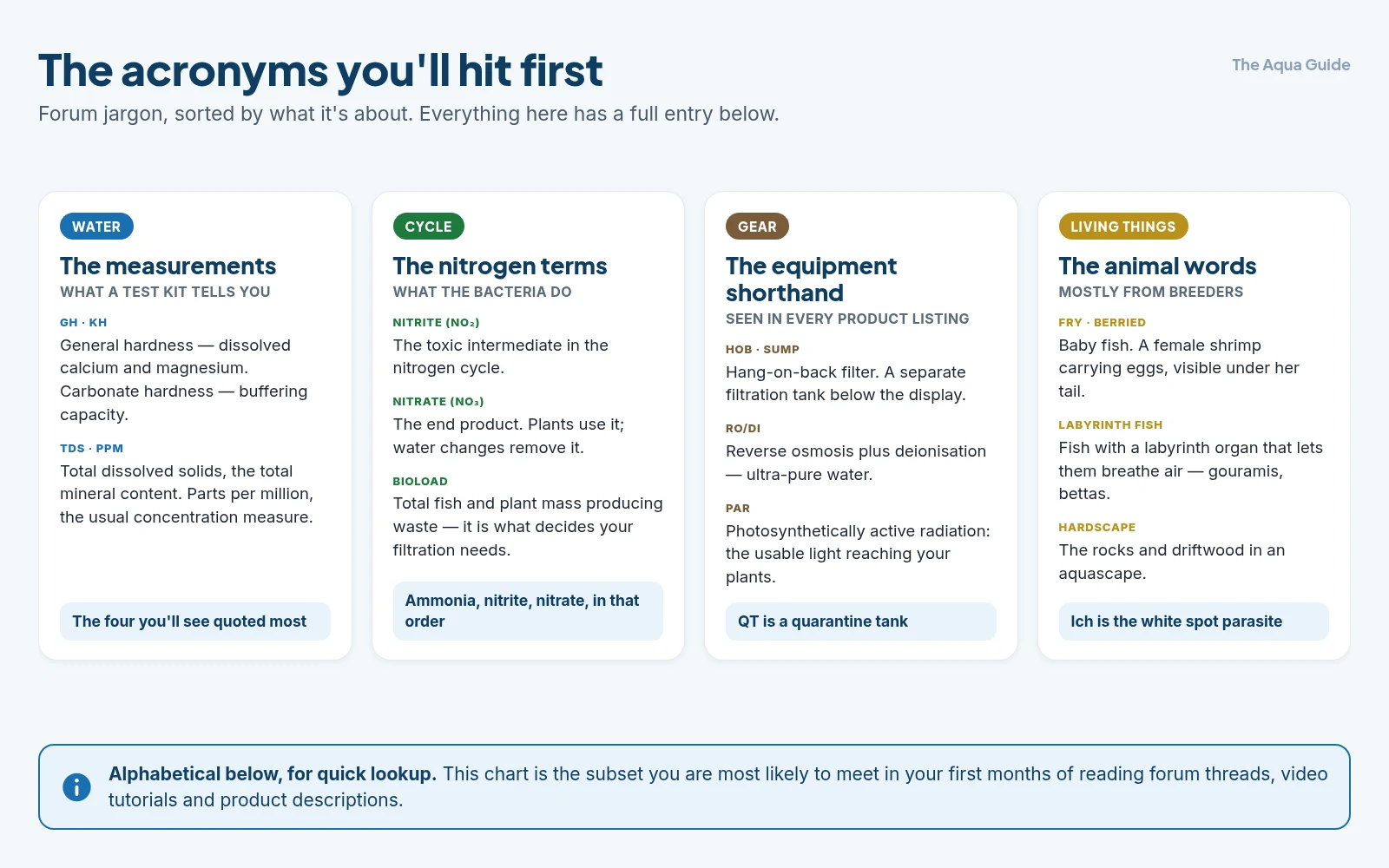
| Short | Stands for |
|---|---|
| GH | General hardness — dissolved calcium and magnesium |
| KH | Carbonate hardness — buffering capacity |
| TDS | Total dissolved solids — total mineral content |
| ppm | Parts per million — the usual concentration measure |
| HOB | Hang-on-back filter |
| RO/DI | Reverse osmosis plus deionisation — ultra-pure water |
| PAR | Photosynthetically active radiation — usable light for plants |
| QT | Quarantine tank |
| AIO | All-in-one — an aquarium with built-in filtration in a back chamber |
| ADA | Aqua Design Amano, the Japanese aquascape company |
Full entries for all of these, and everything else, are alphabetical below.
A
Acclimation — Slowly adjusting new fish to your tank's water (temperature, parameters) before releasing them.
ADA — Aqua Design Amano; influential Japanese aquascape company founded by Takashi Amano. Also refers to their products and styles.
Adipose fin — Small fleshy fin on the back of some fish (corydoras, tetras) between dorsal and tail.
Aeration — Adding oxygen to water; typically via airstone or surface agitation.
Airstone — Porous stone that diffuses air into fine bubbles.
Algae — Photosynthetic organisms (plants and bacteria) that grow in tanks. Common types: green, brown (diatoms), black beard, hair, GSA, GDA.
All-in-one (AIO) — Aquarium with built-in filtration in a separate back chamber.
Ammonia (NH₃) — Toxic fish waste; first stage of nitrogen cycle; should be 0 in established tanks.
Anabantoid / Anabantid — Fish with labyrinth organ allowing air-breathing (gouramis, bettas).
Anaerobic — Without oxygen; dangerous in substrate (gas buildup, toxic compounds).
Aquascape — Designed aquatic landscape; deliberately arranged hardscape + plants.
Aquarium controller — Computer system monitoring/controlling tank parameters (Apex, etc.).
Aquasoil — Specialized substrate for planted tanks (ADA, Tropica, Fluval Stratum); contains nutrients, lowers pH.
B
Beneficial bacteria — Bacteria converting ammonia → nitrite → nitrate; the heart of the nitrogen cycle.
Berried — Female shrimp carrying eggs (visible under tail).
Biotope — Recreating a specific natural environment with appropriate species, substrate, hardscape.
Bioload — Total fish/plant mass producing waste; affects filtration needs.
Biofilm — Microscopic life film on surfaces; essential for fry, shrimp; primary algae food source.
Blackwater — Tannin-stained water; mimics natural acidic environments (Amazon, Southeast Asian rivers).
Bristlenose — Type of pleco (Ancistrus) with bristles on face; smaller than common plecos.
Bubble nest — Foam structure built by bettas and gouramis for egg-laying.
C
Caridina — Genus of shrimp including crystal shrimp, bee shrimp, tiger shrimp.
Carbon (Activated carbon) — Filter media that adsorbs organics, tannins, medications.
Caretaker fish / Algae eater — Fish that consume algae (otocinclus, plecos, some catfish).
Centerpiece fish — A standout, often larger fish that's the visual focus.
Cherry shrimp — Common name for Neocaridina davidi var. red; popular beginner shrimp.
Chloramine — Combined chlorine + ammonia in tap water; harder to remove than chlorine alone.
Cleanup crew (CUC) — Algae eaters, scavengers, snails that help maintain the tank.
CO2 — Carbon dioxide; required for photosynthesis; injected in high-tech planted tanks.
Coldwater fish — Fish needing temps below 72°F (goldfish, white clouds, hillstream loaches).
Community tank — Multi-species peaceful tank.
Coral — Marine invertebrate; key feature of reef tanks.
Cory — Short for corydoras catfish.
CRS — Crystal Red Shrimp.
Cryptocoryne / Crypt — Genus of beginner-friendly aquarium plants.
Cycle / Cycling — Establishing nitrogen cycle in new tank; takes 4-6 weeks.
D
Dechlorinator — Liquid removing chlorine/chloramine from tap water.
DGH / dGH — Degrees of General Hardness (1 dGH = 17.86 ppm). Common hardness measure.
dKH — Degrees of Carbonate Hardness; buffering capacity.
DI — Deionization; produces extremely pure water.
Diatom — Brown algae often appearing in new tanks; harmless; fades.
Diffuser — Device dispersing CO2 into fine bubbles in water.
Discus — Large flat round cichlid; demanding species.
Display tank — The main viewing aquarium.
Drop checker — Device measuring CO2 levels; color changes indicate concentration.
Dropsy — Disease causing internal fluid buildup; pinecone scales.
Dry start — Method of growing carpet plants without water before flooding tank.
E
EI — Estimative Index; fertilization method dosing macros + micros 3x/week with weekly water changes.
Eheim — Long-established German aquarium equipment brand.
Endler — Endler's livebearer; small colorful livebearer related to guppies.
Epiphyte — Plant growing on hardscape (anubias, java fern); rhizome must not be buried.
F
Filter cycling — Establishing nitrogen-cycling bacteria in filter media.
Filter media — Materials inside filter (sponge, ceramic, carbon).
Fishless cycling — Cycling without fish, using ammonia.
Flashing — Fish rubbing against objects; sign of parasites or stress.
Flow — Water movement; important for some species.
Fluidized bed filter — Filter with bio media constantly tumbling.
Foreground — Front of tank; usually short plants or carpet.
Free swimming — Fry that have absorbed yolk sac and now swim/feed independently.
Fry — Baby fish.
FOWLR — Fish-Only With Live Rock (saltwater).
G
GH — General hardness; measures dissolved calcium/magnesium.
Gluteraldehyde — Active ingredient in liquid carbon (Excel); algicide.
Goldfish — Coldwater fish; common but demanding.
Gourami — Anabantoid fish; many community species (dwarf, pearl, blue).
Gravel vacuum — Siphon device for cleaning substrate during water changes.
Greenwater — Free-floating algae causing water to appear green; can be controlled with UV.
H
Hairgrass — Carpet plant (Eleocharis); blades of grass-like leaves.
Hardscape — Rocks and driftwood in an aquascape.
Hatchery (brine shrimp) — DIY setup for hatching baby brine shrimp.
HC Cuba — Hemianthus callitrichoides; carpet plant requiring CO2.
Heat sink — Aquarium location absorbing heat; sometimes used to describe heater behavior.
HOB — Hang-On-Back filter.
Hospital tank — Separate tank for treating sick fish.
I
Ich (Ick) — Ichthyophthirius multifiliis; white spot parasite.
Inert — Not releasing minerals or affecting chemistry; opposite of buffering.
Inline diffuser — CO2 diffuser placed in canister filter line.
Iwagumi — Minimalist aquascape style; 3, 5, or 7 stones with carpeting plant.
J
Java fern — Hardy beginner plant attached to hardscape.
Java moss — Hardy moss for hardscape attachment.
K
KH — Carbonate hardness; buffering capacity.
L
Labyrinth fish — Fish with labyrinth organ for air-breathing (gouramis, bettas).
LED — Light Emitting Diode; modern aquarium lighting.
Lighting period (photoperiod) — How long lights are on; typically 8-10 hours.
Liquid carbon — Glutaraldehyde-based; cheap alternative to CO2 for low-light plants.
Live food — Living food organisms (brine shrimp, daphnia, microworms).
Live rock — Marine rock colonized with beneficial organisms.
M
Macros / Macronutrients — Nitrogen, phosphorus, potassium for plants.
Mature tank — Established 6+ months; biological filtration robust.
Methylene blue — Antifungal/antiparasitic; for eggs and mild fungus.
Micros / Micronutrients — Iron, manganese, zinc, copper, boron, molybdenum.
Midground — Middle area of tank; medium-height plants.
Mini-cycle — Brief ammonia/nitrite spike from cycle disruption.
Mulm — Detritus, fish waste, decaying organic matter; not all bad — contains beneficial bacteria.
N
N — Nitrogen.
Nano — Small tank (typically under 10 gallons).
Neocaridina — Genus including cherry shrimp; hardy beginner shrimp.
Neritina — Genus of nerite snails; algae eaters.
Nitrate (NO₃) — End product of nitrogen cycle; plants use; removed by water changes.
Nitrite (NO₂) — Toxic intermediate in nitrogen cycle.
Nitrogen cycle — Bacterial conversion of ammonia → nitrite → nitrate.
O
Otocinclus / Otto — Small algae-eating catfish.
Overfeeding — Most common beginner mistake; causes ammonia, algae, fish issues.
Overflow — Pipe or chamber removing water from display tank to sump.
Oxygenation — Dissolved oxygen in water; affected by surface agitation, temperature.
P
P — Phosphorus.
PAR — Photosynthetically Active Radiation; measures usable light for plants.
Parasite — Organism living on/in host; ich, velvet, gill flukes are common aquarium parasites.
Pearling — Plants visibly releasing oxygen bubbles during strong photosynthesis.
Pectoral fin — Side fins (like arms).
pH — Acidity/alkalinity measure; scale 0-14, 7 is neutral.
Pleco — Plecostomus; armored catfish; many species.
ppm — Parts per million; common concentration measure.
ppt — Parts per thousand; common salinity measure.
Power filter — Filter with internal pump (HOB or internal).
PPS / PPS-Pro — Perpetual Preservation System; precise daily fertilization method.
Praziquantel — Antiparasitic medication for flukes, internal worms.
Protein skimmer — Saltwater equipment removing organic compounds.
Q
Quarantine — Isolating new fish in separate tank before adding to display.
QT — Quarantine tank.
R
Rack — Multiple stacked tanks (breeding setup).
Refugium — Sump chamber with macroalgae, copepods; natural filtration.
Remineralizer — Salts added to RO water to restore minerals.
Reverse osmosis (RO) — Water filtration removing dissolved minerals.
Reef tank — Marine aquarium with corals + fish + invertebrates.
Rescape — Major redesign of an aquascape.
Rhizome — Modified stem of epiphytic plants (anubias, java fern); must not be buried.
Riparium — Tank with plants growing partially above water.
RO/DI — Reverse Osmosis + Deionization; ultra-pure water.
S
Salinity — Dissolved salt content; measured in ppt or specific gravity.
Salt — Aquarium salt (NaCl); not the same as marine salt mix (contains many minerals).
Saltwater — Marine aquarium; salinity 30-35 ppt.
Schooling fish — Species requiring groups (6+) to thrive.
Sg (Specific gravity) — Density measure for saltwater (1.024-1.026 typical).
Shoal — Group of fish (loose schooling).
Slime coat — Mucus layer on fish skin; defense against pathogens.
Solenoid — Electric valve; common in CO2 systems for automated on/off.
SPS (Stony Polyp Stony) — Hard coral with small polyps (Acropora).
Stem plant — Plant grown from cut stem (most planted tank stems).
Substrate — Bottom material (sand, gravel, aquasoil).
Sump — Separate filtration tank below display.
T
Tank cycling — See nitrogen cycle.
Tannins — Compounds from wood/leaves tinting water amber.
TDS — Total Dissolved Solids; total mineral content.
Tetra — Family of small schooling community fish.
Top off — Adding fresh water to replace evaporation.
U
UV sterilizer — UV light unit killing free-floating organisms.
V
Vallisneria / Val — Grass-like aquarium plant.
Velvet — Oodinium parasitic disease; gold/brown dusting.
W
Wabi-kusa — Japanese-style emergent plant compositions.
Water column — The body of water itself, distinguishing from substrate.
Water change — Removing/replacing tank water; primary maintenance task.
Water conditioner — Dechlorinator + sometimes other additives.
X-Y-Z
Xenia — Type of soft coral; pulsing motion.
Yolk sac — Reserve fry rely on for first days post-hatching.
Zebra fish — Common name; usually refers to zebrafish (danio).
Zone — Distinct ecological area in a tank (territory, hiding spot).
Common Acronyms
ADA — Aqua Design Amano AIO — All-in-one ATO — Auto top-off BBS — Baby brine shrimp CRS — Crystal Red Shrimp EI — Estimative Index FOWLR — Fish-Only With Live Rock GH — General Hardness GFO — Granular Ferric Oxide GSA — Green Spot Algae HOB — Hang-On-Back filter KH — Carbonate Hardness LFS — Local Fish Store LPS — Large Polyp Stony coral N, P, K — Nitrogen, Phosphorus, Potassium PAR — Photosynthetically Active Radiation PPM — Parts Per Million PPT — Parts Per Thousand QT — Quarantine Tank RO — Reverse Osmosis SPS — Small Polyp Stony coral TDS — Total Dissolved Solids UV — Ultraviolet (sterilizer)
The Bottom Line
This glossary covers most fishkeeping jargon you'll encounter — acronyms (TDS, KH, GH, PAR, EI), scientific terms (epiphyte, anabantoid, periphyton), product categories (aquasoil, dechlorinator, protein skimmer), and slang (pearling, mulm, slime coat). Use it as a lookup when reading articles, forums, or product descriptions. Some terms have variations across regions and communities — context usually clarifies. Beyond this glossary, specialized subfields (shrimp keeping, biotope, planted tanks, saltwater) have their own deeper jargon — encountered as you specialize. Bookmark this page for when you encounter unfamiliar terms in your fishkeeping journey.
Related guides
- The complete fishkeeping reference library
- Water parameters cheat sheet
- Understanding pH, KH and GH
- How does the aquarium nitrogen cycle work?
- Choosing the right filter: HOB vs sponge vs canister
- Common aquarium diseases: treatment lookup
- Fish compatibility quick reference
- Aquarium plants quick reference
Got questions about your specific setup? Drop them in our Community Forum — we love helping new fishkeepers get started right.