After dozens of detailed guides covering every aspect of fishkeeping, you sometimes just need a quick lookup — what's the right pH for neon tetras? Can I keep angelfish with corydoras? What does it mean when my fish is flashing? This is the hub for quick-reference content: cheat sheets, lookup tables, glossaries, and templates designed for fast answers rather than deep reading. Each topic below opens into a detailed reference article. Bookmark this page; you'll come back to it.
At a glance: which to reach for
| If you... | Use... |
|---|---|
| Know the question and want the number | A reference table — parameters, compatibility, group sizes, plant demands |
| Don't yet know what's wrong | A detailed guide, which explains the shape of the problem before the figures |
| Are standing at the tank with a test kit | Reference. It is built to be scanned, not read |
| Are planning something new | Guides first, then reference to check the specifics |
Reference content assumes you already know what you are asking. When you don't, it gives you numbers without meaning — which is worse than no answer.
Why a Reference Library
Long-form articles are great for learning new concepts. But once you understand the fundamentals, what you need most often is quick answers:
- "What temperature do mollies prefer?"
- "Are guppies compatible with angelfish?"
- "What plant grows well in low light?"
- "My fish has white spots — what is it?"
- "When should I do my next water change?"
You don't want to re-read a 2,000-word article every time. You want a table, a lookup, a checklist. That's what reference content provides.
The articles in this section are deliberately structured as lookups, tables, and quick-reference summaries — designed to be scanned, not read end-to-end.
What's in This Library
Water Parameters Cheat Sheet
The single most-referenced document for serious fishkeepers. Includes:
- Target ranges for pH, temperature, GH, KH, ammonia, nitrite, nitrate
- Species-specific preferences
- What different levels mean and how to adjust them
- Quick troubleshooting (parameter X is too high/low — common causes)
Use this for: planning a new species, troubleshooting issues, regular testing reference.
Fish Compatibility Quick Reference
Tables of which species play well together and which don't:
- Community vs semi-aggressive vs aggressive fish
- Top/middle/bottom dwellers and how they share space
- Size compatibility matrix
- Common gotchas (fish marketed as compatible but actually aren't)
Use this for: stocking decisions, adding new fish to existing tanks, planning community setups.
Aquarium Plants Quick Reference
Plant species at a glance:
- Beginner / intermediate / advanced difficulty
- Light requirements (low / medium / high)
- CO2 needs (none / optional / required)
- Position in tank (foreground / midground / background / floating / attached)
- Growth rate and trim frequency
Use this for: planning a planted tank, choosing plants for your conditions, identifying plants in stores.
Common Aquarium Diseases & Treatment Lookup
Disease identification by symptom:
- Visual symptoms → likely disease
- Cause (parasite / bacterial / fungal / environmental)
- Treatment approach
- Severity and contagiousness
Use this for: when something looks wrong with your fish, quick triage decisions, deciding when to quarantine.
Maintenance Schedule Templates
Pre-built schedules you can adapt:
- Daily checks (5 minutes)
- Weekly maintenance routine
- Monthly tasks
- Quarterly deep cleans
- Adapted for different tank types (community, planted, shrimp, saltwater)
Use this for: building your maintenance habit, ensuring nothing is forgotten, training new family members on tank care.
Aquarium Equipment Glossary
Every piece of equipment, explained briefly:
- What it is
- What it does
- When you need it
- Beginner / advanced / specialty categorization
Use this for: shopping, understanding what's in others' tanks, deciphering forum discussions, deciding what equipment matters for your goals.
Aquarium Terms Glossary
Common fishkeeping jargon:
- Acronyms (TDS, KH, GH, ppm, NPK, EI, RO)
- Technical terms (cycling, mulm, biofilm, tannins)
- Slang and informal terms
- Latin species names (basic identification)
Use this for: understanding forum discussions, video tutorials, product descriptions, and articles.
How to Use Reference Content
A few suggestions:
Bookmark your most-used pages. Different keepers reference different content. For shrimp keepers, water parameters. For planted tank keepers, plants. For community tanks, compatibility.
Print or save offline. Some keepers print the maintenance schedule and put it on the tank stand. Others save the cheat sheets to their phones for quick reference in stores.
Use in real-time. When standing in a fish store wondering if a new fish fits your tank, pull up compatibility. When testing water and getting unusual readings, pull up parameters.
Cross-reference with detailed guides. Reference content is for quick answers. When something is complicated, the linked detailed guides give the full picture.
Update over time. Some references (like compatibility) are based on patterns and exceptions exist. As you learn your specific fish, you'll develop personal preferences that may differ from generic charts.
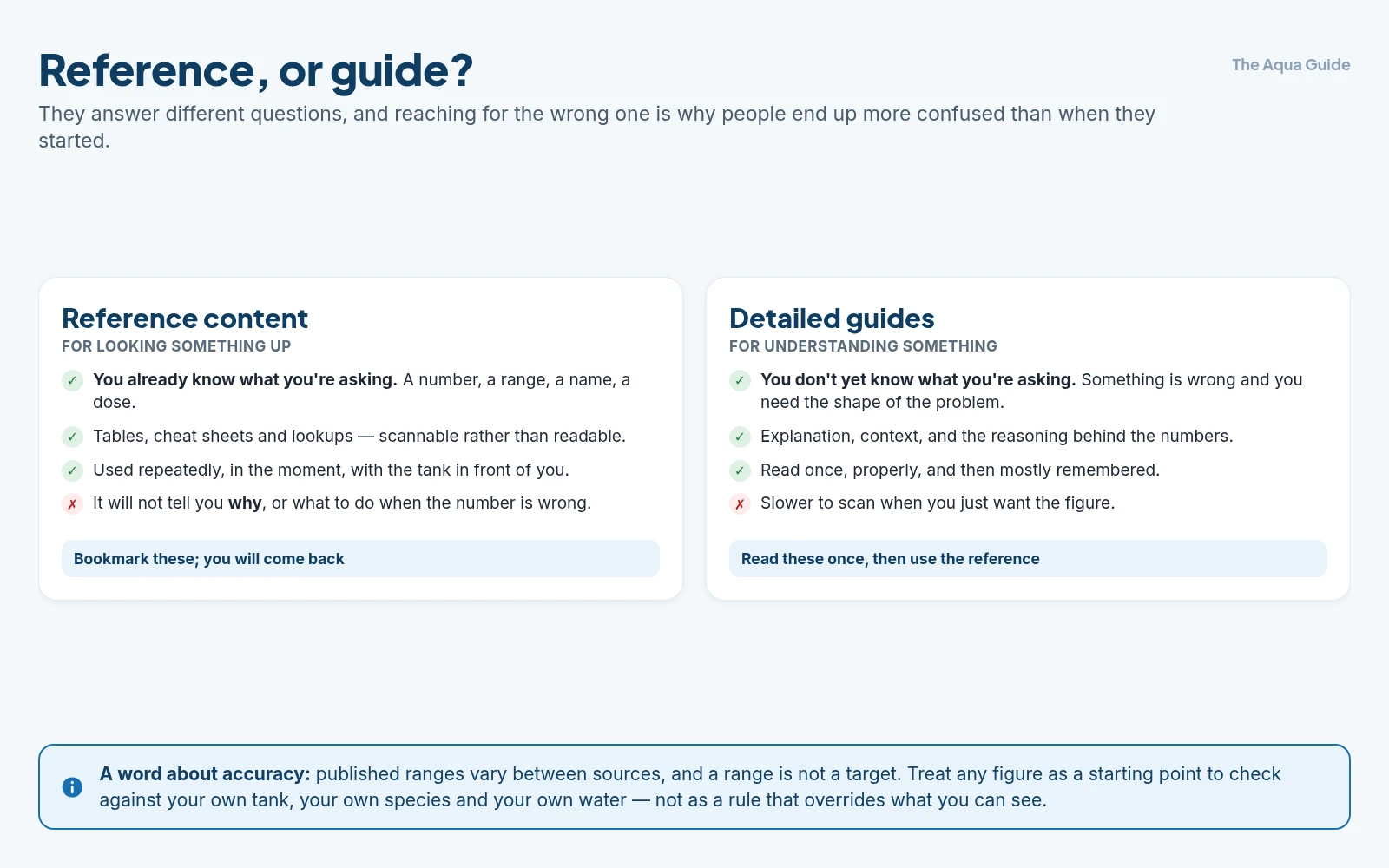
Reference Library vs. Detailed Guides
A useful distinction for navigation:
When you need to learn: Read the detailed guides. Cycling, equipment, breeding, aquascaping all have full-length articles that teach concepts properly.
When you need to look up: Use the reference library. Fast answers to specific questions.
Both serve different purposes. The detailed guides build understanding; the reference library serves established understanding with quick recall.
What's NOT in the Reference Library
To set expectations:
Not opinions. References are factual — parameters, compatibility patterns, taxonomic information. Style choices ("which substrate is best?") belong in the detailed guides.
Not exhaustive lists. No reference can include every species, every plant, every disease. We focus on common keeper-relevant entries. Rare species often need specialty research.
Not substitute for observation. Even the best reference can't tell you what's actually happening in your tank. Your observation of your fish, plants, and water is always primary; references support that, don't replace it.
Not a substitute for community. Online communities, local clubs, and experienced keepers know things no reference captures. The library helps you ask better questions, not replace the asking.
A Word About Accuracy
Reference content tries to be accurate, but the hobby evolves:
Species reclassifications. Latin names sometimes change as biology refines.
New medications. Treatment options grow over time.
Updated compatibility insights. Sometimes long-held wisdom proves wrong.
Local variations. Tap water composition, available species, and seasonal factors vary by region.
Treat references as starting points — accurate generally but worth verifying for specifics, especially for important decisions like new species or significant treatment choices.
Common Use Cases
A few scenarios where the reference library shines:
Planning a new tank. Plants reference → choose suitable species. Compatibility → plan stocking. Equipment glossary → understand what to buy. Parameters → know your targets.
Troubleshooting a problem. Disease lookup → identify symptoms. Parameters cheat sheet → check ranges. Equipment glossary → know what specific equipment does.
Maintenance day. Schedule template → know what to do this week. Parameters → know what to test.
Adding fish. Compatibility → confirm fit. Parameters → check tank meets requirements. Disease lookup → know what to watch for during quarantine.
Conversations with other keepers. Terms glossary → understand jargon. Equipment glossary → know what they're describing. Compatibility → discuss species combinations.
Building Your Personal Reference
The reference library here is general. Over time, build your own personal additions:
Your tap water specifics. What's in YOUR water — GH, KH, pH, TDS — at YOUR house. Test once thoroughly; reference forever.
Your specific species notes. Behavioral quirks of your particular fish that won't appear in any general reference.
Your equipment serial numbers. Filter media schedules, bulb age, heater installation date. Personal tracking that no reference covers.
Your treatment history. What worked, what didn't, when, for which fish. Your personal medical record for the tank.
Combined with the general references, your personal notes become the most useful reference of all.
The Bottom Line
The Reference Library provides quick-lookup content for fishkeepers who already understand the fundamentals — water parameters cheat sheets, compatibility tables, plant species references, disease identification by symptom, maintenance schedule templates, equipment glossaries, and terms glossaries. Use them when you need fast answers rather than deep learning. They complement (don't replace) the detailed guides in other sections — references serve established knowledge; detailed guides build new knowledge. Build personal additions over time (your specific water, your specific fish quirks, your treatment history). The library is your aquarist's cheat sheet — bookmark the pages you'll use most, keep them accessible, and let them save you time on countless small decisions throughout your fishkeeping journey.
Related guides
- Water parameters cheat sheet
- Fish compatibility quick reference
- Aquarium plants quick reference
- Common aquarium diseases: treatment lookup
- Maintenance schedule templates
- Aquarium terms glossary
- The daily, weekly and monthly maintenance checklist
- Advanced aquarium topics
Got questions about your specific setup? Drop them in our Community Forum — we love helping new fishkeepers get started right.