After a year or two of successful fishkeeping, many hobbyists find themselves curious about topics beyond the basics. CO2 injection. RO water. Sump filtration. Saltwater. Photography. Each opens a new dimension of the hobby — more equipment, more knowledge, often more cost, but also significantly expanded possibilities. This is the hub for advanced and specialist topics, the next step after mastering planted tanks, breeding, and aquascaping. Each topic below opens into a more detailed guide.
At a glance: are you ready?
| Signal | What it means |
|---|---|
| Your current tank runs itself | Stable parameters, healthy fish, a routine you actually keep — that is the prerequisite |
| You can diagnose problems yourself | You know what to test, what the readings mean, and what to change |
| You want something specific your setup can't do | A carpet, a reef, a species with strict requirements. A real goal, not restlessness |
| You have budgeted for the whole thing | Advanced paths have ongoing costs, not just a purchase |
If your current tank still has problems you haven't solved, adding equipment adds variables rather than answers. Fix the basics first — that is not a platitude, it is the cheaper path.
What "Advanced" Actually Means
A useful distinction: "advanced" topics aren't necessarily harder — they're often more specialized. Many require additional equipment or commitment, but they're not impossibly complex. The shift is from general-purpose fishkeeping to specific goals:
- Faster, lusher plant growth → CO2 injection and advanced fertilization
- Demanding species (crystal shrimp, discus, soft-water tetras) → RO water
- Marine species → saltwater systems
- Maximum filtration with minimum visible equipment → sumps
- Documenting and sharing your work → aquarium photography
- Specific natural recreations → brackish setups
You don't need any of these to be a successful fishkeeper. You might need some of them to achieve specific results.
When You're Probably Ready
A few signs you might be ready for advanced topics:
Your current tanks run easily. Weekly maintenance is routine, water parameters stay stable, fish are healthy long-term. The fundamentals are second nature.
You've identified a specific goal that requires going further — a fish species you want to keep that needs RO water, a planted look you can't achieve without CO2, a saltwater fish you've always wanted.
You're willing to spend more. Most advanced topics cost meaningful money: a pressurized CO2 system runs $200-400, an RO unit similar, saltwater starts in the thousands. Not infinite budgets but not casual purchases either.
You're prepared for steeper learning curves. Initial setup of advanced systems often takes weeks of tweaking. Things go wrong; you troubleshoot; you learn.
You're not bored, just curious. Advanced doesn't mean "what to do when basic is boring" — basic tanks done well are endlessly rewarding. Advanced means specific curiosity drives you forward.
If you're not seeing these signs, that's fine. Many keepers spend decades on planted community tanks and shrimp colonies without going further. There's no obligation to keep advancing.
The Major Advanced Paths
CO2 Injection
Pressurized CO2 transforms what's possible in planted tanks. With supplemental carbon dioxide, plants grow dramatically faster, denser, more colorfully, and the previously-impossible carpet plants (HC Cuba, dwarf hairgrass, monte carlo) become achievable. The trade-off: complex equipment, ongoing CO2 refills, careful titration to avoid harming fish.
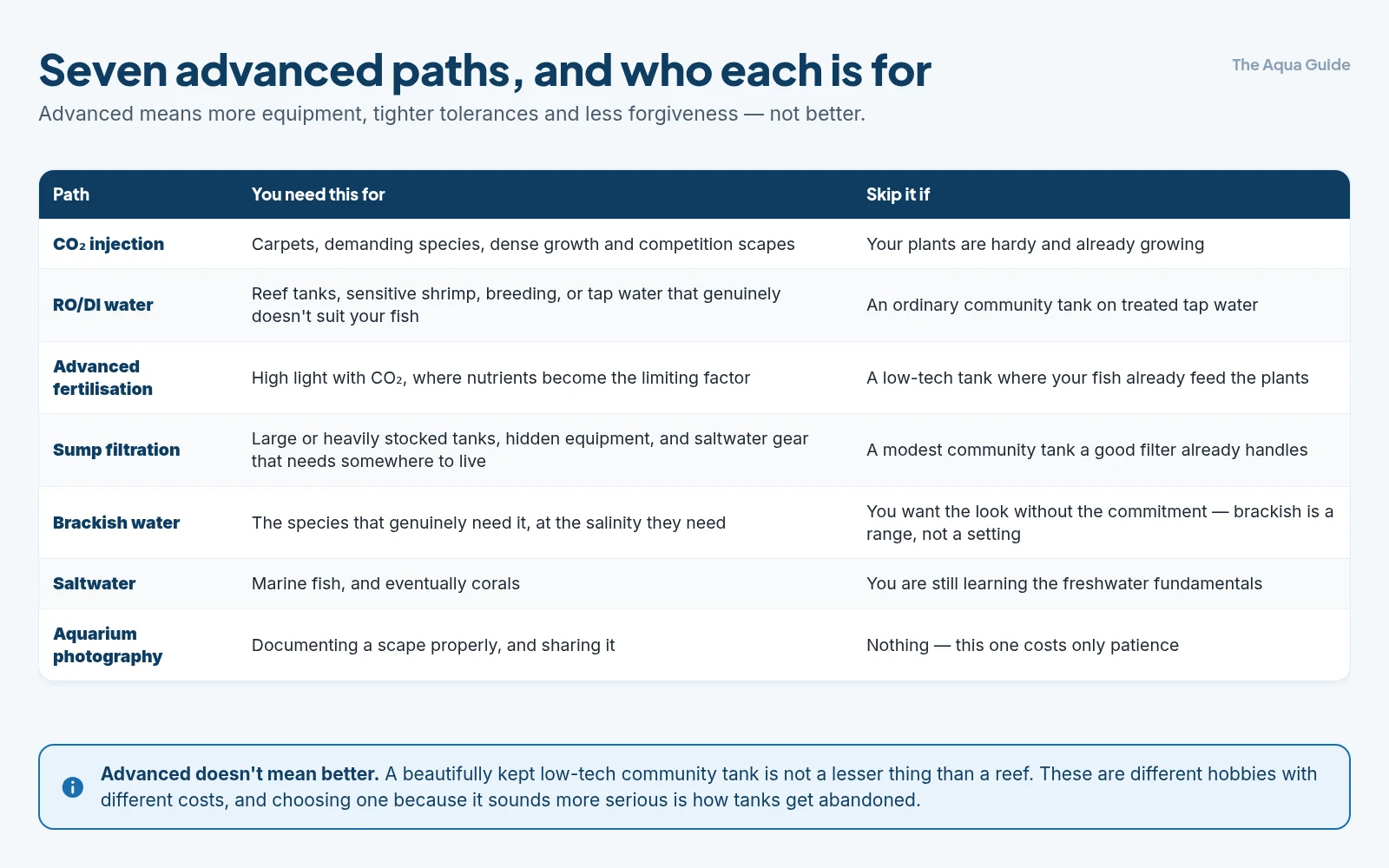
You need this for: Carpet plants, dense Dutch-style scapes, fast plant growth, vibrant red plants.
Skip if: You're happy with low-tech plants, want simple maintenance, on a tight budget. (Detailed guide.)
RO/DI Water
Reverse osmosis with deionization produces water with virtually no dissolved minerals — a blank canvas you can remineralize for specific species' needs. Essential for keepers of soft-water-loving fish (discus, wild-caught tetras, some apistogramma) or specific shrimp (crystal shrimp, certain caridina varieties).
You need this for: Demanding soft-water species, crystal shrimp, blackwater biotopes, areas with hard tap water that limits your options.
Skip if: Your tap water suits your fish; you're keeping hardy adaptable species. (Detailed guide.)
Advanced Fertilization
The "Estimative Index" (EI), "Perpetual Preservation System" (PPS), and "lean dosing" methods provide structured frameworks for feeding planted tanks. Beyond root tabs and all-in-one liquids, these involve dosing macros (NPK), micros (iron, trace elements) separately, often daily or every other day.
You need this for: High-tech planted tanks with CO2, demanding plants, achieving competition-level growth.
Skip if: Low-tech tanks where simple all-in-one fertilizers work fine. (Detailed guide.)
Sump Filtration
A sump is a separate tank (usually in a cabinet below the display) that handles filtration, heating, equipment placement, and water volume expansion. Almost universal in saltwater; increasingly popular in larger freshwater setups.
You need this for: Large tanks (75+ gallons), saltwater systems, hidden equipment aesthetics, expanded biological filtration.
Skip if: Small to medium tanks where conventional filters work fine. (Detailed guide.)
Brackish Water
Brackish tanks have salinity between freshwater (0 ppt) and full marine (35 ppt) — typically 5-15 ppt. They host fascinating species (mudskippers, scats, monos, archerfish, some pufferfish) found in nature where rivers meet the sea.
You need this for: Specific brackish species, unusual ecological setups.
Skip if: You're focused on standard freshwater or full marine. (Detailed guide.)
Saltwater (Marine)
Saltwater aquariums open up an entirely different world: vivid corals, dramatic reef fish, complex ecosystems mimicking ocean environments. The most ambitious step in the hobby — significant cost, different equipment, steep learning curve, but extraordinary rewards.
You need this for: Reef fish, corals, the saltwater experience.
Skip if: Freshwater satisfies you; budget or space limits don't allow. (Detailed guide.)
Aquarium Photography
Capturing your tank well is its own skill — beyond pointing a phone through glass. Proper lighting, exposure settings, glass cleaning, fish behavior timing, post-processing all matter. Worth learning for anyone who wants to share their work or document their tank's evolution.
You need this for: Sharing tanks online, competitions, personal documentation.
Skip if: Snapshots are fine for your purposes. (Detailed guide.)
What Order to Tackle Them
If you're considering multiple advanced paths, a reasonable order:
1. Advanced fertilization first — minimal new equipment, immediate plant improvements, foundation for future CO2.
2. CO2 injection — when you're ready to commit to a planted-tank focused path.
3. RO water — when you've identified specific species or styles that require it.
4. Photography — anytime, low equipment requirement, transferable skill.
5. Sump filtration — when you're upgrading to a larger tank or starting fresh on a complex build.
6. Brackish — specific species focus, side path.
7. Saltwater — when you're ready for a major new commitment.
Don't try to tackle them all at once. Each takes time to learn properly.
The Cost Reality
A rough sense of what advanced topics cost:
- CO2 injection system: $200-400 initial, $30-50/refill every few months
- RO/DI unit: $150-300 + filter replacements every 6-12 months
- Advanced fertilizers (dry chemicals + dosing): $50-100 initial for years of supply
- Sump (with overflow, return pump): $200-500+ depending on size
- Brackish setup: Mostly converts existing tank + salinity testing equipment ($30-50)
- Saltwater tank setup: $500-2000+ depending on size and ambition
- Aquarium photography (beyond phone): $300-1000+ for camera and lens
Plan one major advance at a time. The hobby budget grows fast otherwise.
What This Section Covers
The detailed guides ahead cover each major advanced path with the depth you'd want before investing in equipment and time. CO2 systems with both pressurized and DIY alternatives. RO/DI selection and use. Fertilization methods. Sump design and setup. Brackish vs saltwater introduction. And aquarium photography fundamentals.
Each guide is designed to help you decide whether a topic is right for you — not to push you into advancing. Many readers will read a guide and conclude "interesting, but not for me." That's a legitimate conclusion.
The Mental Shift
Beginners ask "what equipment do I need?" Advanced keepers ask "what am I trying to achieve, and what equipment supports that?"
This is the shift advanced topics introduce. Instead of acquiring more gear, you're choosing tools that serve specific goals. A CO2 system isn't "advanced equipment" — it's the tool for serious planted-tank growth. An RO unit isn't impressive — it's what crystal shrimp and discus need. The framing matters because it prevents accumulating equipment for its own sake.
The most experienced keepers often run setups that look simpler than mid-level keepers' tanks — they've identified what they actually need and stripped away what they don't.
A Caution: Advanced Doesn't Mean Better
Some honest truth: a well-maintained low-tech community tank with healthy fish and modest plants is genuinely more rewarding for many people than a high-tech CO2-injected aquascape requiring weekly precise maintenance. Advanced doesn't mean better, just different.
Pick advanced topics based on what genuinely interests you, what your fish need, what your space and budget allow — not based on online comparisons or what's trendy. Many tanks at competitions are stressful to maintain at the level shown. The keepers running them often have multiple setups, dedicated workspaces, and significant time investment.
The basic-to-intermediate sweet spot is where most keepers find lasting satisfaction. Advance further only when specific curiosity or goals justify it.
The Bottom Line
Advanced aquarium topics — CO2 injection, RO water, dosing fertilizers, sump filtration, brackish tanks, saltwater systems, aquarium photography — open up specialized capabilities beyond standard fishkeeping. None are required; each serves specific goals (lusher plants, demanding species, larger systems, marine life, sharing your work). The signs you're ready: stable successful basics, a specific goal driving the interest, willingness to invest money and learning time, and curiosity rather than boredom motivating you. Approach one at a time, in rough order from least to most demanding (fertilization → CO2 → RO → photography → sump → brackish/saltwater). Cost meaningfully more than basic equipment ($200-2000+ depending on path). The biggest mental shift: from acquiring equipment to choosing tools for specific goals. Many keepers find their lasting satisfaction at basic-to-intermediate levels — don't advance because you "should," advance because something specific calls you forward. The detailed guides in this section help you decide what's right for your specific path.
Related guides
- CO₂ injection: pressurised systems and alternatives
- RO/DI water: when and how to use it
- Advanced fertilisation: dosing methods for planted tanks
- Sump filtration: setup and benefits
- Brackish water tanks: halfway to saltwater
- Introduction to saltwater aquariums
- Aquarium photography: capturing your tank
- The complete fishkeeping reference library
Got questions about your specific setup? Drop them in our Community Forum — we love helping new fishkeepers get started right.