Between pure freshwater and full marine lies brackish water — water with salinity somewhere in the middle, found naturally where rivers meet the sea. Brackish tanks recreate these unique ecosystems and host fascinating species you can't keep in either pure freshwater or full saltwater. They're a specialty niche in the hobby but accessible — easier than full saltwater, more unusual than freshwater. Here's the complete guide.
At a glance: the salinity ranges
| Range | Salinity | Specific gravity |
|---|---|---|
| Freshwater | 0–0.5 ppt | 1.000–1.001 |
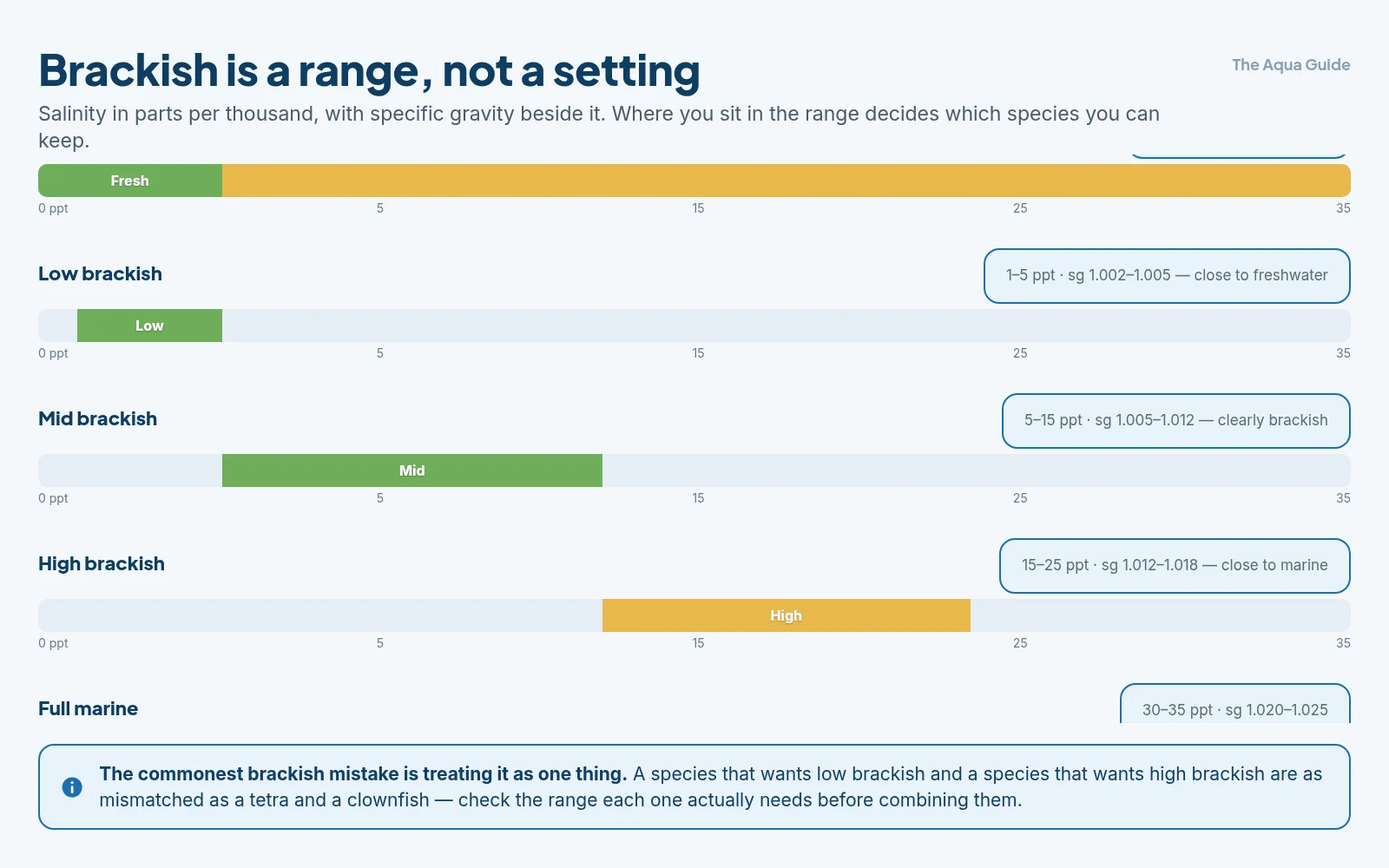
| Low brackish | 1–5 ppt | 1.002–1.005 — close to freshwater |
| Mid brackish | 5–15 ppt | 1.005–1.012 — clearly brackish |
| High brackish | 15–25 ppt | 1.012–1.018 — close to marine |
| Full marine | 30–35 ppt | 1.020–1.025 |
"Brackish" covers a very wide span. A species suited to the low end and one suited to the high end are not tankmates, however similar the label on the shop tank looked.
What "Brackish" Actually Means
Salinity is measured in parts per thousand (ppt) or specific gravity (sg):
- Freshwater: 0-0.5 ppt (sg 1.000-1.001)
- Low brackish: 1-5 ppt (sg 1.002-1.005) — close to freshwater
- Mid brackish: 5-15 ppt (sg 1.005-1.012) — clearly brackish
- High brackish: 15-25 ppt (sg 1.012-1.018) — close to marine
- Full marine: 30-35 ppt (sg 1.020-1.025)
Most brackish aquarium species need 5-15 ppt — the "true brackish" range. Some species tolerate either side; some need specific levels precisely.
Why Keep Brackish
A few reasons keepers go brackish:
Unique species. Brackish hosts fascinating fish unavailable in pure freshwater: mudskippers that walk on land, archerfish that shoot down insects with water jets, scats, monos, target fish, fiddler crabs.
Easier than full saltwater. No protein skimmers required (usually), no demanding lighting for corals, less precise parameter control, lower cost.
Fewer demanding species than reef tanks. Brackish fish are generally robust and adaptable.
Visually distinct. Brackish setups look different from typical freshwater or reef tanks — often featuring driftwood, sparse vegetation, sand substrate, and an open water column.
Ecologically interesting. Recreating estuary or mangrove environments has educational appeal.
Common Brackish Species
Fish
Mudskippers (Periophthalmus species)
- Iconic brackish species — amphibious fish that walk on land
- Need partial land area + brackish water (10-25 ppt depending on species)
- Active, personable, hardy
- Tank size: 30-40 gallons minimum for a small group
Archerfish (Toxotes jaculatrix)
- Famous for "shooting" insects with water jets from below the surface
- Grow large (6-10 inches); need 75+ gallon tanks
- 10-15 ppt salinity
- Hunt live food and surface targets
Scats (Scatophagus argus)
- Beautiful spotted disc-shaped fish
- Grow 8-12 inches; need large tanks
- 15-20 ppt salinity
- Active, hardy, eat anything
Monos (Monodactylus argenteus)
- Silver disc-shaped schooling fish
- Grow 6-8 inches; schooling fish need at least 6 in 75+ gallon tanks
- 15-25 ppt salinity (sometimes going full marine as adults)
- Active swimmers
Bumblebee Gobies (Brachygobius species)
- Small (1-2 inch) yellow-and-black banded gobies
- 5-10 ppt salinity
- Need fine sand bottom, hiding spots
- Group of 4-6 in a 10-20 gallon brackish tank
Glassfish (Parambassis ranga)
- Translucent body — see through them
- 5-10 ppt salinity (often misidentified as freshwater)
- Small (2-3 inches), schooling
Figure 8 Pufferfish (Tetraodon biocellatus)
- Small (3-4 inches) pufferfish
- 5-10 ppt salinity
- Aggressive, often kept solo
- Need snails for food (their teeth grow continuously)
Other Species
Fiddler Crabs
- Land-based crabs requiring partial land area in tank
- 5-10 ppt salinity
- Active, fascinating creatures
Mollies (yes, common mollies)
- Tolerate freshwater through brackish
- Some keepers transition mollies to brackish for better health
- Surprisingly common brackish setup
Setting Up a Brackish Tank
Tank Setup
Tank size: Match to species — 30 gallons minimum for most, 75+ for monos/scats/archers.
Substrate: Sand (white or natural) — most brackish environments have sand bottoms. Avoid coral substrate unless you want pH buffering (helpful for high-brackish but not required for low-brackish).
Hardscape: Driftwood (releases tannins suggesting estuary water), some rocks, mangrove roots (if available).
Plants: Most freshwater plants don't tolerate salt. Brackish plant options:
- Java fern — tolerates low brackish
- Anubias — tolerates low brackish
- Java moss — somewhat tolerant
- Mangrove propagules — actual mangrove plants in higher salinity
- Generally accept sparse planting; brackish habitats are not lush
Filtration: Standard freshwater filtration works (canister, HOB, internal). Strong filtration helps maintain stability.
Lighting: Modest. No need for plant lighting unless you're growing mangroves.
Water Setup
Mixing brackish water:
- Use dechlorinated tap water as base (or RO water for full control)
- Add marine salt mix (NOT aquarium salt — must be marine salt)
- Measure salinity with a refractometer or hydrometer
- Mix thoroughly until salt fully dissolves
- Match temperature before adding to tank
Marine salt is the same product used for saltwater (Instant Ocean, Reef Crystals, etc.) — just at lower concentrations.
Aquarium salt is NOT the same — aquarium salt is sodium chloride only, missing the magnesium, calcium, and other minerals marine salt provides. Don't substitute.
Testing salinity:
- Refractometer — most accurate, $25-60. Use a few drops, read salinity directly.
- Hydrometer — measures specific gravity, $10-20. Less accurate but workable.
- TDS meter — works but requires calculation; less common for brackish.
Cycling
Same nitrogen cycle as freshwater — bacteria establish in brackish water too. May take slightly longer due to bacterial adjustment to salinity, but otherwise standard cycling process.
Tip: Cycle with fish-in or fishless methods. Brackish-tolerant hardy fish (mollies) work for fish-in cycling. Or use ammonia for fishless cycling.
Stocking
After cycling, add fish gradually as you would freshwater. Same compatibility rules apply — brackish species have different temperaments. Research your specific species.
Common issue: Fish from pet stores are often sold as freshwater but are actually brackish (especially bumblebee gobies, figure 8 puffers, mollies). They survive in freshwater but thrive in brackish. Always research the actual native habitat.
Brackish Maintenance
Salinity Management
The biggest difference from freshwater maintenance:
Evaporation lowers water level but salinity stays the same. When topping off, use freshwater (dechlorinated tap or RO) — never replace with brackish.
Water changes use freshly-mixed brackish water at the target salinity. Match temperature.
Monitor salinity weekly. Refractometer or hydrometer reading should match your target. Drift up means you've been replacing evaporation with brackish water; drift down means salt is being removed without replacement.
Standard Maintenance
Otherwise similar to freshwater:
- Weekly 20-25% water changes (with brackish water at correct salinity)
- Monitor parameters (ammonia, nitrite, nitrate, pH)
- Clean filter as needed
- Trim plants/mangroves if growing
- Spot-clean substrate
Equipment Notes
- Brackish corrodes metal faster than freshwater — avoid metal components inside tank
- Heaters fail more often in brackish — periodic check
- Pumps and impellers may need occasional descaling
- Glass develops salt creep at waterline — periodic wipe-down
Common Mistakes
Using aquarium salt instead of marine salt. Common beginner error. Aquarium salt provides sodium chloride only; marine salt provides the full mineral profile brackish species need.
Topping off with brackish water. Slowly raises salinity above target. Always top off with freshwater.
Underestimating species size. Many "brackish" species sold as juveniles grow huge — archerfish reach 10 inches, monos and scats similar. Research adult size before buying.
Wrong salinity for the species. Bumblebee gobies need ~5 ppt; archerfish ~10-15; monos ~20+. One-size-fits-all doesn't work.
Keeping in pure freshwater long-term. Even tolerant species (mollies, glassfish, figure 8 puffers) live shorter lives in pure freshwater. Their natural habitat is brackish.
Mixing incompatible salinity tolerances. A scat at 20 ppt and a bumblebee goby at 5 ppt can't share a tank.
Brackish Communities
Building a brackish community requires similar thinking to freshwater communities — compatible temperaments, similar sizes, matching salinity preferences:
Low brackish (5-10 ppt):
- Bumblebee gobies + figure 8 puffer (carefully — puffer might attack gobies)
- Mollies + bumblebee gobies
- Glassfish + mollies
Mid brackish (10-15 ppt):
- Archerfish + mudskippers (if you have land area)
- Mollies + figure 8 puffer
High brackish (15-25 ppt):
- Monos + scats (similar requirements)
- Targets + monos
Each setup needs species that genuinely overlap in salinity preference.
Going Further
If you enjoy brackish, the natural progressions:
- Higher salinity setups — eventually approaching marine, then full marine
- Mangrove tanks — growing actual mangrove plants in brackish water
- Mudskipper paludariums — combined water/land setups for mudskippers
- Estuary biotopes — recreating specific natural brackish environments
Many keepers find brackish a gateway to saltwater. The salinity management, equipment considerations, and brackish-marine compatible species (some species can transition) make the move feel less dramatic than freshwater-to-marine.
The Bottom Line
Brackish water tanks (5-15 ppt salinity) recreate estuary and mangrove environments and host fascinating species unavailable in pure freshwater or saltwater: mudskippers, archerfish, scats, monos, bumblebee gobies, figure 8 puffers, glassfish, fiddler crabs. Easier than full saltwater (no protein skimmer, no reef lighting, more forgiving parameters), more interesting than typical freshwater. Setup: standard tank with sand substrate, sparse hardscape (driftwood/mangrove roots), modest planting (anubias, java fern tolerate low brackish), standard freshwater filtration. Water mixed using marine salt (NOT aquarium salt) to target salinity, measured with refractometer or hydrometer. Match salinity to species (5 ppt for bumblebee gobies, 10-15 ppt for archerfish, 20+ ppt for monos/scats). Cycle as normal. Maintenance: top off with freshwater for evaporation, do water changes with brackish water at target salinity. Skip salt-only "aquarium salt" — it lacks needed minerals. Brackish is a specialty niche with strong rewards — unique species, simpler than saltwater, more accessible than reef. A natural step for keepers wanting something different from standard freshwater.
Related guides
- Introduction to saltwater aquariums
- RO/DI water: when and how to use it
- Tap, RO and remineralised water explained
- Understanding pH, KH and GH
- Water parameters cheat sheet
- Community tank compatibility: what gets along
- Aquarium snails: helpful vs pest
- Advanced aquarium topics
Got questions about your specific setup? Drop them in our Community Forum — we love helping new fishkeepers get started right.