For most aquariums, tap water with dechlorinator works fine. But for some species and goals, tap water — with its dissolved minerals, pH, and unknown contaminants — isn't enough. RO/DI water (Reverse Osmosis / Deionization) provides a clean, mineral-free starting point that you can customize to specific requirements. Here's the complete guide to when you need it, how the systems work, and how to use the resulting water.
At a glance: needed, or not?
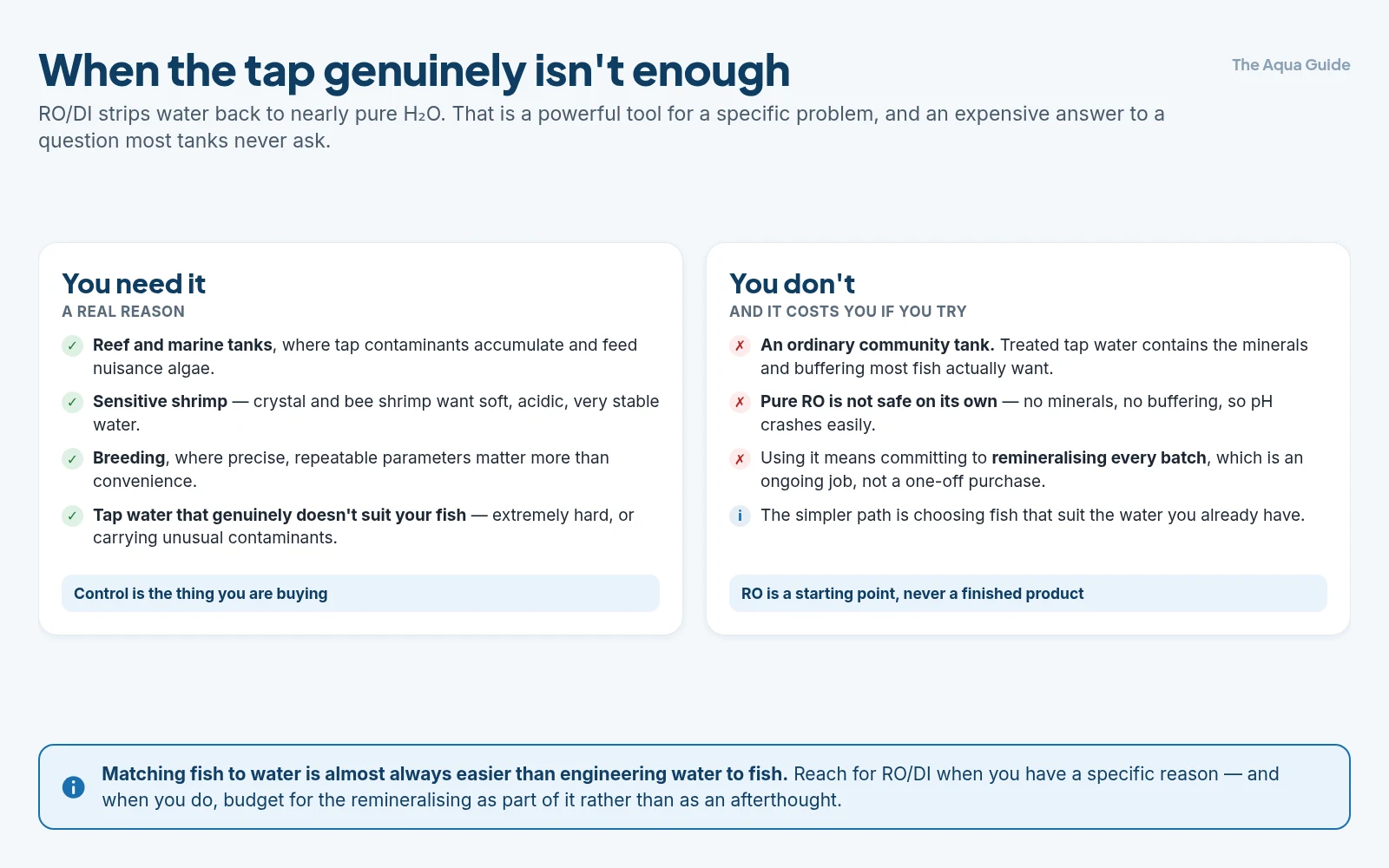
| Your setup | RO/DI? |
|---|---|
| A reef or marine tank | Yes. Tap contaminants accumulate and feed nuisance algae |
| Crystal or bee shrimp | Yes. They want soft, acidic, very stable water that tap rarely provides |
| Breeding, where parameters must repeat exactly | Yes. Control is the point |
| Tap water that genuinely doesn't suit your fish | Yes — but consider changing the fish first |
| An ordinary freshwater community tank | No. Treated tap water has the minerals and buffering they want |
Whatever you decide, RO water must be remineralised before it touches fish. Pure RO has no minerals and no buffering, so the pH crashes easily and the fish lack what they need.
What RO/DI Water Actually Is
The terminology:
Reverse osmosis (RO) is a filtration method that forces water through a semi-permeable membrane at pressure. The membrane blocks dissolved minerals, salts, contaminants, and most everything else — letting nearly-pure water through.
Deionization (DI) is a secondary stage using ion-exchange resins that strip any remaining ions from the water. Combined with RO, you get water that's essentially 100% pure H2O.
Result: Water with TDS (total dissolved solids) close to 0 ppm, pH around 7 (briefly, before it absorbs ambient CO2), and zero hardness.
Tap water typically has 100-500+ ppm TDS depending on your area; RO/DI water has 0-5 ppm.
When You Need RO/DI
Most fishkeepers don't need RO/DI. You probably need it if:
You Want to Keep Soft-Water Species
Many wild-caught and demanding species evolved in soft acidic water (pH 5.5-6.5, low GH/KH):
- Discus — classic soft-water demanders
- Wild-caught tetras (cardinal, neon variants from acidic rivers)
- Apistogramma and other dwarf cichlids
- Most ramirezi/blue rams
- Many killifish
- Wild bettas
In hard tap water, these species often survive but struggle to thrive or breed. RO water remineralized lightly creates the conditions they need.
You Keep Demanding Shrimp
Crystal shrimp (CRS) and related Caridina species require very specific water parameters — soft, slightly acidic, low TDS. Tap water rarely matches. Most serious crystal shrimp keepers use RO water plus shrimp-specific remineralizers.
Your Tap Water Has Problems
- Very hard water (GH 20+, TDS 500+) — limits species options dramatically
- High chloramine — possible but cumbersome to fully remove with standard dechlorinators
- High nitrate from source — already at 20-40 ppm before fish add any
- Heavy metals or contaminants — depending on region
- Unstable/inconsistent parameters from utility
In any of these cases, RO/DI gives you control over what's actually in your water.
You're Doing Saltwater
Marine systems essentially require RO/DI water. Tap water contaminants (especially phosphates, silicates, nitrates, copper, chloramines) cause algae blooms, coral problems, and can be lethal in reef tanks. Standard practice is RO/DI water mixed with marine salt to specified salinity.
You're Running High-Tech Planted Tanks
Some advanced aquascapers prefer RO/DI for absolute control of parameters and to avoid unknown contaminants in tap water that could affect algae or plant growth.
When You Don't Need RO/DI
Most situations:
- Standard community tanks with hardy fish (livebearers, most tetras, danios, barbs)
- Asian rift lake cichlids (which want hard water — tap water is often perfect)
- Goldfish
- Hardy beginner setups
- Tanks where your tap water already produces good results
If your fish are healthy and your water parameters are stable, RO/DI is unnecessary expense and complexity.
How RO/DI Systems Work
A typical RO/DI unit has 4-5 stages:
Stage 1 - Sediment filter. Removes physical particles (sand, rust, sediment) before they reach the membrane.
Stage 2 - Carbon block filter. Removes chlorine, chloramines, and organic contaminants that would damage the RO membrane.
Stage 3 - RO membrane. The heart of the system. Forces water through semi-permeable membrane; pure water permeates through, while concentrated waste water ("brine") is rejected.
Stage 4 - DI resin. Final polish removes any remaining ions, producing water at 0-1 ppm TDS.
Stage 5 (optional) - Post-carbon polish. Some systems add a final activated carbon stage.
Waste water — RO is inefficient. Producing 1 gallon of pure water typically wastes 3-4 gallons of "brine" water. Some keepers use this for plants or garden; others let it go to drain.
RO Unit Components
Beyond the filter stages:
Pressure gauge — shows incoming water pressure. Lower pressure = lower production. Most systems need 40+ psi for efficient operation.
TDS meter — tests output water TDS. Critical for monitoring filter health.
Flush valve — periodically flushes the membrane to extend lifespan.
Float valve / shutoff — automatically stops production when storage tank is full.
Storage tank (optional) — pressurized tank holding pure water for on-demand dispensing.
Tubing and fittings — standard 1/4" tubing connects everything.
Buying an RO/DI Unit
For aquarium use, look for:
Production rate — typically rated in gallons per day (GPD). 50-75 GPD suits most home setups; higher for large saltwater systems.
5-stage design with sediment, carbon, membrane, and DI resin.
TDS meter included — essential for monitoring.
Quality brand — BRS (Bulk Reef Supply), Aquatic Life, Spectrapure are well-regarded for aquarium use.
Reasonable cost — quality 75 GPD systems run $150-300. Higher-end systems with multiple DI stages, booster pumps, etc. cost more.
Avoid: Cheap drinking-water RO systems without DI stage; these produce 5-30 ppm output which isn't pure enough for sensitive species.
Installing and Using
Setup:
- Connect to a cold water source (laundry, under sink, dedicated tap)
- Direct waste water to a drain
- Connect pure water output to your storage container or measuring jugs
- Run for 30 minutes initially to flush new filters
Storage:
- Use food-grade containers (5-gallon buckets, dedicated water jugs)
- Cover containers to prevent contamination
- Best used within a few weeks (water can grow bacteria or absorb CO2 over time)
Monitoring:
- Test TDS regularly — should be 0-5 ppm
- When TDS rises, time to replace filters (sediment/carbon usually first; DI resin lasts longer; membrane lasts 1-3 years)
- Maintain pressure — note any drop and investigate
Remineralizing RO Water
You cannot use pure RO water directly. It has no buffering capacity, will cause pH crashes, and lacks the minerals fish and plants need.
You must remineralize before use:
For Most Soft-Water Tanks
Use a shrimp/aquarium remineralizer salt like:
- Salty Shrimp GH+ or GH/KH+ (popular for crystal and bee shrimp)
- Seachem Equilibrium (adds GH only)
- Seachem Replenish (balanced GH/KH)
- SaltyShrimp Bee Shrimp Mineral GH+ for caridina shrimp
- Cichlid salts for African setups
Process:
- Calculate water volume you'll prepare
- Add appropriate amount of remineralizer (label provides per-gallon dosing)
- Mix thoroughly
- Test GH/TDS to confirm target
- Use for water changes
Typical targets:
- Crystal/bee shrimp: TDS 100-150 ppm, GH 4-6, KH 0-1
- Soft-water tetras: TDS 100-200 ppm, GH 4-8, KH 2-4
- Discus: TDS 150-250 ppm, GH 3-6, KH 1-3
For Saltwater
Mix RO/DI with marine salt mix to specific gravity 1.024-1.026 (35 ppt salinity).
For Mixed Tap + RO
Some keepers mix RO with tap to dilute hardness. E.g., 50% RO + 50% tap water cuts mineral content in half — useful for moderate softening without full RO commitment.
Costs of Running RO/DI
Initial:
- RO/DI unit: $150-300
- Storage containers: $20-50
- TDS meter: $15-25
- Remineralizer (year supply): $20-40
Ongoing:
- Sediment + carbon filter replacements: Every 6-12 months, $20-30 each set
- RO membrane: 1-3 years, $40-60
- DI resin refills: Every 6-12 months depending on usage, $20-40
- Water bill increase: RO wastes 3-4x as much water as it produces. Minimal cost in most areas but noticeable in expensive water markets.
Total first year: $250-400 typical, then $50-100/year ongoing.
Alternatives to a Full RO/DI System
If RO/DI is too much commitment:
RO water from a fish store — many stores sell RO water by the gallon ($0.50-1.00/gallon). Workable for small-volume needs.
Bottled water — only viable for very small tanks. Look for "purified by reverse osmosis" on the label.
Distilled water — works but expensive and inconvenient at volume.
Rainwater — clean (collect from non-treated surfaces) and naturally soft, but inconsistent quality and contains particles/organics.
For occasional small-volume needs, store-bought RO water is the simplest path. For ongoing large-volume needs (shrimp tank water changes, large planted tank with weekly RO), an at-home unit pays for itself within a year.
Common Issues
TDS keeps rising over time. Filters or membrane need replacement. Check pressure first, then replace filters in order.
Production rate dropping. Low pressure (check inlet), clogged filters, or aging membrane.
Water tastes off. RO water tastes "flat" because of no minerals. This is normal; not for drinking without remineralizing.
Excess waste water. Normal — 3-4 gallons of waste per gallon of product. Some systems have lower ratios but still produce significant waste.
Plants/shrimp dying after remineralization. Likely poor mixing or wrong target parameters. Test water before use; adjust dosing.
The Bottom Line
RO/DI water provides mineral-free, contaminant-free water that you can customize to specific needs — essential for keeping demanding soft-water species (discus, wild tetras, dwarf cichlids), crystal shrimp, saltwater systems, or any situation where your tap water creates problems. Not needed for most standard community tanks where tap water works fine. A typical home system has 4-5 stages (sediment, carbon, membrane, DI resin) producing 50-75 gallons daily of water at 0-5 ppm TDS. Critical: never use pure RO water directly — remineralize first with species-appropriate salts (Salty Shrimp for shrimp tanks, Equilibrium/Replenish for general softwater, marine salt for saltwater). Initial cost is $150-300 for the unit plus accessories; ongoing maintenance includes filter replacements every 6-12 months and a new membrane every 1-3 years. Alternatives exist (store-bought RO water, mixing tap + RO at home) but for serious soft-water keepers, an at-home system is worth the investment. The water itself is a tool; what you do with it depends on your species and goals.
Related guides
- Tap, RO and remineralised water explained
- Understanding pH, KH and GH
- Introduction to saltwater aquariums
- Freshwater shrimp: cherry, amano and more
- Setting up a breeding tank
- Water parameters cheat sheet
- Brackish water tanks: halfway to saltwater
- Aquarium water quality: the complete guide
Got questions about your specific setup? Drop them in our Community Forum — we love helping new fishkeepers get started right.