Saltwater aquariums are the most ambitious step in the hobby — and for many, the most rewarding. Vivid corals, dramatic reef fish, fascinating invertebrates, complex ecosystems mimicking ocean environments. The learning curve is real, the cost is significant, but the results are spectacular. Here's the introduction to going saltwater: what you'll need, what's involved, and how to decide whether it's right for you.
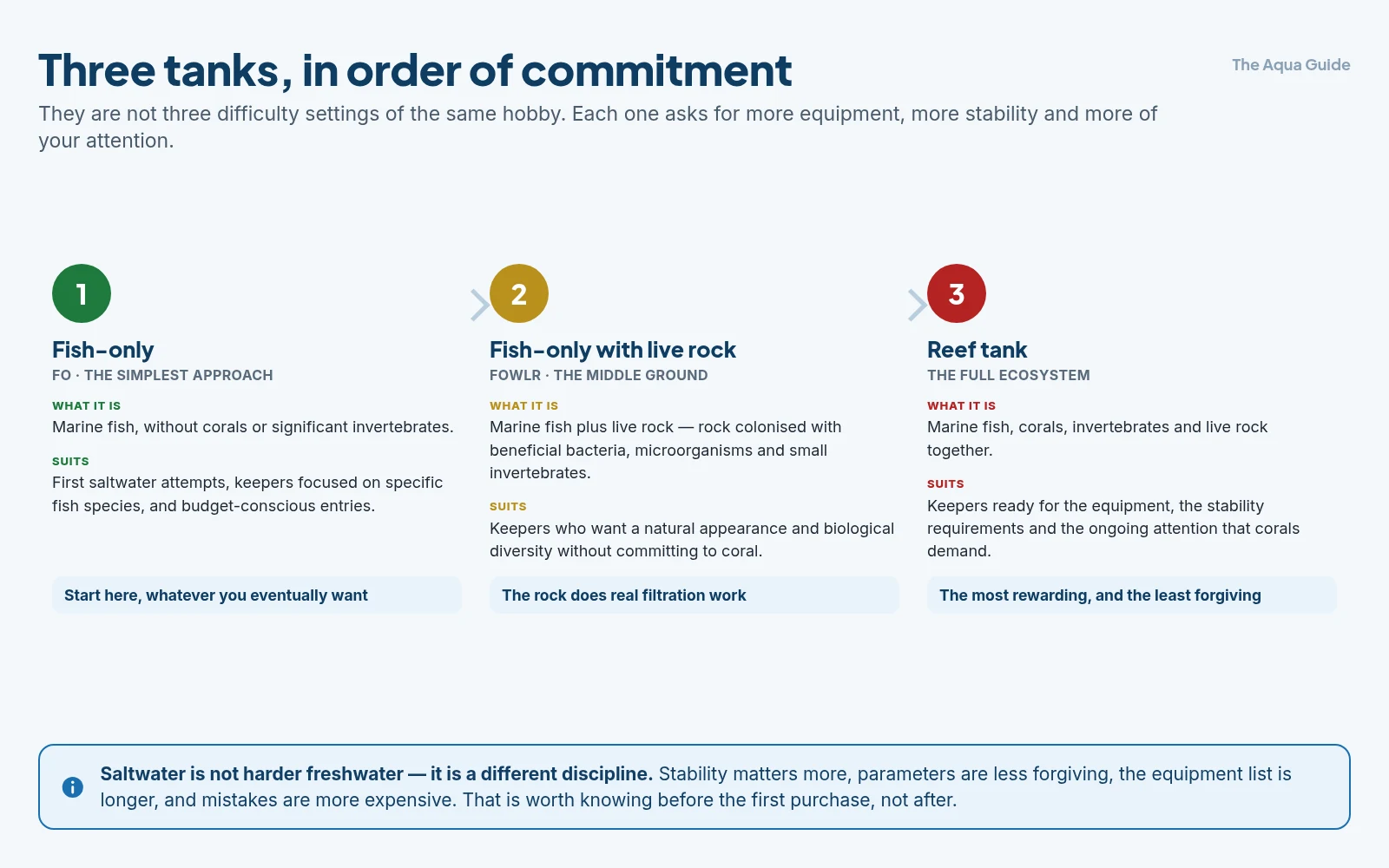
At a glance: which type, and why
| Type | What's in it | Who it suits |
|---|---|---|
| Fish-only (FO) | Marine fish, no corals or significant invertebrates | First saltwater attempts, and keepers focused on particular species |
| Fish-only with live rock (FOWLR) | Marine fish plus rock colonised with bacteria, microorganisms and small invertebrates | Anyone wanting a natural look and biological diversity without coral |
| Reef tank | Fish, corals, invertebrates and live rock together | Keepers ready for the equipment and the stability corals require |
The honest order is the one above. Starting at the reef end is how most abandoned saltwater tanks begin.
How Saltwater Differs From Freshwater
The fundamentals shift considerably:
Water chemistry is more complex. Beyond pH, you're managing salinity, calcium, alkalinity, magnesium, nitrate, phosphate, and trace elements precisely. Reef systems need stable parameters within tight ranges.
Equipment is more sophisticated. Protein skimmers, refugiums, calcium reactors, UV sterilizers, automated dosing pumps. Saltwater setups have more gear by default.
Cost is substantially higher. Fish cost more, corals cost more, equipment costs more, salt mix is ongoing expense. Budget at least 2-3x a comparable freshwater setup.
Lighting matters dramatically. Reef tanks need specialized lighting to grow corals — strong, full-spectrum, often programmable. Significant investment.
Lifespan considerations differ. Many marine fish live 10+ years with proper care; corals can live decades. Longer commitment than typical freshwater species.
Compatibility is stricter. Marine fish are often more territorial and demanding about tankmates than freshwater species.
Mistakes cost more. A water parameter swing in freshwater might stress fish; in saltwater, it can crash a reef.
This isn't to discourage — millions of hobbyists successfully run reef tanks. But the additional learning and investment are real.
The Three Main Types of Saltwater Tanks
Fish-Only (FO)
The simplest saltwater approach. Marine fish without corals or significant invertebrates.
Pros:
- Most forgiving — less precise parameters needed
- Less expensive equipment (no high-end lighting needed)
- Can keep "harder" fish that would damage corals (tangs, triggers, large angels)
- Tolerates more nitrate/phosphate
Cons:
- Less visually striking than reef tanks
- Still requires saltwater equipment and learning
Good for: First saltwater attempts, keepers focused on specific fish species, budget-conscious entries.
Fish-Only with Live Rock (FOWLR)
A common middle ground. Marine fish plus live rock (rock colonized with beneficial bacteria, microorganisms, and small invertebrates).
Pros:
- Live rock provides excellent biological filtration
- Natural look closer to reef tanks
- More biodiversity than bare FO
- Stepping stone toward reef tanks
Cons:
- More expensive than FO due to live rock cost
- Still no corals
Good for: Keepers who want natural appearance and biological diversity without coral commitment.
Reef Tank
The full reef ecosystem. Marine fish + corals + invertebrates + live rock.
Pros:
- Most visually stunning
- Truly mini-ocean ecosystem
- Continuous learning and growth
- Living art
Cons:
- Highest equipment cost (specialized lighting, advanced filtration)
- Strictest parameter requirements
- Less compatible with "rough" fish that damage corals
- Steepest learning curve
Good for: Experienced keepers, those willing to invest substantially, anyone enchanted by reef ecosystems.
Essential Saltwater Equipment
Beyond freshwater fundamentals:
Tank
60+ gallons recommended for serious reef tanks. Larger is more stable. Bow-front and rimless tanks are popular for aesthetic reasons.
Sump
Essentially required. Houses protein skimmer, heater, return pump, and other equipment. (Detailed in sump guide.)
Protein Skimmer
The most unique saltwater equipment. Creates massive bubbles that grab proteins and other organics from the water, removing them before they break down into nitrate/phosphate.
Cost: $100-500+ depending on tank size and quality.
Reef Lighting
Specialized LED arrays designed for coral photosynthesis. Look for:
- Full spectrum (blues, whites, reds, greens, violets)
- Programmable for natural day/night cycle
- Sufficient PAR (light intensity) for your coral choices
Cost: $200-1000+ depending on tank size and ambition. Reef LEDs are not the same as freshwater plant lights.
Live Rock
Rocks colonized with beneficial life — bacteria, microorganisms, small invertebrates. The biological foundation of marine systems.
Sources:
- Cured live rock from local fish stores
- Dry rock (gradually colonized through cycling)
- Eco-rock (artificial alternatives)
Cost: $5-15/lb live rock; dry rock cheaper but takes months to colonize.
Quantity: 1-1.5 lbs per gallon is typical.
Powerheads / Wave Makers
Generate water flow essential for coral health and proper nutrient distribution. Reef tanks need strong, varied flow.
Cost: $30-200 each; usually need multiple.
Reverse Osmosis Water
Essential. Tap water contains phosphates, silicates, and other compounds that cause algae issues in saltwater. RO/DI is the standard. (See RO water guide.)
Salt Mix
Marine salt for mixing saltwater. Major brands: Instant Ocean, Reef Crystals, Tropic Marin, Red Sea.
Cost: $50-100 per box (makes 150-200 gallons of saltwater).
Heaters
Same as freshwater, but submersible quality more important due to corrosion considerations.
Testing Equipment
Critical for reef tanks:
- Salinity refractometer
- pH test
- Ammonia, nitrite, nitrate tests
- Alkalinity (KH) test
- Calcium test
- Magnesium test
- Phosphate test (for reefs)
Cost: $100-200 for a complete test kit set.
The Saltwater Workflow
A typical setup process:
1. Plan extensively. Saltwater tanks reward planning. Decide on tank type (FO, FOWLR, reef), size, species you want to keep, equipment to support them.
2. Set up the system. Tank, sump, lighting, plumbing, all hardware installed.
3. Mix saltwater. RO water + marine salt to target salinity (1.024-1.026 specific gravity). Allow to mix for 24+ hours.
4. Add live rock. Place in tank; let bacteria do their work.
5. Cycle. Same nitrogen cycle, possibly longer than freshwater (4-8 weeks typically).
6. Test parameters consistently. Don't add livestock until ammonia and nitrite are zero.
7. Add hardy fish first. Damselfish, chromis, gobies — known beginner saltwater species.
8. Build slowly. Add fish in stages, weeks apart. Don't rush.
9. Add invertebrates. Snails, hermit crabs, shrimp once parameters are stable.
10. Eventually add corals (reef tanks only) starting with hardy beginner species.
The entire process from empty tank to mature reef takes 6 months to a year for a stable system.
Costs for a Saltwater Start
A realistic budget for a 60-75 gallon reef:
- Tank + stand: $300-600
- Sump + plumbing: $400-700
- Lighting: $400-800
- Protein skimmer: $200-400
- Powerheads: $100-200
- Live rock: $200-400
- Heaters: $50-80
- Testing equipment: $100-150
- RO/DI unit: $200-300
- Salt mix initial supply: $80-120
- Misc supplies: $200-300
Total upfront: $2,200-4,000+ for a quality setup.
Ongoing costs:
- Salt mix: $30-50/month
- Replacement bulbs: $50-200/year
- Live additions (fish, corals): variable, $50-300+/month for active builders
- Maintenance supplies: $30-50/month
- Water changes: water, salt, electricity
Per year ongoing: $500-2000+ depending on ambition.
Beginner-Friendly Saltwater Fish
Hardy species suitable for first-time saltwater keepers:
Damselfish — extremely hardy but often aggressive (the "easy first fish that becomes a problem")
Clownfish (especially common clowns) — hardy, charismatic, captive-bred widely available
Royal Gramma — small, peaceful, beautiful purple-and-yellow
Yellow Watchman Goby — small, hardy, fascinating behavior
Banggai Cardinalfish — peaceful, captive-bred, schooling
Chromis (Green or Blue) — schooling damsels, peaceful, hardy
Firefish (Goby) — beautiful, hardy, beginner-friendly
These give beginners reasonable success while learning the salt water hobby.
Major Mistakes to Avoid
Starting too small. Nano reefs (under 30 gallons) are harder than 75+ gallon tanks — less stable parameters. Bigger is better for beginners.
Skipping the cycle. Adding fish too soon kills them. Saltwater requires the same nitrogen cycle as freshwater.
Overstocking. Marine tanks support fewer fish per gallon than freshwater. 1-2 inches of fish per gallon is conservative.
Adding corals too soon. Wait 6+ months for parameters to stabilize before adding corals.
Inadequate flow. Corals need significant water movement; underflow is a common problem.
Skipping water testing. Saltwater parameter swings are deadly. Test weekly minimum, daily for the first months.
Using tap water. Contaminants cause algae and coral problems. RO/DI only.
Wrong salt mix for reef vs FO. "Reef Crystals" has higher calcium for corals; basic mixes work for FO.
When You're Ready (and When You're Not)
Signs you're ready for saltwater:
- Successful freshwater keeping for 2+ years
- Stable, healthy maintained tanks
- Willingness to invest financially
- Time available for weekly maintenance
- Comfortable with chemistry and testing
- Goal-driven (specific species or aesthetic)
Signs you're not ready:
- Struggling with current freshwater tank parameters
- Budget constraints (saltwater is genuinely expensive)
- Limited time for maintenance
- Wanting "easier" tanks — saltwater is harder, not easier
- Inconsistent care patterns (vacations, busy life)
Saltwater rewards consistency and patience. If those aren't available, it's better to wait.
The Bottom Line
Saltwater aquariums are the most ambitious step in the hobby — vivid corals, dramatic reef fish, complex marine ecosystems — but require significant investment in equipment ($2,000-4,000+ for a 60-75 gallon reef), specialized knowledge, and ongoing commitment. Three main types: Fish-Only (simplest), Fish-Only with Live Rock (transitional), and Reef Tank (most ambitious). Essential equipment beyond freshwater: sump filtration, protein skimmer, reef lighting (full-spectrum LED), live rock, powerheads, RO/DI water system, marine salt mix, and detailed testing kits. The workflow takes 6-12 months from empty tank to mature stable reef. Begin with hardy beginner species (damselfish, clownfish, royal gramma, yellow watchman goby, banggai cardinal). Avoid common mistakes: starting too small, skipping cycle, overstocking, adding corals too soon, inadequate flow, using tap water. Saltwater is genuinely harder than freshwater — start when you've mastered freshwater fundamentals, have the budget, and feel called by specific marine goals. For those ready, it offers the most spectacular and rewarding tanks possible.
Related guides
- Brackish water tanks: halfway to saltwater
- RO/DI water: when and how to use it
- Sump filtration: setup and benefits
- Aiptasia and majano: identifying and removing pest anemones
- Advanced aquarium topics
- Water parameters cheat sheet
- What equipment do you actually need vs store upsells
- How much does a fish tank cost to set up and run?
Got questions about your specific setup? Drop them in our Community Forum — we love helping new fishkeepers get started right.