When something looks wrong with your fish, you need fast identification. This is the lookup for common diseases by visible symptom — what it likely is, what causes it, and how to treat. Use this alongside the Disease Guide in Part 10 for deeper context.
At a glance: symptom to likely cause
| If you see... | Most likely... | First treatment |
|---|---|---|
| Salt-grain white spots | Ich | Heat treatment — 86°F for 14 days |
| Gold or rust dusting | Velvet | Heat, plus reduced lighting |
| Ragged, eroding fins | Fin rot | Water quality, salt, and an antibacterial |
| Cottony white fuzz | Fungus | Salt and an antifungal |
| Flat white patches, progressing fast | Columnaris | Antibiotics urgently — kanamycin |
| Pinecone scales | Dropsy | Antibiotics and epsom salt, with a low success rate |
| Pits in the head | Hole-in-the-head | Better diet and water quality |
| Bulging eye or eyes | Pop-eye | Water quality; antibiotics if both eyes |
| Red streaks in fins or body | Septicemia | A strong antibiotic course |
The same symptom can point at several conditions, and a treatment for one does nothing for another — so identify before you dose. The detailed guides for each are linked below.
Identifying Disease: Where to Look
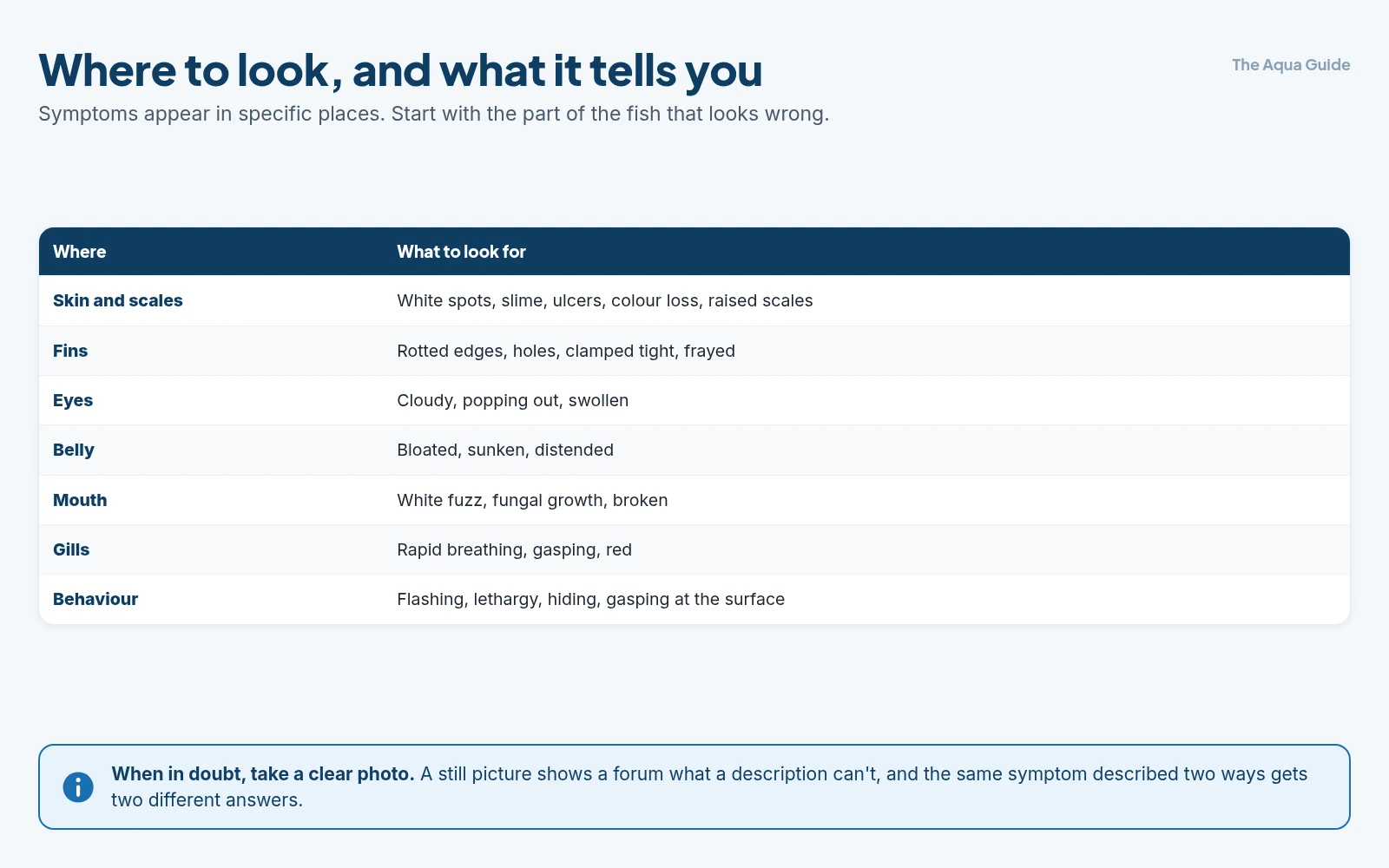
Symptoms appear in specific locations:
Skin/scales: white spots, slime, ulcers, color loss, raised scales Fins: rotted edges, holes, clamped tight, frayed Eyes: cloudy, popping out, swollen Belly: bloated, sunken, distended Mouth: white fuzz, fungal growth, broken Gills: rapid breathing, gasping, red Behavior: flashing, lethargy, hiding, gasping at surface
When in doubt, take a clear photo and search online + consult a knowledgeable forum.
Symptom-Based Disease Lookup
White Spots Like Salt Grains
Most likely: Ich (Ichthyophthirius multifiliis) — also called "white spot disease" Cause: Parasitic protozoa Severity: Highly contagious; can kill all fish quickly if untreated Visible features: Small white grains (like salt) scattered on body and fins; fish may flash against objects Treatment:
- Raise temperature to 82-86°F (speeds parasite lifecycle)
- Add aquarium salt (1 tbsp per 5 gallons, gradually) — for some species
- Use ich treatment (Ich-X, copper-based meds — careful with shrimp/scaleless fish)
- Treat for at least 2 full weeks (lifecycle dependent) Note: Treating mid-cycle when parasites are in free-swimming stage is most effective
Cottony White Patches on Body or Mouth
Most likely: Cotton mouth (Flexibacter/Columnaris) OR Fungal infection (Saprolegnia) Cause: Bacterial (columnaris) or fungal (saprolegnia) Severity: Columnaris is highly contagious and serious; saprolegnia often secondary to other issues Visible features: Fuzzy white growths; columnaris often around mouth; saprolegnia anywhere Treatment:
- For columnaris: antibacterial medication (Furan-2, Kanaplex)
- For fungal: antifungal medication (API Fungus Cure, methylene blue)
- Improve water quality, reduce stress
- May benefit from salt treatment (low salinity)
Frayed, Rotted, or Receding Fins
Most likely: Fin rot Cause: Bacterial — usually secondary to poor water quality or stress Severity: Slow progression; treatable if caught Visible features: Fins look ragged at edges; black or red discoloration where rotting; fins gradually shortening Treatment:
- Fix water quality first (water changes, test parameters)
- Treat with antibacterial medication (Furan-2, API Bettafix for mild cases)
- Improve diet; reduce stress
- Often resolves with just water quality fix in mild cases
Velvety Gold/Brown Dusting on Body
Most likely: Velvet (Oodinium/Piscinoodinium) Cause: Parasitic dinoflagellate Severity: Serious; spreads quickly Visible features: Dusty/velvety appearance, often gold or brown; fish may flash Treatment:
- Copper-based medication (be very careful with scaleless fish and invertebrates)
- Increase temperature carefully
- Reduce lighting (parasite is photosensitive)
- Treatment typically 10-14 days
Bulging or Cloudy Eyes
Most likely: Pop-eye (Exophthalmia) OR cloudy eye Cause: Bacterial infection, injury, water quality issues Severity: Pop-eye can indicate serious systemic issues Visible features: One or both eyes protruding from socket; cloudy white film over eye Treatment:
- Improve water quality
- Antibacterial medication (Kanaplex, Furan-2)
- Stress reduction
- May need quarantine
Swollen Belly, Pinecone-like Scales
Most likely: Dropsy Cause: Bacterial infection causing internal fluid retention Severity: Often fatal even with treatment Visible features: Bloated body; scales standing out from body like pinecone; lethargy Treatment:
- Kanaplex (antibacterial)
- Epsom salt baths
- Improve water quality dramatically
- Often a poor prognosis; consider humane euthanasia if severe
Lethargy + Hiding + Loss of Appetite
Most likely: Multiple possibilities — internal parasites, bacterial infection, water quality, age Severity: Variable Visible features: Not eating, staying in one spot, dark/pale colors, sometimes white stringy feces Treatment:
- Test water parameters first (often the cause)
- Check feeding routine
- Internal parasite treatment (Praziquantel or General Cure) if poo is stringy/white
- Quarantine if available
Gasping at Surface, Rapid Gill Movement
Most likely: Ammonia poisoning, low oxygen, or gill disease/parasites Cause: Multiple possibilities Severity: Emergency if many fish affected Visible features: Fish at surface gulping air; rapid gill movement; lethargy below Treatment:
- Immediate: large water change, increase aeration
- Test ammonia/nitrite/nitrate immediately
- If parameters fine, check for gill flukes (treat with Praziquantel)
- Check temperature (high temp = low oxygen)
Flashing (Rubbing Against Objects)
Most likely: Skin parasites (Ich, gill flukes, copepods, Chilodonella) Cause: Parasitic infections Severity: Variable; sign of underlying issue Visible features: Fish darts and rubs body on substrate, rocks, plants Treatment:
- Quarantine if possible
- Treat for likely parasites (start with Praziquantel for flukes)
- Examine closely for visible parasites
- Check water parameters
White Stringy or White Mucus Feces
Most likely: Internal parasites (Hexamita, Camallanus worms, etc.) Cause: Parasitic worms Severity: Slow but progressive Visible features: Long white stringy feces hanging from fish; sometimes loss of weight Treatment:
- Praziquantel-based treatment (PraziPro, API General Cure)
- Levamisole for camallanus worms
- Improve diet
- Treat for 2-4 weeks
Tumors, Bumps, or Cysts
Most likely: Tumors (sometimes cancer), bacterial cysts, or fish TB (Mycobacterium) Cause: Variable Severity: Often slow but progressive Visible features: Bumps under skin, sometimes growing over weeks Treatment:
- Often not treatable
- Mycobacterium can affect humans — handle with care
- Consider euthanasia if quality of life suffers
- Quarantine to prevent spread
Rapid Color Loss (Suddenly Pale)
Most likely: Stress or sickness, sometimes environmental Cause: Variable Severity: Sign of underlying issue Visible features: Once colorful fish now pale, washed out Treatment:
- Test water parameters
- Check for parasites or signs of illness
- Reduce stress (tankmates, lighting, water changes)
- Provide hiding cover
Black Patches/Spots (Body)
Most likely: Ammonia burns (during healing), or rare disease Cause: Usually environmental (recovering from ammonia damage) Severity: Healing process is good sign Visible features: Dark patches on body, often where skin was previously damaged Treatment:
- Keep water quality excellent
- These usually fade over weeks as fish heals
- If persistent or growing, investigate more
Treatment Quick Reference
Common Medications
API Furan-2 — Broad spectrum antibacterial; good for fin rot, columnaris, pop-eye API General Cure — Praziquantel + metronidazole; treats many parasites and protozoa Kanaplex (Seachem) — Antibacterial; effective for many bacterial infections Methylene Blue — Antifungal, antiparasitic; for hatching eggs, mild fungal infections Ich-X (Hikari) — Specifically for ich; safer than copper for most fish PraziPro — Specific praziquantel for parasites (gill flukes, internal worms) Levamisole — Specifically for Camallanus worms Salt — Aquarium salt (NaCl) for some bacterial/parasitic issues — careful with scaleless fish and plants
Treatment Best Practices
1. Quarantine if possible — separate sick fish; prevent spread.
2. Test water first — many "diseases" are actually water quality issues.
3. Use the right medication — antibacterial doesn't kill parasites; antifungal doesn't help bacterial infections.
4. Read instructions carefully — dosing for size of tank, duration of treatment.
5. Remove carbon from filter during medication — carbon adsorbs medication.
6. Don't mix medications without research — many combinations are dangerous.
7. Complete the full course — stopping treatment mid-way often causes recurrence.
8. Watch for sensitivities — scaleless fish, shrimp, snails react badly to many meds.
Medication Cautions
With shrimp:
- AVOID copper-based meds (kills them)
- AVOID most "tonic" salts
- Most ich medications are toxic
With scaleless fish (loaches, eels, some catfish):
- Use HALF dose of most medications
- Avoid copper-based meds
- Watch for stress signs
With snails:
- Avoid copper (deadly)
- Most other meds tolerable but check
Quarantine Procedure
When you have a sick fish:
1. Hospital tank — 5-10 gallon bare-bottom tank, sponge filter, heater, hiding spot
2. Move sick fish — net or cup transfer, minimize stress
3. Treat in hospital tank — main tank stays untreated unless ALL fish are affected
4. Daily water changes — 25% with appropriate temperature water
5. Watch for treatment effects — improvement, worsening, or no change
6. Complete treatment course — typically 1-2 weeks
7. Return fish to display — after treatment + observation period (3-7 days of normal behavior)
Prevention Beats Treatment
The best disease management is preventing disease:
Quarantine new fish — 2-4 weeks in hospital tank before adding to display Maintain water quality — most disease is opportunistic on stressed/weakened fish Avoid overcrowding — stress kills more fish than disease Quality food — varied, fresh, age-appropriate Regular observation — catch problems early Test water regularly — catch parameter issues before they cause disease Don't mix wild-caught and store-bought — different disease exposures
When to Euthanize
Hard but sometimes necessary. Signs:
- Disease too advanced for treatment
- Fish suffering visibly (gasping, lethargic, unable to feed for days)
- Quality of life severely impaired
- Risk of spread to other fish
Humane methods:
- Clove oil overdose (most accepted method)
- Quick decapitation (for skilled keepers)
- DO NOT flush live fish
Consult resources online for proper humane euthanasia procedures.
The Bottom Line
Disease identification starts with observation: where on the fish, what does it look like, what's the behavior? Common diseases by symptom — white spots (ich), cotton mouth/fuzz (columnaris or fungus), frayed fins (fin rot), velvety gold dust (velvet), bulging eyes (pop-eye), pinecone scales (dropsy), gasping (ammonia/oxygen issue), flashing (parasites), stringy feces (internal parasites). Match treatment to disease — antibacterial for bacterial, antifungal for fungal, antiparasitic for parasites. Always test water first; many "diseases" are actually water quality issues. Quarantine sick fish; remove carbon during treatment; complete full medication courses. Be careful with shrimp (no copper), scaleless fish (half doses), snails (no copper). Prevention beats treatment — quarantine new fish, maintain water quality, avoid overcrowding. Severe untreatable cases may require humane euthanasia. Most healthy fish stay healthy with stable parameters and stress-free environments.
Related guides
- The beginner's guide to fish disease
- Ich (white spot): identification and treatment
- Fin rot: causes, recognition and recovery
- Fungal infections: cotton-like growth
- Velvet, columnaris and other bacterial issues
- Internal parasites: signs and treatment
- Aquarium medications: when to use what
- Setting up and using a hospital tank
Got questions about your specific setup? Drop them in our Community Forum — we love helping new fishkeepers get started right.