If you keep fish long enough, you'll see ich. It's the single most common disease in freshwater aquariums, and almost every keeper encounters it at some point — often after adding new fish, after a temperature drop, or during a stressful period in the tank. The good news: ich is instantly recognizable, well-understood, and very treatable when caught early. Here's the full playbook.
How do I treat ich (white spot) in an aquarium?
For most community tanks the simplest option is heat: raise the temperature to 86°F (30°C) and hold it for 14 days, with aquarium salt or a commercial medication as alternatives where heat is not suitable. Keep treating for 10–14 days after the last spot disappears — only the free-swimming stage of the parasite can be killed, and stopping early is why treatment fails.
At a glance: heat or salt
| Heat treatment | Salt treatment | |
|---|---|---|
| What you do | Raise the tank to 86°F (30°C) over 24 hours, no more than 2°F an hour | Dissolve aquarium salt — about 1 tbsp per 5 gallons — in a container first, never granular into the tank |
| How | Hold it there continuously for 10–14 days, then lower it back over 24 hours | Add it gradually over 12–24 hours in 2–3 portions to prevent osmotic shock, then hold the level for 10–14 days |
| Don't forget | Increase aeration significantly — warm water holds less oxygen and fish need more of it | Replace only what water changes remove, then taper it out through changes without adding more |
| Not for | Cold-water species like goldfish and white clouds, delicate species that can't take 86°F, or tanks with plants that won't survive the heat | Scaleless fish, plants and invertebrates that don't tolerate salt |
Heat is the simplest and gentlest option for hardy community fish — no chemicals, and no harm to the beneficial bacteria. Combine salt with a milder 82°F if your fish tolerate it, for the fastest result.
What Ich Looks Like
Ich (pronounced "ick," short for Ichthyophthirius multifiliis) appears as small white spots on fish, looking like:
- Salt grains sprinkled across the body, fins, and gills
- Very uniform in size — about the size of a pinhead, much smaller than scales
- Distinct individual spots, not patches or fuzzy coverage
- White or slightly off-white, clearly visible against dark or light fish
The spots start sparse — maybe a few visible on one fish — and progress rapidly. Within a few days, an infected fish can be covered in spots. The progression is fast, which is why early detection matters.
Distinguishing ich from other conditions:
- Velvet is finer and gives a "gold dust" or rust-colored sheen rather than individual spots
- Fungus is fuzzy and cottony, growing outward from the body
- Lymphocystis (a viral condition) produces larger cauliflower-like lumps, not pinpoint spots
- Bubbles or air pockets in fins can look spot-like but are translucent, not white
Ich's hallmark is "salt grains" — uniform tiny white dots, not patches or fuzz.
Behavioral Signs to Watch For
Visual spots are the obvious giveaway, but behavior often shifts before spots appear:
- Scratching or "flashing" against rocks, substrate, and décor — fish trying to relieve irritation
- Rapid gill movement as gill parasites cause breathing difficulty
- Lethargy and hiding
- Loss of appetite
- Clamped fins
- Rubbing against tank surfaces
If you see scratching behavior without visible spots, ich may still be developing — and treating early gives the best outcomes.
The Ich Parasite Lifecycle (Why It Matters)
Understanding the lifecycle is genuinely important for treatment success.
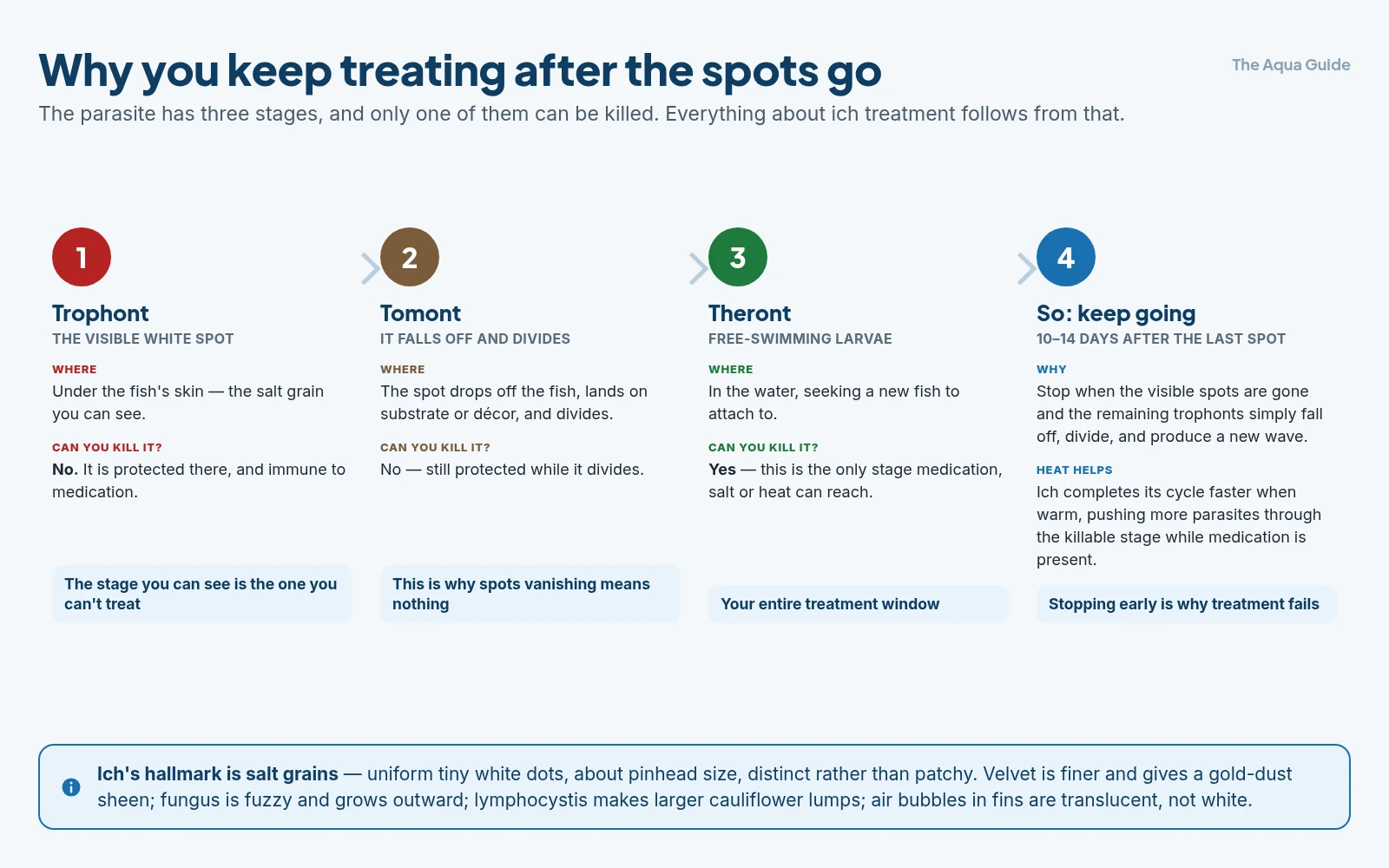
The Ichthyophthirius parasite has three life stages: the trophont (the visible white spot under the fish's skin — protected and untreatable), the tomont (the spot falls off the fish, lands on substrate or décor, and divides), and the theront (free-swimming larvae that seek new fish hosts). Only the free-swimming theront stage is killable by medications — the protected trophont under the skin is immune.
This is why effective ich treatment continues for 10–14 days after symptoms disappear. Stopping when the visible spots are gone leaves remaining trophonts to fall off, divide, and produce a new wave. The reset cycle takes about a week at standard temperatures, longer when cooler.
The lifecycle also explains why temperature matters: ich completes its cycle faster at higher temperatures (about 7–10 days at 78–80°F, much slower below 70°F). Raising temperature speeds up the cycle, exposes more parasites to medication, and helps treatment succeed faster.
Treatment Method 1: Heat Treatment
The simplest, gentlest, and often most effective method for hardy community fish.
Process:
- Gradually raise tank temperature to 86°F (30°C) over 24 hours. Increase by no more than 2°F per hour to avoid shocking fish.
- Maintain 86°F for 10–14 days continuously. The high temperature accelerates the parasite lifecycle through the killable theront stage faster than the parasite can reproduce.
- Increase aeration significantly — warm water holds less oxygen, and fish need more at higher temperatures. Add an airstone, raise filter outflow, or both.
- Watch all fish carefully — some species can't tolerate 86°F (cold-water fish, some delicate species). Check species tolerances before starting.
- After 14 days, gradually lower temperature back to normal over 24 hours.
Best for: most common community tropical fish (tetras, danios, livebearers, most cichlids, most catfish that handle warmth).
Don't use heat treatment for: cold-water species (goldfish, white cloud mountain minnows), sensitive species that can't tolerate 86°F, tanks with live plants that won't survive prolonged heat.
This method works because it requires no chemicals, doesn't harm beneficial bacteria, and is gentle on most fish — just hot.
Treatment Method 2: Salt Treatment
Aquarium salt (sodium chloride, NOT table salt with iodine) at moderate concentrations kills the free-swimming theront stage. Suitable when heat alone isn't enough or when fish can't handle high temperatures.
Process:
- Dissolve aquarium salt in tank water at approximately 1 tablespoon per 5 gallons (or follow your product's specific recommendation). Dissolve in a small container of water before adding to tank — never add granular salt directly.
- Add gradually over 12–24 hours in 2–3 portions to prevent osmotic shock.
- Maintain salt level for 10–14 days by replacing only what's removed during water changes.
- Combine with elevated temperature if your fish tolerate it (around 82°F) for fastest results.
- After 14 days, gradually remove salt through water changes without adding more.
Don't use salt with: scaleless fish (most catfish including corydoras, loaches), some sensitive species (some tetras), live plants (most don't tolerate salt), invertebrates (shrimp, snails).
Salt is a useful tool but check tolerance for everything in your tank before using.
Treatment Method 3: Medications
Several commercial ich medications work effectively — copper-based, malachite green / formalin combinations (like ick-clear products), or proprietary blends.
General approach:
- Identify the right medication for your situation (planted tank, shrimp present, sensitive species — read labels).
- Remove activated carbon from the filter — it absorbs medications. Replace with sponge or skip carbon during treatment.
- Follow the label's dosing exactly for your tank volume. Underdosing is ineffective; overdosing harms fish.
- Treat for the full duration specified, often 10–14 days.
- Increase aeration — many medications reduce dissolved oxygen.
- Watch sensitive fish carefully — some species don't tolerate certain ich medications well.
Cautions:
- Copper-based medications are particularly hard on invertebrates (will kill shrimp and many snails) and some sensitive fish — avoid in planted/inverted tanks
- Malachite green can stain silicone seams and is harmful to scaleless fish at high doses
- Always do a water change before starting treatment to give fish the best baseline
- After completing treatment, water changes plus replacing carbon helps remove residual medication
For most planted community tanks with mixed species, the heat method is the safest first choice, with salt or medications as backup if heat alone fails.
The Treatment Sequence Day by Day
A typical heat-treatment plan:
Day 0: Notice spots. Test water (often poor water quality contributed to outbreak). Do 30% water change. Start raising temperature.
Day 1: Temperature reaches 86°F. Add airstone for extra oxygen. Continue normal feeding (slightly reduced) and observation.
Days 2–5: Spots may seem to increase as more trophonts mature and become visible — this is normal as the lifecycle progresses. Keep treatment going.
Days 5–10: Visible spots gradually disappear as trophonts fall off and free-swimming theronts are killed by heat. Don't stop treatment yet.
Days 10–14: Continue heat. No visible spots should remain. The parasite lifecycle is being broken.
Day 14: Gradually lower temperature back to normal over 24 hours. Continue normal water changes.
Day 21: If no recurrence, treatment was successful.
If spots return in the weeks following treatment, repeat — sometimes a second round is needed for stubborn cases.
Preventing Ich
Ich outbreaks have predictable triggers, and preventing them is straightforward:
Quarantine all new fish for 2–4 weeks before adding to the main tank. Most ich introductions come with new fish carrying low-level infections that aren't yet visible. Quarantine catches them.
Maintain stable temperatures. Sudden drops (heater failure, cold water change, room temperature swing) commonly trigger ich outbreaks. Use a reliable heater and monitor temperature.
Reduce general stress. Stable water quality, modest stocking, proper feeding, no chronic conflict. Stressed fish are vulnerable; happy fish are resistant.
Don't add wild-caught plants without inspection — plants can carry ich cysts. Quarantine or inspect plants before adding.
Observe daily. Catching ich at first appearance (a few spots) makes treatment far easier than catching it after the tank is fully infected.
When Ich Treatment Fails
A few reasons ich treatment sometimes fails:
Stopped too soon. The most common cause — stopping when spots disappear but before the full 10–14 days. Trophonts under the skin survive and reinfect the tank. Always complete the full treatment duration.
Temperature not high enough. Heat treatment below 86°F slows the lifecycle but doesn't accelerate it enough; aim for the full 86°F.
Water quality stayed poor. Treatment without addressing underlying stress factors often fails. Test water; fix issues alongside treating ich.
Resistant strain. Some ich strains have developed resistance to certain medications. If one medication fails, try a different approach (heat, salt, or different medication class).
Reinfection from another source. A new fish added during or right after treatment can reintroduce ich. Quarantine seriously.
The Bottom Line
Ich (white spot disease) is the most common aquarium disease — instantly recognizable as salt-grain-like white spots on fish, behaviorally preceded by scratching and rapid gill movement. The parasite has a multi-stage lifecycle where only the free-swimming stage is killable, which is why treatment must continue 10–14 days after symptoms disappear. The three main treatment options are heat treatment (raise to 86°F for 14 days — simplest and safest for most community tanks), salt treatment (use carefully, not with scaleless fish, shrimp, or plants), and commercial medications (effective but watch for interactions with invertebrates and sensitive species). Combined with prevention — quarantine new fish, stable temperatures, low stress, daily observation — ich becomes a manageable occasional event rather than a catastrophic outbreak. Recognize early, treat through the full lifecycle, prevent recurrence with quarantine: that's the playbook.
Related guides
- Common aquarium diseases: treatment lookup
- Velvet, columnaris and other bacterial issues
- Fungal infections: cotton-like growth
- Setting up and using a hospital tank
- Aquarium medications: when to use what
- Quarantine: why and how
- How to spot a healthy vs stressed fish
- The beginner's guide to fish disease
Got questions about your specific setup? Drop them in our Community Forum — we love helping new fishkeepers get started right.