A hospital tank (sometimes called a treatment tank or sick tank) is a small separate aquarium used specifically for treating sick fish — isolated from your main display, set up for easy observation, and ready to receive medication without exposing healthy tankmates. It's not glamorous, but for any keeper serious about fish health, it's one of the most valuable additions to the hobby. Here's how to set one up and use it well.
Do I need a hospital tank?
If you intend to treat sick fish properly, yes — a bare 10–20 gallon tank with a sponge filter, heater, minimal decor and a lid is all it takes. Treating in the display tank instead exposes healthy fish, plants and invertebrates to medication they do not need, and many medications damage the filter bacteria holding your water quality together.
At a glance: what treating in the display costs you
| What happens | Why it matters |
|---|---|
| Medications affect everyone | Healthy fish get stressed, invertebrates may die, plants may suffer — all for a chemical none of them needed |
| Filter bacteria get hit | Many medications, especially antibiotics, harm the colony maintaining your water quality. Treating in the display can trigger a mini-cycle |
| Healthy fish stay exposed | Even asymptomatic ones may carry the pathogen longer |
| Sick fish don't get calm | A hospital tank is quiet, lightly stocked, low-flow, and free of competition for food — better recovery conditions than a busy display |
| Observation is harder | A sparse, easily viewed tank shows you what a planted display hides |
A hospital tank solves all of it, and it is not expensive to set up.
Why a Hospital Tank Matters
Treating sick fish in the display tank works for some situations but has real downsides:
Medications affect everyone. Most aquarium medications expose all fish in the tank to chemicals they don't need. Healthy fish get stressed; invertebrates may die; plants may suffer.
Filter bacteria get hit. Many medications, especially antibiotics, harm the beneficial bacteria that maintain water quality. Treating in the display can trigger mini-cycles.
Healthy fish stay exposed to whatever disease is going around — even if asymptomatic, they may carry pathogens longer.
Sick fish need calm. Hospital tanks are quiet, with reduced stocking, lower flow, and less competition for food — better recovery conditions than a busy display.
Observation is easier when the sick fish is alone or with a few similar cases in a sparse, easily-viewed tank.
A hospital tank solves all of this — and it's not expensive to set up.
What a Hospital Tank Needs
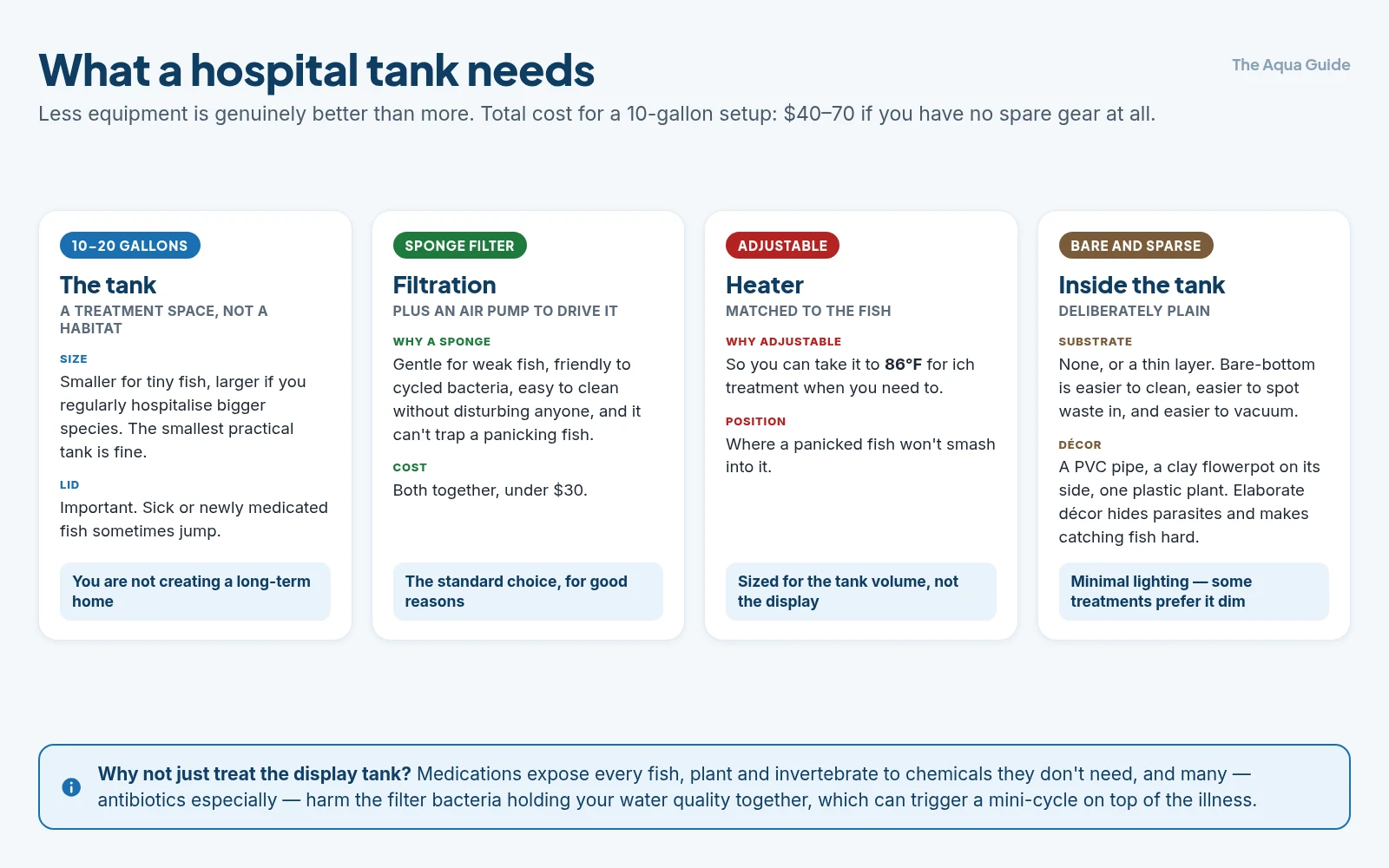
The good news: hospital tanks are simple. Less equipment is actually better than more.
Tank size: 10–20 gallons is plenty for most situations. Smaller for tiny fish; larger if you regularly hospital larger species. The smallest practical tank is fine — you're not creating a long-term habitat, just a treatment space.
Filter: A small sponge filter is the standard choice. Sponge filters are:
- Gentle (good for weak/sick fish)
- Cycled-bacteria-friendly
- Easy to clean without disturbing fish
- Inexpensive
- Don't trap fish during medication-induced stress
Sponge filters need an air pump to drive them. Both together cost under $30.
Heater: Match the temperature your fish need. A small heater appropriate for the tank volume — adjustable so you can use 86°F for ich treatment if needed.
Lighting: Minimal. A small light is fine; some treatments (velvet, for instance) prefer dim conditions, so being able to keep lights low is useful.
Substrate: None, or a thin layer. Bare-bottom tanks are easier to clean during treatment, easier to spot waste, and easier to vacuum. Most experienced keepers prefer bare-bottom hospital tanks.
Décor: Sparse. A piece of PVC pipe, a clay flowerpot on its side, or a single plastic plant gives sick fish a place to hide and feel secure. Avoid elaborate décor — it makes catching fish harder and provides places for parasites to lurk.
Lid: Important. Sick or newly-medicated fish sometimes jump.
Heater protector: If treating skittish or jumpy fish, ensure the heater is positioned where panicked fish won't smash into it.
Total cost for a 10-gallon hospital setup: $40–70 if you don't already have spare equipment.
Maintaining the Hospital Tank
Two approaches, both valid:
Approach 1: Always-Cycled Hospital
Keep the hospital tank set up and running permanently, with the sponge filter holding bacteria. Need to feed the bacteria — either:
- A few hardy "guinea pig" fish living permanently in the hospital tank (a few cherry shrimp or a hardy tetra works)
- Periodic ammonia dosing (fishless cycling maintenance)
- A regular tiny pinch of food to feed the bacteria
Advantages: Always ready when needed; bacteria can handle bioload immediately.
Disadvantages: Need to maintain a permanently-running tank; the guinea-pig fish (if used) get exposed to whatever treatments you run.
Approach 2: On-Demand Hospital
Keep the hospital tank empty and stored between uses. When needed:
- Set up the tank with fresh water + dechlorinator
- Move a seasoned filter sponge from your main tank's filter to seed bacteria
- Or use a piece of established filter media you keep stored in a bag with periodic ammonia
Advantages: No permanent ongoing maintenance; tank only operates when needed.
Disadvantages: Need to plan ahead — borrowing media from main filter weakens it temporarily; in true emergencies, the tank starts uncycled.
For most beginners, Approach 2 (borrowed media on demand) is simpler. As your hobby grows, an always-cycled hospital becomes worth maintaining.
Setting Up for a Treatment
When you need to use the hospital tank:
1. Prepare the water. Same source as your display tank, dechlorinated, temperature-matched to where you'll treat.
2. Seed the filter. Move a seasoned sponge or media from your display filter; or use stored seasoned media; or accept it will partially cycle during treatment.
3. Set the heater. To target temperature (sometimes elevated for ich, sometimes lower for columnaris, sometimes normal).
4. Add the basic décor. PVC pipe or hiding spot.
5. Acclimate the sick fish using a proper drip or float-and-mix from the display to the hospital. Sick fish are extra-stressed by transfers — be gentle.
6. Add medication according to the diagnosis and product label.
7. Observe carefully. Take notes if treatment is multi-stage.
During Treatment
A few practices help during the treatment period:
Daily water changes of 20–25%. Use water matched to the hospital tank conditions; re-dose medication to maintain concentration (most medications need fresh dosing after water changes).
Reduce feeding significantly. Sick fish eat little. Feed sparingly so uneaten food doesn't foul the small tank.
Monitor ammonia and nitrite. Without an established cycle, parameters can spike — water changes mitigate this.
Adjust heater carefully. If treating ich at 86°F, ensure aeration is heavy. If treating columnaris at lower temperatures, return slowly.
Note behavioral changes. Improvement (eating, activity, color return) and worsening (more lethargy, new symptoms) both inform whether treatment is working.
Don't disturb unnecessarily. Each disturbance stresses already-sick fish. Quick water changes, gentle handling.
After Treatment
When treatment is complete:
1. Gradually return the fish to the display tank if recovered. Some keepers add a post-treatment observation period (a week of clean conditions, no medication) to confirm recovery sticks.
2. Acclimate carefully going from hospital water (possibly different temperature, possibly residual medication) back to display water.
3. Remove medication residue from the hospital tank with several large water changes and activated carbon. Don't leave medication-saturated water sitting.
4. Clean the hospital tank thoroughly if a contagious condition was treated — bleach rinse (1:20), thorough water rinse, drying for a few days, before next use.
5. If using an on-demand approach, drain and store the tank ready for the next use.
Common Hospital Tank Uses
What hospital tanks are typically used for:
Treating sick fish with medications that would harm the display tank ecosystem (invertebrates, sensitive species, plants).
Quarantining new fish before adding to the main tank (same setup, different purpose). Many keepers use a single tank for both functions, alternating roles.
Recovering injured fish that need to escape harassment from tankmates — a fish with damaged fins given a peaceful recovery space heals faster.
Treating pregnant livebearers that need a calm space to give birth without losing fry to hungry tankmates.
Acclimating wild-caught or sensitive species before they join a community.
Spawning setups — some species need controlled conditions to breed, and a hospital tank doubles as a breeding setup.
Tips and Common Mistakes
Don't try to make it look pretty. Hospital tanks aren't display tanks. Function over form. Sparse, bare-bottom, minimal décor is correct.
Don't share equipment without disinfection. Nets, siphons, hands moving between hospital and display tanks can spread disease. Dedicate equipment to the hospital, or disinfect thoroughly between tanks.
Don't leave medication running indefinitely. Long medication exposure stresses fish; complete the treatment course, then transition to clean conditions for recovery.
Don't treat with multiple medications at once without research. Some combinations are dangerous or counterproductive.
Don't return fish too soon. A few days of clean-water recovery confirms the disease is actually gone before reintroducing to the display.
Don't forget the hospital tank exists between uses. Periodic checks on the empty setup (or maintenance of always-cycled version) keeps it ready.
The Bottom Line
A hospital tank is one of the most useful tools an aquarium keeper can add — a small, simple, sparse 10–20 gallon setup with a sponge filter, heater, minimal décor, and a lid, used for isolating and treating sick fish. The advantages over treating in the display tank are real: medications stay contained, healthy fish aren't exposed, the sick fish gets calm focused care, and observation is easier. Choose between always-cycled (ready immediately, requires ongoing maintenance) or on-demand (set up when needed, requires planning) approaches based on your hobby scale. During treatment, do daily water changes, reduce feeding, monitor carefully, and don't disturb unnecessarily. Combined with quarantine of new fish (often using the same setup), the hospital tank is foundational to long-term fish health success — and inexpensive enough that there's no good reason not to have one.
Related guides
- Quarantine: why and how
- Aquarium medications: when to use what
- Common aquarium diseases: treatment lookup
- Ich (white spot): identification and treatment
- Velvet, columnaris and other bacterial issues
- Fin rot: causes, recognition and recovery
- Choosing the right filter: HOB vs sponge vs canister
- The beginner's guide to fish disease
Got questions about your specific setup? Drop them in our Community Forum — we love helping new fishkeepers get started right.