The single most valuable skill in fishkeeping is learning to read your fish — to notice the difference between a thriving fish and one that's quietly stressed before stress becomes illness. Most aquarium problems give you warning signs days before they become emergencies; the keepers who don't lose fish are the ones who recognize those signs early. Here's what to look for.
At a glance: healthy against stressed
| Healthy | Warning sign | |
|---|---|---|
| Behaviour | Active and exploratory, moving through the whole tank | Persistent hiding by fish that don't normally hide; daytime lethargy |
| Colour | Full, species-typical intensity | Faded colour, especially over a short period |
| Fins | Erect, intact, fully spread | Clamped — held tight to the body. One of the earliest physical signs |
| Breathing | Steady and calm — visible, but not laboured | Gasping at the surface, or hovering by the filter outflow, seeking oxygen |
| Eating | Eager but not frantic | Consistently refusing food it normally eats |
| Body | Smooth lines, no swelling or sunken belly | Spots, growths, cottony patches, sunken belly, bloating, cloudy or bulging eyes |
| Swimming | Steady and controlled | Darting, spiralling, sideways or upside-down, or shimmying in place |
| Skin | Clean | Scratching and flashing against rocks and décor; heavy slime coat |
Don't panic at small things. A fish occasionally hiding, occasionally scratching, occasionally skipping a meal is normal variation. It is patterns and combinations that matter.
What Healthy Fish Look Like
Start by knowing what good looks like. A healthy fish in a healthy tank shows:
Active, exploratory behavior. Healthy fish swim with purpose — exploring, foraging, interacting with tankmates, investigating their environment. They move through different parts of the tank, not stuck in one corner.
Bright, full coloration. Each species has its typical color intensity. Healthy fish wear their colors fully — neons are vividly striped, platies are saturated, tetras shimmer. Faded color is a warning sign.
Erect, intact fins. Fins are fully spread, no clamping (held tight against the body), no tearing, no fraying, no discoloration. Long-finned species hold their fins out and flowing.
Steady, calm breathing. Gills work at a steady rhythm — fast enough to see but not labored. You shouldn't notice obvious gasping or hyperventilating.
Eager but not frantic eating. At feeding time, healthy fish come up quickly and eat with interest. Not desperate, not refusing.
Normal body shape. Smooth body lines, no abnormal swelling, no sunken belly, no obvious lumps or growths.
Smooth swimming. Steady, controlled movement — not erratic darting, not floating sideways, not sinking helplessly.
Social behavior appropriate to species. Schoolers in their group, bottom-dwellers exploring the bottom, top-feeders patrolling the surface. They're doing what their species does.
If most of your fish, most of the time, look like this, your tank is healthy.
Behavioral Warning Signs
Behavior usually shifts before physical symptoms appear. Watch for:
Persistent hiding. Some hiding is normal — bottom-dwellers like cover, new fish hide for a day or two, schooling fish hide if their group is too small. Persistent hiding by fish that normally don't hide is a warning. Something is making them want to disappear.
Lethargy. Fish that hang in one spot, barely moving, or that spend the day in corners or behind décor. Different from resting (most fish do rest, especially at night) — this is daytime inactivity in fish that should be active.
Loss of appetite. A fish that consistently refuses food it normally eats is sending a strong signal. Single missed meals can happen; persistent disinterest is concerning.
Gasping at the surface. Fish coming up repeatedly to "breathe" the surface usually means oxygen is low — could be poor surface agitation, overstocking, high temperature, ammonia toxicity, or gill problems. Take it seriously.
Scratching, flashing, or rubbing against surfaces. Fish rubbing themselves on rocks, substrate, or décor is often a sign of irritation — parasites (ich, flukes), water quality issues, or chemical irritants. Occasional brief scratching can be incidental; repeated or persistent flashing is a real warning.
Erratic swimming. Sudden darting, spiraling, swimming sideways or upside-down, or "shimmying" in place (back-and-forth shaking without forward motion) all indicate something is wrong — usually water quality, neurological issues, or severe stress.
Hanging near filter outflow or surface. Fish persistently hovering near the filter outflow are often seeking oxygenated water, which means oxygen is low elsewhere.
Aggressive or fearful behavior changes. A formerly peaceful fish becoming aggressive, or an active fish becoming withdrawn, is a meaningful behavioral shift worth investigating.
Physical Warning Signs
When stress goes long enough, physical signs follow. Watch for:
Clamped fins. Fins held tight against the body instead of spread. This is one of the earliest physical signs of stress, illness, or poor water quality. A fish with clamped fins is telling you something is wrong.
Faded color. Loss of normal color intensity, especially over a short period. Could be water quality, disease, or chronic stress.
Visible spots or growths. White spots (ich), gray patches (fungus or bacterial), velvety dusting (velvet), cottony growths (fungal infection), red sores, or any abnormal markings call for attention.
Sunken belly. A noticeably hollow or thin appearance — often a sign of long-term issues (parasites, malnutrition, internal disease).
Bloated or swollen body. Could be constipation (often from overfeeding or dry foods), dropsy (a serious bacterial infection causing visible pinecone-like raised scales), or internal issues.
Cloudy or popped eyes. Cloudy eyes can indicate bacterial infection or poor water quality. Bulging eyes ("popeye") is a serious sign needing intervention.
Fin damage. Ragged, eroding, white-edged, or rotting fins — fin rot, often bacterial, often secondary to water quality issues or stress.
Excess slime coat or visible mucus. Heavy slime is the fish's stress response — common in poor water or chemical exposure.
Heavy breathing or gill discoloration. Rapid gill movement, gasping, or red/inflamed gills — often water quality issues (ammonia, nitrite) or gill infections.
Reading the Patterns
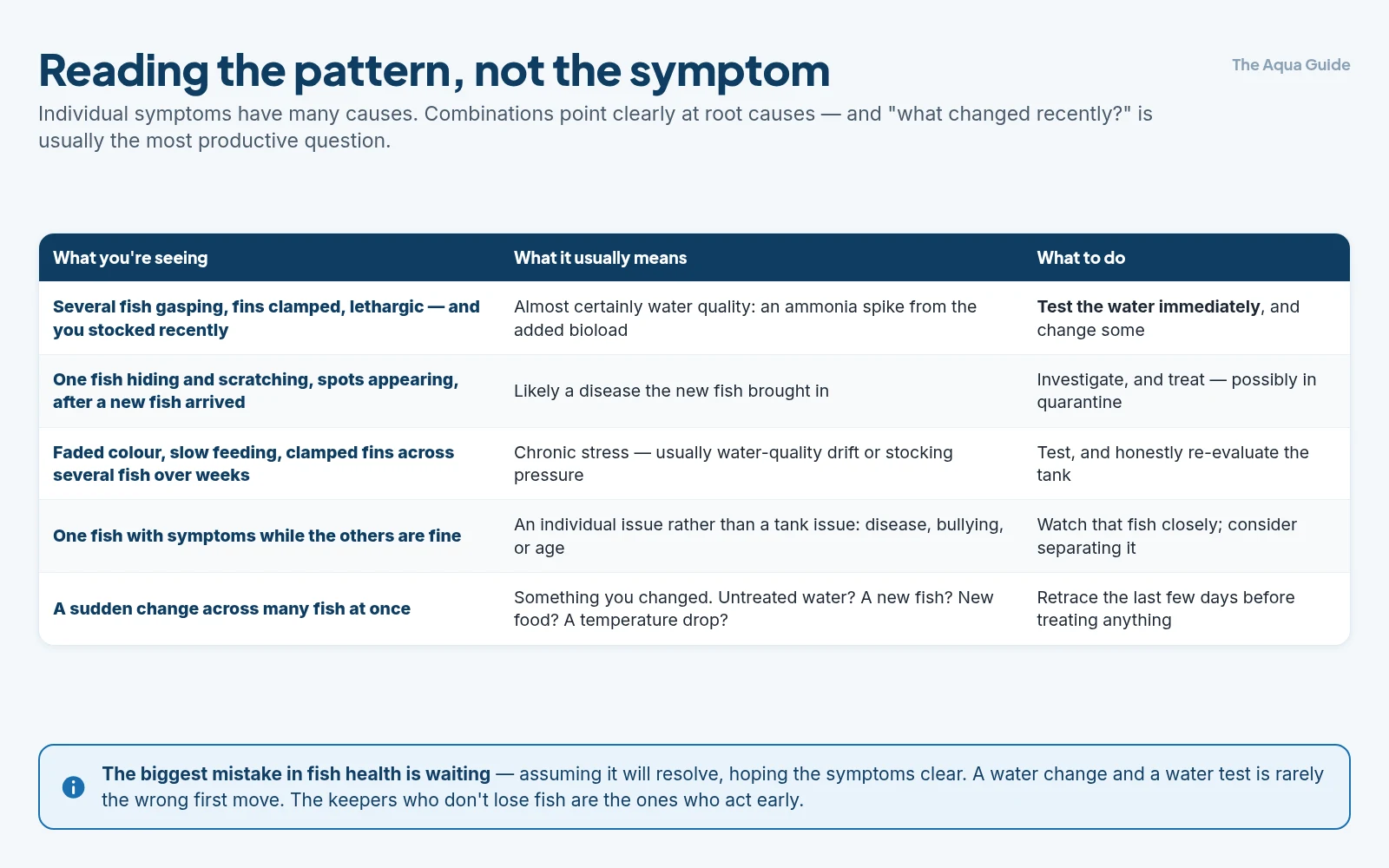
Individual symptoms can have multiple causes, but patterns of symptoms often point clearly at root causes. A few useful mental connections:
Multiple fish gasping + clamped fins + lethargy + recent stocking change → almost certainly water quality (ammonia spike from added bioload). Test water immediately.
One fish hiding + scratching + spots appearing + recent new fish addition → likely disease introduced by the new fish. Investigate, possibly treat.
Faded color + slow feeding + clamped fins on multiple fish over weeks → chronic stress, often water quality drift or stocking pressure. Test water, evaluate tank.
One specific fish showing symptoms while others are fine → individual issue rather than tank issue. Could be disease in that fish, social stress (bullying), or aging.
Sudden behavior change across many fish → recent environmental change. Did you do a water change with un-treated water? Add a new fish? Change food? Drop in temperature?
Asking "what changed recently?" is usually the most productive diagnostic question.
Acting on What You See
The point of observation isn't just noticing — it's responding. A few practical responses:
Mild symptoms in one fish: observe more closely over the next day or two. Many minor stresses pass on their own. If symptoms worsen or spread, act sooner.
Multiple fish affected or symptoms worsening: test water immediately. Water quality is the most common cause of multi-fish issues. A water change is rarely the wrong response.
Visible disease (spots, growths, fin damage): identify the likely cause and treat appropriately. Most common diseases (ich, fin rot, fungus) have well-known treatments. Some need quarantine.
Anything serious or fast-moving: act immediately. A water change while you research is often the best first step — fresh water rarely hurts and frequently helps.
The biggest mistakes in fish health are waiting — assuming things will resolve, hoping symptoms will clear — when symptoms actually need intervention. The keepers who don't lose fish are the ones who act early.
Building the Observation Habit
The 2-minute daily look (in the maintenance routine) is where this skill develops. A few practical tips:
Make it part of feeding time. When you feed, you're naturally watching the tank — pay attention to how fish come up to eat, not just whether they do.
Compare to "normal." Once you know what your specific fish look like when they're thriving, deviations stand out. Pattern recognition only works if you know the pattern.
Watch through different parts of the day. Fish behave differently at lights-on, mid-day, evening, and lights-off. Some species are more active at certain times. Notice the rhythm.
Look at individuals. It's easy to scan the tank and miss that one fish is acting differently. Take a moment to count fish and observe each one's behavior.
Don't panic at small things. A fish occasionally hiding, occasionally scratching, occasionally not eating one meal — these are normal variations. It's patterns and combinations of symptoms that matter.
The Bottom Line
Spotting a healthy versus stressed fish is the most valuable skill in fishkeeping — and it comes from consistent observation rather than expert knowledge. Healthy fish are active, brightly colored, fins fully spread, breathing steadily, eating eagerly, and behaving like their species normally does. Stressed fish hide persistently, lose color, clamp fins, gasp at the surface, scratch against surfaces, lose appetite, develop visible spots or growths, or behave erratically. Watch for patterns of symptoms (especially across multiple fish), ask "what changed recently?" when problems appear, and act early rather than waiting — a water change and water test is rarely the wrong first move when you see warning signs. Build the 2-minute daily observation into your routine, learn what normal looks like for your tank, and catch issues while they're small. That habit alone prevents most fish losses beginners experience.
Related guides
- Common aquarium diseases: treatment lookup
- The beginner's guide to fish disease
- What are safe ammonia, nitrite and nitrate levels?
- Quarantine: why and how
- The daily, weekly and monthly maintenance checklist
- Ich (white spot): identification and treatment
- Fin rot: causes, recognition and recovery
- Do I need an air pump or airstone?
Got questions about your specific setup? Drop them in our Community Forum — we love helping new fishkeepers get started right.