Air pumps and airstones are one of those classic pieces of aquarium equipment that seem essential at first glance — the iconic bubbling stream is part of how many people picture an aquarium — but the actual answer is more nuanced. Here's when an air pump or airstone is genuinely useful, when it's optional, and the few situations where it really does matter for your fish.
At a glance: setting one up properly
| Do | Why |
|---|---|
| Match the pump to your tank | Most are sized by volume, and slightly oversized is fine |
| Fit a check valve in the air hose | A one-way valve stops water siphoning back into the pump if the power cuts — a small detail that prevents real damage |
| Stand the pump on something soft, or use isolators | It is the vibration, not the air, that makes the noise |
| Replace airstones periodically | They clog with mineral deposits and produce weaker bubbles |
| Adjust the bubble intensity with a flow control valve | For some applications gentle bubbles are better than aggressive ones |
The mechanism is worth knowing: oxygen enters water at the surface, where water meets air. Bubbles do some direct gas exchange as they rise, but the bigger effect is the surface disturbance they make when they pop.
What an Air Pump and Airstone Actually Do
The pump itself sits outside the tank and pushes air through a hose to an airstone (or other diffuser) submerged in the water, producing a stream of bubbles. A common assumption is that the bubbles themselves are oxygenating the water — but the real mechanism is slightly different and worth understanding.
Oxygen enters water primarily at the surface, where water meets air, in a process called gas exchange. The more the surface is agitated — broken up, moved, ripple-y — the more oxygen dissolves into the water. The bubbles from an airstone do some direct gas exchange as they rise, but the bigger effect is the surface disturbance they create when they pop at the top. That ripple is doing most of the work.
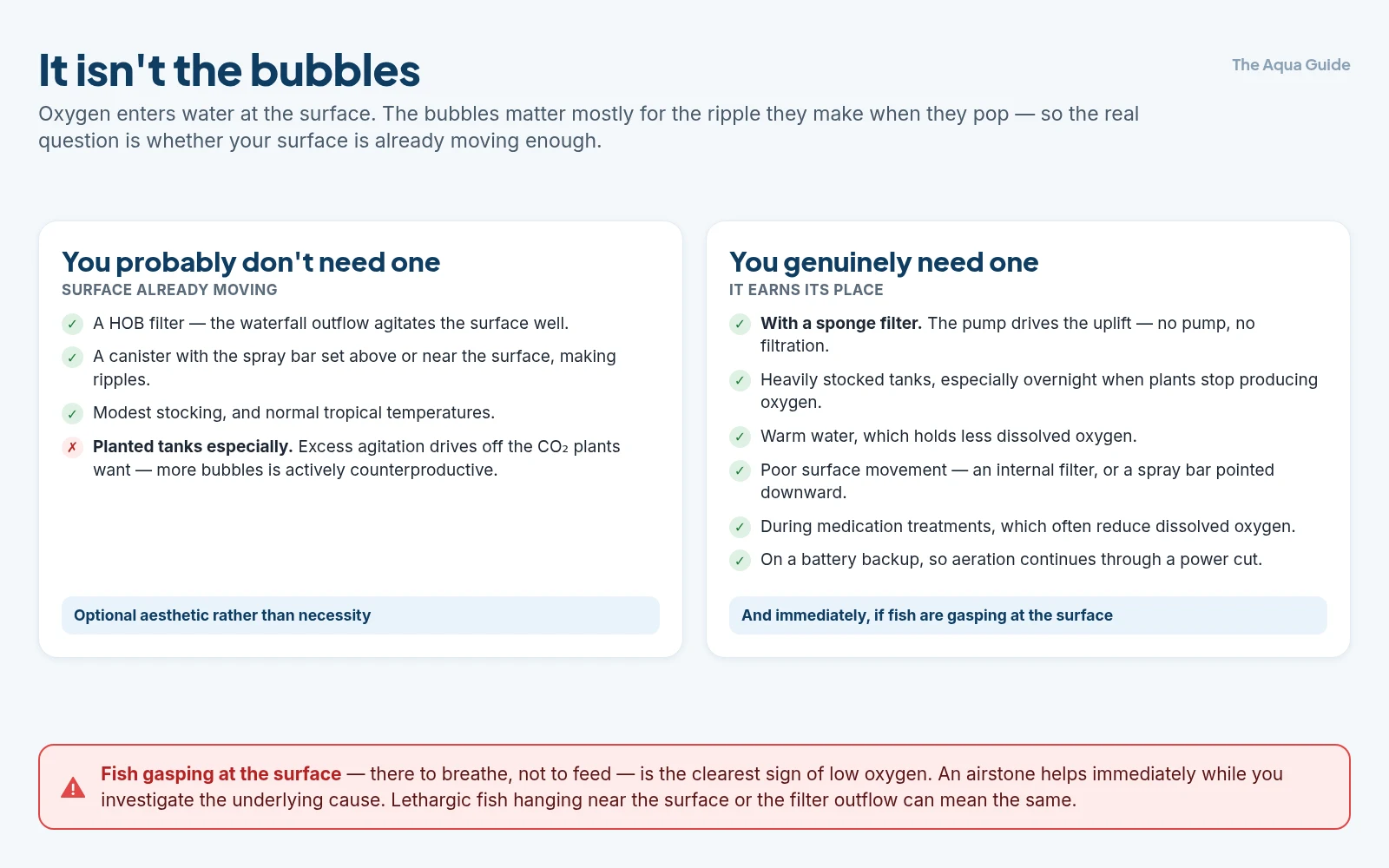
This insight changes the framing entirely. The question isn't really "do I need bubbles?" — it's "does my tank have enough surface agitation to keep oxygen levels healthy?" If your filter (especially a HOB with its waterfall return) is already creating good surface movement, you may already have plenty of oxygenation without any air pump at all.
When You Don't Need an Air Pump
For many typical aquariums, the honest answer is you don't need one. If you have:
- A HOB filter (the waterfall outflow agitates the surface well), or
- A canister filter with a spray bar set above or near the surface (creates ripples), or
- Modest stocking levels (not packed with oxygen-hungry fish), and
- Normal temperature (warm water holds less oxygen, but tropical norms are fine)
…then your tank likely has adequate oxygenation already, and adding an air pump is optional aesthetic rather than necessity. Many planted tanks deliberately avoid excess surface agitation because it drives off CO₂ that plants want — for these tanks, more bubbles is actively counterproductive.
When You Genuinely Need One
That said, there are situations where an air pump or airstone earns its place:
With a sponge filter. Sponge filters require an air pump to function — the air pump drives the uplift that pulls water through the sponge. No air pump, no filtration. If you've chosen a sponge filter (for shrimp, fry, breeding, or a quarantine tank), the pump is essential, not optional.
Heavily-stocked tanks. More fish means more oxygen consumption. Tanks pushing stocking limits, or with large/active species, may need supplemental aeration to keep oxygen levels comfortable, especially overnight when plants stop producing oxygen.
Warm water. Warmer water holds less dissolved oxygen — so tanks running hotter than typical (some species require this, or hot summer rooms) benefit from additional aeration to compensate.
Tanks with poor surface movement. If your filter setup leaves the surface still — like some internal filters, or canisters with spray bars pointed downward — adding an airstone restores surface agitation and gas exchange.
Medication treatments. Many medications reduce dissolved oxygen in water, so during treatments it's standard practice to add extra aeration to compensate.
Power-outage backup. Some keepers run an air pump on a battery backup so that if the main filter fails (power cut), at least aeration continues. Especially useful for heavily-stocked tanks.
Fish that show oxygen distress. If fish are gasping at the surface persistently — not eating, but actually gulping for air — that's a strong signal of low oxygen, and an airstone provides immediate help while you investigate the underlying cause.
Diagnosing: Do I Need More Oxygenation?
Before assuming you need an air pump, look at the signs. Fish gasping at the surface repeatedly is the clearest indicator of low oxygen — fish there to breathe, not to feed. Lethargic fish hanging near the surface or filter outflow can also indicate low oxygen. Heavy summer heat with no surface movement is a high-risk combination. If you see these signs, more aeration helps.
Conversely, if your fish are active throughout the tank, exploring, eating, and behaving normally, oxygen levels are probably fine — adding an air pump won't hurt (provided it doesn't disturb plant-heavy CO₂ setups), but it isn't urgent.
A Note on Planted Tanks
Planted tanks have a particular relationship with surface agitation. Live plants produce oxygen during the day (which they make from CO₂), and CO₂ is the limiting nutrient for plant growth. Excessive surface agitation drives off both CO₂ and oxygen — bad for plants. So most planted-tank keepers minimize surface turbulence during the day and may add aeration only at night, when plants consume oxygen rather than producing it, or run a quieter setup that balances both. If you have a planted tank, don't add an air pump reflexively; consider whether your setup already balances things.
Choosing and Setting Up an Air Pump
If you decide to add one, a few practical tips. Match the pump size to your tank — most are sized by tank volume, and slightly oversized is fine. Use a check valve in the air hose (a one-way valve) to prevent water from siphoning back into the pump if the power cuts — a small detail that prevents real damage. Place the pump on a soft surface or use isolators to reduce vibration noise. Replace airstones periodically when they get clogged with mineral deposits and produce weaker bubbles. And adjust the bubble intensity with a flow control valve if needed — for some applications, gentle bubbles are better than aggressive ones.
The Bottom Line
The bubbles from an air pump and airstone work mostly by agitating the surface to drive gas exchange — and if your filter already creates good surface movement (HOB waterfall, canister spray bar at the surface), you likely don't need supplemental aeration in a normally-stocked tank. Air pumps become genuinely necessary when you're running a sponge filter (which requires one), when your tank is heavily stocked or runs warm, when surface agitation is poor, during medication treatments, or when fish show oxygen distress. Planted-tank keepers should be especially thoughtful, since excess surface movement drives off CO₂ that plants want. So don't add an air pump reflexively — assess your situation, look for the actual signs of low oxygen, and add aeration where it serves a real purpose.
Related guides
- Choosing the right filter: HOB vs sponge vs canister
- CO₂ injection: pressurised systems and alternatives
- What equipment do you actually need vs store upsells
- How to spot a healthy vs stressed fish
- Aquarium medications: when to use what
- The beginner's guide to aquarium equipment
- Heater sizing and placement
- How many fish can my tank hold?
Got questions about your specific setup? Drop them in our Community Forum — we love helping new fishkeepers get started right.