For tropical fish, the heater is one of the two pieces of equipment whose failure can end a tank quickly — so getting it right matters. The good news is heater sizing and placement come down to a few clear rules. Here's how to choose the right wattage for your tank, where to place it for even heat distribution, and the safety habits that prevent the most common heater disasters.
At a glance: the warning signs
| What you see | What it means | What to do |
|---|---|---|
| Colder than the set temperature | Undersized, failing, or the thermostat has drifted | Verify with an independent thermometer, then replace |
| Warmer than set, or visibly climbing | Stuck on — a runaway | Unplug immediately. This is a real emergency |
| Clicking audibly, and often | Normal heaters cycle quietly | Replace |
| Cracks, fogging or scorching | On its way out | Replace, not repair |
For tanks above roughly 50–75 gallons, many keepers split the load between two smaller heaters at opposite ends. Heat spreads more evenly, and if one fails — off or on — the consequences are halved. A 75-gallon might run two 150 W heaters rather than one 300 W.
Why Heaters Matter (And Why Sizing Does)
Tropical fish need a stable, warm temperature — most freshwater species are happy somewhere in the mid-to-high 70s°F (24–27°C), and what they really need is steadiness, not just warmth. A heater that's too small struggles to keep up — it runs constantly, the tank slowly drifts cool when room temperature drops or you do a water change, and it wears out faster. A heater that's the right size cycles on and off gently, holding temperature stable with margin to spare. The right wattage isn't about heating power for its own sake; it's about stability.
The other side of heater importance is the risk of failure. A heater that fails off (stops heating) is a slow problem you can catch and fix. A heater that fails on (stuck heating, runaway) can cook a tank in hours. Reliability matters, which is why buying a known-brand heater rather than the cheapest no-name option is genuinely worth the small extra cost.
Sizing Rule of Thumb
The classic guideline that works well for most tanks:
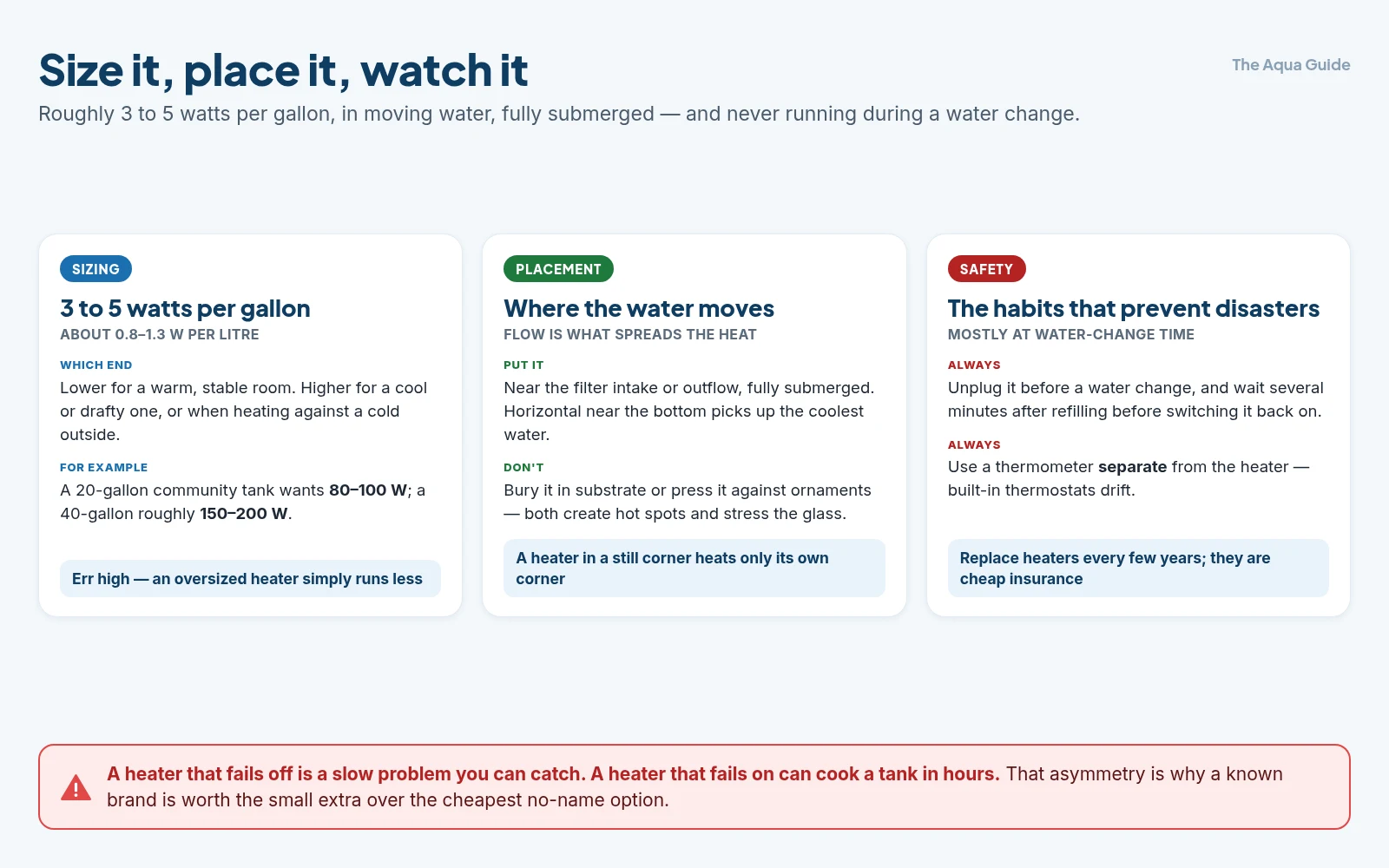
Roughly 3 to 5 watts per gallon (about 0.8–1.3 W per litre).
Use the lower end if your room stays warm and stable, the higher end if your room is cool or drafty, or if you're heating against a colder outside temperature. For tanks in particularly cold rooms or unheated spaces, scale up further; for tanks in consistently warm rooms, you can be at the lower end.
A few practical examples to anchor this: a typical 20-gallon community tank in a moderately-warm room is well-served by an 80–100 W heater. A 40-gallon by roughly 150–200 W. Bigger tanks scale up similarly. Many heater products are sold pre-sized to volume — check the manufacturer's recommendation, then check it against the wattage-per-gallon principle, and lean a bit higher rather than lower if you're between sizes.
The cost of going slightly oversized is essentially nothing — the heater simply runs less. The cost of being undersized is real — temperature drift, struggling equipment, and wear. So err high.
Two-Heater Setups for Larger Tanks
For tanks above roughly 50–75 gallons, many experienced keepers split the load between two smaller heaters rather than running one large one. The benefits are real: heat distributes more evenly across a longer tank, and if one heater fails (off or on), the consequences are halved — the other still provides some warmth, and a runaway heater is less catastrophic at lower wattage. For example, a 75-gallon tank might run two 150 W heaters at opposite ends instead of one 300 W. It's an inexpensive insurance policy for bigger setups.
Placement: Where to Put the Heater
Where you place the heater has a real impact on how evenly your tank heats and how reliably it works. A few principles:
Place the heater in a spot with good water flow — typically near the filter intake or outflow, where moving water carries the heat around the tank. A heater stuck in a still corner heats only its immediate area while the far end of the tank stays cool. Flow is what distributes heat evenly.
Mount it on the back or side glass, angled or horizontal, fully submerged. Most modern heaters are submersible, meaning the entire unit can be underwater. Mounting horizontally near the bottom (where water is coolest) helps it pick up the cooler water that needs heating most. Vertical mounting is also fine if the heater is fully submerged.
Don't bury the heater in substrate or press it against ornaments — both create hot spots and stress the glass. Leave it suspended in open water with flow around it.
For tanks longer than about 36 inches, place the heater (or both heaters) where flow distributes heat best, ideally not all at one end.
Safety Habits That Prevent Disasters
A short list of habits that prevent the heater-related accidents that occasionally wreck tanks.
Always unplug the heater before water changes or any work that drops the water level. A hot heater exposed to air can crack from thermal shock, and depending on the model, it can also overheat and fail. Make it a fixed step: water change starts with unplugging the filter and the heater.
Wait several minutes after refilling before turning the heater back on. This lets the glass acclimate to the new water temperature, avoiding thermal shock.
Always use a thermometer separate from the heater. Heaters' built-in thermostats can drift; an independent stick-on or digital thermometer lets you verify the actual temperature and catch a malfunctioning heater early.
Position the temperature dial above the waterline if possible so you can adjust without getting wet, and so any condensation on the dial can dry rather than soaking the controls.
Replace heaters every few years, especially if they're aging or have ever shown odd behavior. Heaters are cheap insurance; a tired heater is a future emergency.
Signs a Heater Is Failing
A few warning signs worth knowing. A tank that's colder than the set temperature suggests the heater is undersized or failing (or its thermostat has drifted). A tank that's warmer than the set temperature, or visibly climbing, suggests the heater is stuck on — a real emergency; unplug immediately and replace. A heater that clicks audibly often (normal heaters cycle quietly) or shows cracks, fogging, or scorching is on its way out. Any of these symptoms calls for replacement, not repair.
The Bottom Line
Size your heater at roughly 3–5 watts per gallon, leaning toward the higher end for cool rooms or larger water changes, and never err on the small side. For tanks above roughly 50–75 gallons, consider two smaller heaters split across the tank for even heat and safety redundancy. Place the heater fully submerged, in a spot with good water flow (near the filter), not buried in substrate or pressed against décor. Always unplug it during water changes, use an independent thermometer to verify temperature, and replace aging units before they fail. A properly-sized, properly-placed, regularly-watched heater keeps your tropical fish comfortably stable for years — and gets you past the single piece of equipment whose failure causes the most preventable damage.
Related guides
- Water parameters cheat sheet
- The beginner's guide to aquarium equipment
- What equipment do you actually need vs store upsells
- The correct step-by-step water change
- Choosing the right filter: HOB vs sponge vs canister
- What causes a nitrogen cycle crash?
- The daily, weekly and monthly maintenance checklist
- First aquarium setup: a day-by-day beginner's guide
Got questions about your specific setup? Drop them in our Community Forum — we love helping new fishkeepers get started right.