Every aquarium is a small machine made of a few core parts working together. Understanding what each piece does — and why — turns equipment from an intimidating shopping list into a system you can actually reason about. This is the hub for everything gear-related. Each topic below opens into a more detailed guide, but by the end of this page you'll know what every essential piece of equipment does, how the pieces fit together, and what really matters when you buy.
At a glance: what each piece is for
| Equipment | Its job |
|---|---|
| Filter | Moves water, traps debris, and — most importantly — houses the bacteria that keep ammonia and nitrite at zero |
| Heater | Holds a steady temperature. Tropical fish need steadiness more than they need warmth |
| Light | So you can see the tank, and so live plants can photosynthesise |
| Substrate | The floor of the tank, and somewhere for roots to hold |
| Water conditioner | Neutralises chlorine and chloramine in every drop of tap water you add |
| Test kit | The only way to see the things that matter, since good and bad water look identical |
Sizing matters more than brand on most of these. An undersized filter or heater causes problems that no amount of quality elsewhere compensates for.
The Core Equipment, and What Each Does
A working freshwater aquarium needs a short list of equipment. Here's what each piece is for — the job it does in your tank.
The filter is the heart of the system. It moves water, traps debris, holds your beneficial bacteria, and (with the right media) can polish or chemically treat the water. The filter is the most consequential piece of equipment you'll buy, because the biological filtration it houses is what keeps your fish alive. There are several types — hang-on-back, sponge, canister — each with their own strengths, which is its own guide.
The heater keeps water at a stable temperature for tropical fish. The key word is stable — sudden swings stress fish and damage your bacteria. Sizing the heater to your tank and placing it where flow distributes heat evenly are simple but important details, covered in their own guide.
The light lets you see your fish and lets plants photosynthesize. For a basic tank with hardy plants, a standard aquarium light is plenty; only demanding planted setups need high-output lighting. The art is in the schedule (photoperiod), not the wattage, which is worth understanding on its own.
Filter media is the stuff inside your filter that actually does the work — sponges for mechanical filtration, ceramic or biomedia for bacteria, activated carbon or other chemical media when needed. Understanding what each media type does (and what you actually need vs. what stores sell) is one of the most useful things a beginner can learn.
Beyond these essentials, a few situational items round out the list: an air pump or airstone for extra oxygenation in specific cases (often not strictly needed), a UV sterilizer for tackling persistent green water or pathogens (specialty gear, not for everyday use), a test kit for monitoring water (genuinely essential, covered in the water-quality section), and basic maintenance tools — net, bucket, gravel vacuum.
That's the entire equipment universe. Filter, heater, light, media, plus a handful of optional add-ons. Everything else is accessory.
The Mental Model: How It All Fits Together
It helps to picture how the pieces interact. The filter pulls water through media, where mechanical layers catch debris and biological media hosts the bacteria that detoxify ammonia and nitrite. The heater warms the moving water, and the filter's circulation distributes the heat evenly. The light governs the day/night cycle for plants and fish. Your maintenance — water changes, feeding, cleaning — keeps the whole system from accumulating waste. The fish live inside this circulating, heated, illuminated system, and every piece supports the biology that supports them.
When equipment fails or is sized wrong, the effects ripple outward. An undersized filter can't handle your fish's waste — water quality slips, bacteria struggle, fish suffer. An unreliable heater swings the temperature and stresses both fish and bacteria. Too much light without matching nutrients fuels algae. Understanding the connections is what turns equipment shopping from guesswork into reasoned choice.
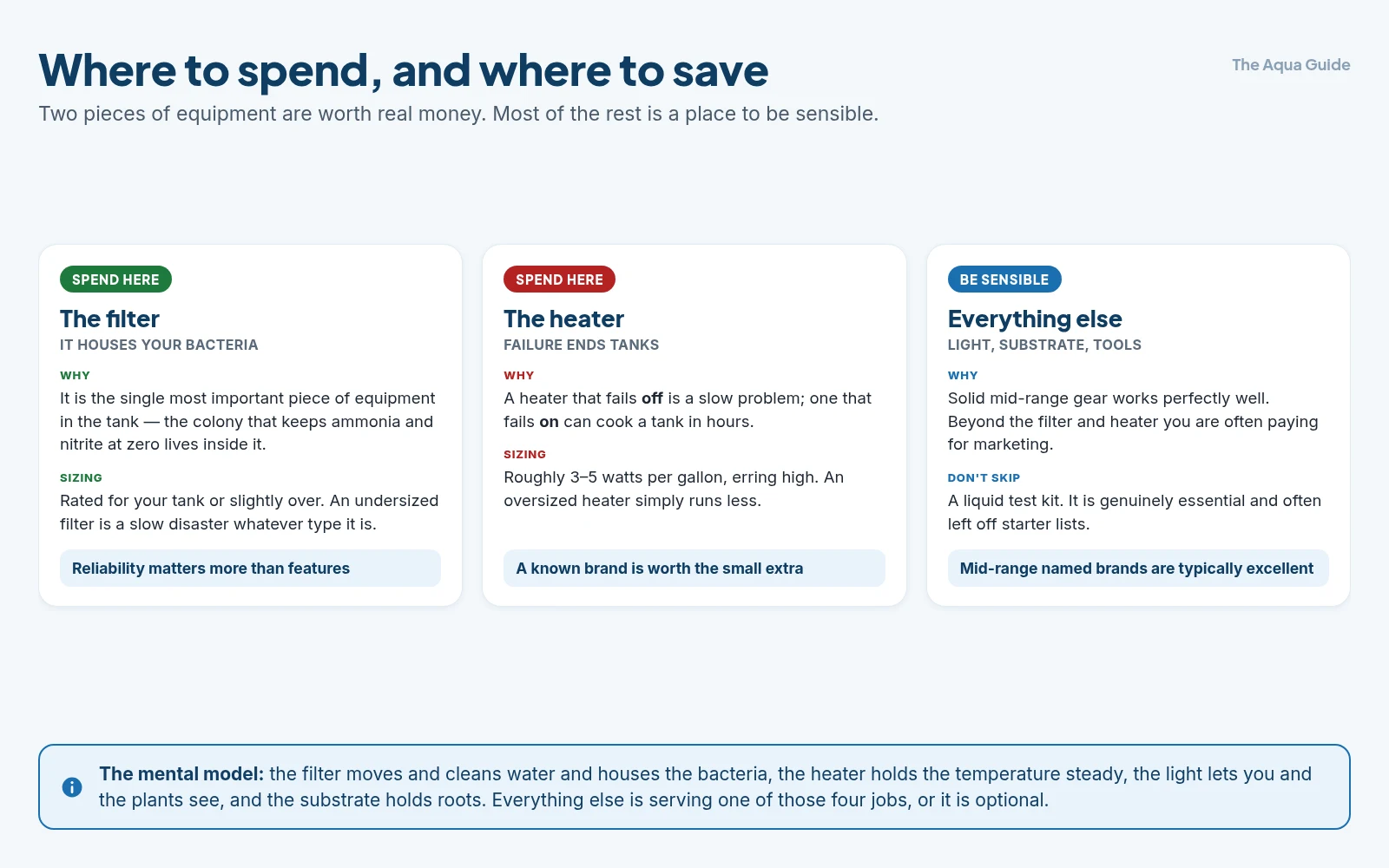
Where to Spend (and Where to Save)
A practical framework for budgeting. The two items worth buying reliable, decent-quality versions of are the filter and the heater — because both failing has serious consequences. A filter that breaks or is undersized causes a slow decline in water quality; a heater that fails cold or, worse, runs away hot can wipe out a tank. You don't need top-of-the-line gear, but the cheapest no-name option is a false economy.
Everything else is more flexible. A standard light is fine unless you're growing demanding plants. Substrate can be basic gravel. Media beyond the essentials (mechanical sponge, biological media) is often optional or replaceable with cheaper alternatives. Décor is whatever fits your taste. Save here freely, but don't cheap out on the filter and heater that keep your fish alive.
Sizing Equipment to Your Tank
Sizing is per-item rather than a single rule: heater sizing and placement covers wattage for your volume, choosing a filter covers turnover and filter type, and what size aquarium to start with covers the decision those two depend on.
The Equipment That Beginners Most Commonly Get Wrong
The recurring ones are an undersized heater, a filter chosen on box claims, and accessories bought before they are needed. What you actually need vs store upsells separates the two, and the air pump and UV steriliser questions are answered directly in do I need an air pump and do I need a UV steriliser.
A Note on Kits
All-in-one starter kits bundle a tank, filter, heater, and light together. They're convenient and can be good value for beginners — but check that the included filter is genuinely adequate (kits often skimp here), the heater is reliable, and you're not paying for extras you don't need. A good kit is a fine start; a poor kit teaches you to upgrade quickly.
How the Rest of This Section Works
The rest of Part 6 goes deeper into each piece of equipment so you can choose, size, and maintain it well. The dedicated guides cover choosing the right filter type, how to clean a filter without crashing your cycle, sizing and placing a heater, whether you need a UV sterilizer, whether you need an air pump or airstone, lighting brightness and photoperiod basics, and what each type of filter media actually does. Read them as your tank needs them; come back to this hub when you want the overview.
The Bottom Line
The equipment list for a healthy aquarium is short: a filter, a heater (for tropicals), a light, the right media inside the filter, and a few maintenance tools. The filter and heater are the two items worth buying reliable and properly-sized; everything else is more flexible. Each piece supports the biology that keeps your fish alive, and most equipment problems come down to undersized filtration, an unreliable heater, too much light, or unnecessary add-ons. Match your gear to your tank's needs, prioritize reliability where it matters, and resist the upsells — that's the whole equipment philosophy. The detailed guides in this section help you fine-tune each piece.
Related guides
- What equipment do you actually need vs store upsells
- Choosing the right filter: HOB vs sponge vs canister
- Heater sizing and placement
- Filter media explained: mechanical, biological, chemical
- Aquarium lighting basics: brightness and photoperiod
- Do I need an air pump or airstone?
- Glass vs acrylic: which tank should you buy?
- How to use a liquid test kit (and why strips fail)
Got questions about your specific setup? Drop them in our Community Forum — we love helping new fishkeepers get started right.
Each piece of kit, in detail
The overview above is the mental model. Each decision below has its own page.
- What you actually need — versus what the shop will suggest
- What size tank to start with — and why bigger is usually easier
- Glass vs acrylic — the trade-off that matters in practice
- Choosing a filter — HOB, sponge and canister compared
- Filter media explained — mechanical, biological and chemical
- Heater sizing and placement — wattage, position and failure modes
- Lighting basics — brightness and photoperiod
- Do I need an air pump? — when aeration actually helps
- Do I need a UV steriliser? — and at what wattage
- Sump filtration — when a sump earns its complexity
- Stand, levelling and weight — the part that is a safety question
- Where to place the tank — light, traffic and floor loading
- What it costs — setup and running costs