Open any aquarium filter and you'll find media — sponges, ceramic rings, foam pads, bags of dark pellets — and a lot of beginners have no idea what each piece is actually doing. Stores compound the confusion by selling specialty media, "polishing pads," "ammonia removers," and other extras that may or may not be necessary. Here's a clear breakdown of the three categories of filter media, what each one is for, and what you actually need versus what's upsell.
At a glance: what you need, and what's upsell
| Media | What it is | Verdict |
|---|---|---|
| Mechanical | At least one layer of sponge or filter floss | Essential in every filter |
| Biological | Dedicated biomedia, downstream of the mechanical layer | Essential — and more of it means more bacterial capacity, so a more stable tank |
| Activated carbon | Adsorbs tannins, odours, dyes and medication residues | Useful when you have a reason. Don't run it permanently |
| Ammonia-removing resins | Sold for ammonia | Mostly upsell — a cycled tank doesn't need them |
| Nitrate removers | Sold for nitrate | Mostly upsell — water changes are cheaper and work better |
The simple version: mechanical for clarity, biological for the cycle, chemical only as needed. Don't let the wall of media products at the store convince you that you need them all.
The Three Jobs of Filtration
Every aquarium filter does three potential kinds of work — though not every filter needs to do all three. The categories of media each correspond to one of these jobs.
Mechanical filtration physically traps debris — uneaten food, fish waste, plant bits, fine particles. Mechanical media is what catches the visible "stuff" in the water before it breaks down further. This is what keeps your water clear.
Biological filtration is where your beneficial bacteria live — the colony that converts toxic ammonia and nitrite into much-safer nitrate, completing the nitrogen cycle. Biological media gives that colony surface area to colonize. This is the most important job filtration does, because it's what actually keeps your fish alive.
Chemical filtration uses adsorbent or reactive materials to remove specific dissolved substances from the water — things like tannins, medications, or odors. Chemical media is the most situational of the three; not every tank needs it permanently.
Most filters layer these three kinds of media in sequence, with water passing through mechanical first (to remove debris before it clogs the biological media), then biological (where bacteria do their work), and optionally chemical last (for any remaining target substances).
Mechanical Media
This is the category you'll touch most often. Examples include sponges (coarse and fine), filter floss/polishing pads, and filter pads or foam blocks. Their job is straightforward: filter the water physically, catching particles.
What you need: at least one layer of mechanical filtration in your filter. A coarse sponge handles the bigger debris, and a finer sponge or filter floss "polishes" the water by catching smaller particles. Many filters come with a basic mechanical layer; if water clarity is poor or particles are escaping, adding a layer of fine filter floss is a cheap, effective upgrade.
Maintenance: mechanical media clogs over time as it traps debris — this is exactly its job, but it also means it's the media you'll clean most often. Rinse sponges and floss gently in old tank water (never tap water) when flow noticeably reduces. Replace filter floss/pads when they're falling apart, not on a schedule. Coarse sponges last for years with rinsing alone.
A key point: mechanical media also hosts some bacteria, so don't replace it casually — rinse and reuse the same sponge for as long as possible. When you do replace it, do so gradually rather than all at once.
Biological Media
This is the most important and the most misunderstood. Examples include ceramic rings, ceramic noodles, bio-balls, lava rock, and specialty biomedia like sintered glass. The goal is to provide huge surface area for beneficial bacteria to colonize.
What you need: dedicated biological media in your filter, downstream of the mechanical layer. The amount matters — more biomedia means more bacterial capacity, which means a more stable tank that handles waste better. Most filters come with some biological media; for heavily-stocked tanks or larger setups, adding more is often a real upgrade.
Maintenance: as little as possible. Your bacteria live here — disturb them as little as you can. If biomedia is visibly clogged or flow is reducing, give it a gentle swish in old tank water; otherwise, leave it completely alone. Don't scrub it, don't replace it on a schedule, and absolutely never rinse it under the tap. Quality biological media lasts essentially forever — many keepers go years without replacing it.
A note: any reasonably-porous surface in your filter (and tank) hosts bacteria, including the mechanical sponges. So your biological filtration isn't only the dedicated biomedia — but the dedicated media provides the densest, most efficient bacterial home.
Chemical Media
The most situational category, and the one often oversold. Examples include activated carbon (the most common), various ammonia-removing resins, peat (releases tannins; the opposite of "remove"), and specialty resins for nitrate or phosphate.
Activated carbon is the workhorse of chemical media. It adsorbs (binds to its surface) a wide range of dissolved organic substances — tannins, odors, dyes, many medications. It's useful for: clearing yellow/tannin-stained water if you don't want the tint, removing residues after a medication treatment, and freshening water of dissolved organics in general. It does not remove ammonia, nitrite, or nitrate meaningfully.
Specialty resins target specific things — ammonia removers (rarely necessary in a cycled tank), nitrate removers (expensive; water changes do the job for far less), phosphate removers (for very specific algae situations). These are mostly niche tools, not standard equipment.
What you need: chemical media isn't required in a typical healthy tank. Many keepers run no chemical filtration at all once their tank is established, and it works fine. Add carbon when you have a specific reason — clearing tannins, post-medication cleanup, persistent yellowing — then remove it when the job is done. Don't run carbon permanently as a habit; it adds nothing once a tank is balanced and just becomes another consumable expense.
Maintenance: chemical media is consumable. Activated carbon becomes exhausted (saturated) after typically 3–4 weeks of active use — it stops adsorbing and is just sitting there. Replace it when needed, or remove it when the job is done. Don't try to "rinse and reuse" exhausted chemical media; once it's saturated, it's done.
What Order Should Media Be In?
The standard, sensible order for water passing through a filter:
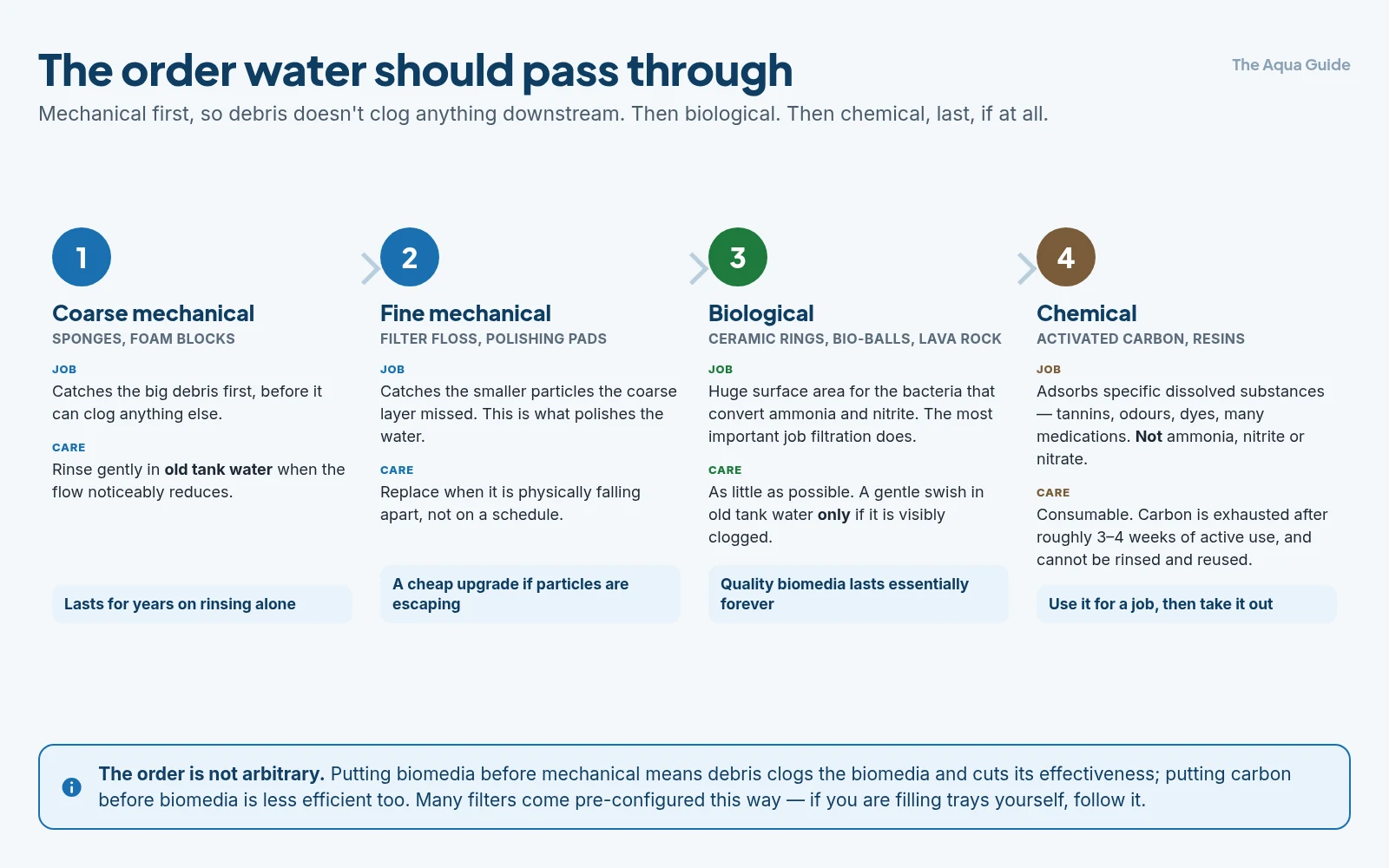
- Coarse mechanical (catches big debris first, before it clogs anything else)
- Fine mechanical / polishing (catches finer particles)
- Biological (bacteria do their work in pre-cleaned water)
- Chemical (last, where it adsorbs anything remaining)
Many filters are pre-configured this way; if you're setting up media in trays or chambers, follow this order. Putting biomedia before mechanical means debris clogs the biomedia, reducing its effectiveness; putting carbon before biomedia is less efficient too.
What You Actually Need vs. What's Upsell
A clear summary. Truly essential in every filter: at least one layer of mechanical media, and dedicated biological media. That's it. Useful when needed: activated carbon for specific tasks (tannins, post-medication). Mostly upsell: ammonia-removing resins (a cycled tank doesn't need them), nitrate removers (water changes are cheaper and work better), "miracle" media with vague claims, and the constant replacement schedules some manufacturers push.
The simple version: mechanical for clarity, biological for the cycle, chemical only as needed. Don't let the wall of media products at the store convince you that you need them all.
The Bottom Line
Filter media comes in three categories matching three jobs: mechanical (sponges and floss that physically catch debris, cleaned in old tank water), biological (ceramic rings and biomedia where your beneficial bacteria live — touch as little as possible), and chemical (activated carbon and resins that target specific dissolved substances, used only when needed). Every healthy tank needs mechanical and biological media; chemical media is situational. Arrange media so water flows through mechanical, then biological, then any chemical. Rinse mechanical when it clogs, leave biological alone as much as possible, and treat chemical media as a tool for specific jobs rather than something to run permanently. Get the three categories right and your filter is doing exactly what it should.
Related guides
- Choosing the right filter: HOB vs sponge vs canister
- How to clean your filter without crashing the cycle
- What equipment do you actually need vs store upsells
- What causes a nitrogen cycle crash?
- Aquarium medications: when to use what
- Sump filtration: setup and benefits
- How does the aquarium nitrogen cycle work?
- The nitrogen cycle, explained
Got questions about your specific setup? Drop them in our Community Forum — we love helping new fishkeepers get started right.