Lighting is one of the parts of fishkeeping where beginners most often overthink the gear and underthink the schedule. The truth is the lighting unit often matters less than how you use it — and most algae problems traced back to "the light" are really schedule problems in disguise. Here's how to think about aquarium lighting in plain terms, what brightness you actually need, and how to set a photoperiod that keeps plants happy and algae in check.
At a glance: the photoperiod
| Hours a day | What happens |
|---|---|
| 6 to 8 hours | The recommended range. Enough for hardy plants to thrive, and short enough that algae doesn't get an excess to feed on |
| Around 7 hours | A sensible, consistent default for most planted tanks — and it works just as well for a non-planted tank run purely for viewing |
| 12+ hours | Doesn't grow better plants. Plants reach photosynthetic saturation after a few hours; algae keeps benefiting all day long |
The photoperiod matters more than the brightness for most setups. Getting it right does more for plant health and algae control than any equipment upgrade.
What the Light Is Actually For
Two main jobs. First, it lets you (and your fish) see the tank — without light, the aquarium is just a glass box of darkness. Second, it powers photosynthesis for live plants and any algae present — plants need light to grow, and so does algae. Those two facts together drive almost everything about how to light a tank: enough light for visibility and plants, not so much (or so long) that algae takes over.
For tanks without live plants, lighting is essentially a viewing concern — any reasonable aquarium light works, and the schedule is purely about when you want to see the tank. For tanks with live plants, lighting becomes a biological tool that needs more thought, but the basics are still simple.
Brightness: How Much Do You Need?
This is where beginners overcomplicate things. The honest framework:
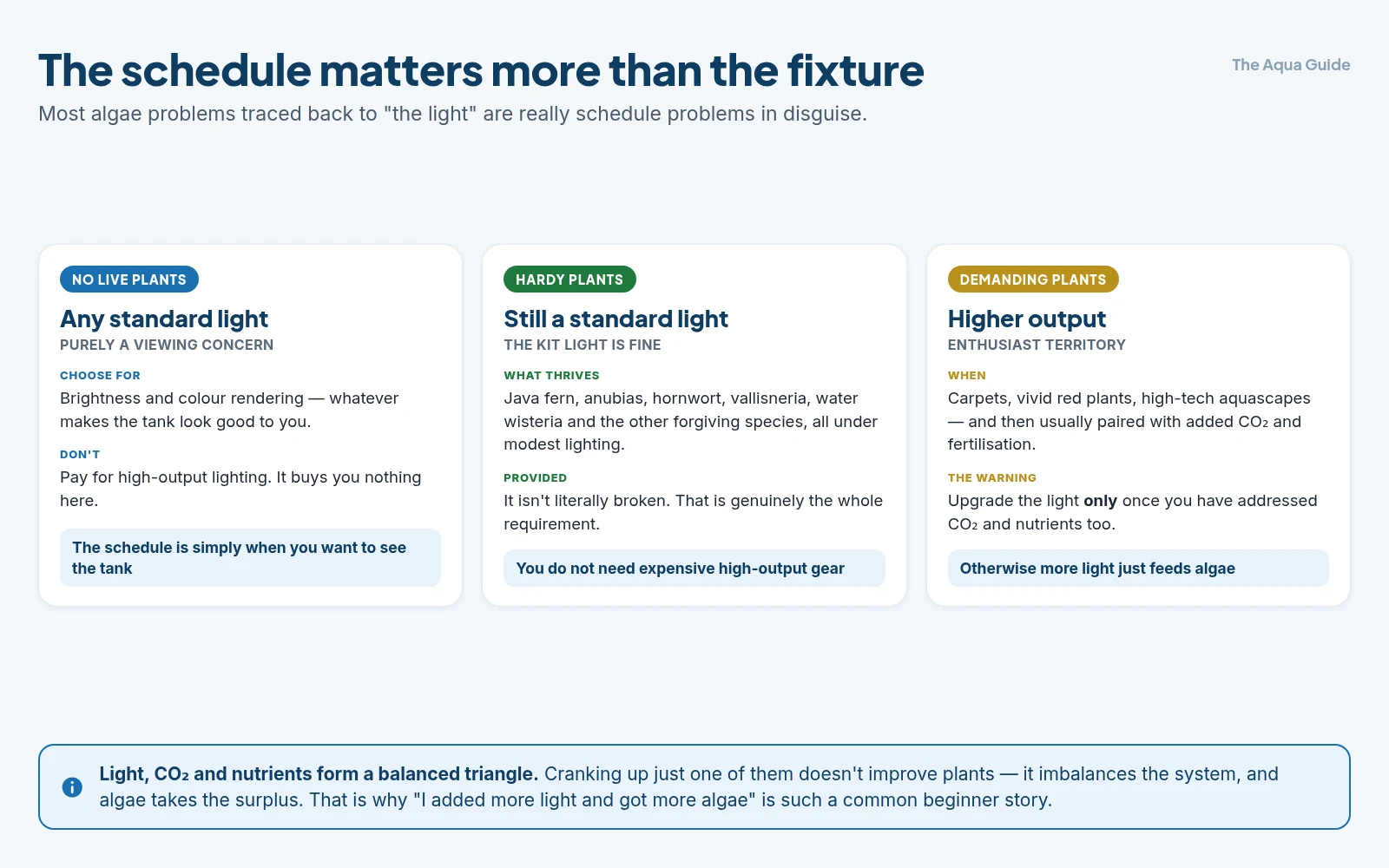
For tanks without live plants: any standard aquarium light is enough. You're choosing for viewing — brightness, color rendering, whatever makes the tank look good to you. Don't pay for high-output lighting.
For tanks with hardy live plants (the beginner-friendly species): a standard aquarium light, the kind that often comes with a kit, is enough. Java fern, anubias, hornwort, vallisneria, water wisteria, and the other forgiving plants thrive under modest lighting. Again, you do not need expensive high-output gear.
For tanks with demanding plants (carpets, vivid red plants, high-tech aquascapes): higher-output lighting becomes necessary, often paired with added CO₂ and fertilization. This is enthusiast territory, not where beginners need to start.
So the brightness answer for almost everyone is: the standard light that came with your tank or kit is fine, provided it's not literally broken. Upgrade lighting only when you've committed to demanding plants and you've also addressed CO₂ and nutrients — otherwise more light just feeds algae without helping anything.
A useful concept: light, CO₂, and nutrients form a balanced triangle for plant growth. Cranking up just one (say, lighting) without matching the others doesn't improve plants — it imbalances the system and algae takes the surplus light. This is why "I added more light and got more algae" is such a common beginner story.
Photoperiod: How Long the Light Should Be On
This is the part that matters more than brightness for most setups. The photoperiod is how many hours per day your light is on, and getting it right does more for plant health and algae control than any equipment upgrade.
The recommended starting range for most planted tanks:
Roughly 6 to 8 hours per day. A consistent, modest photoperiod — say 7 hours — is enough for hardy plants to thrive and short enough that algae doesn't get an excess to feed on. For non-planted tanks, you can run a similar schedule purely for viewing.
Why not longer? Because plants reach photosynthetic saturation after a few hours and don't grow faster with more light — but algae keeps benefiting from excess light all day long. Running lights 12+ hours doesn't grow better plants; it grows more algae. The 6–8 hour window is the sweet spot where plants get what they need and algae is limited.
Why not shorter? Below about 5 hours, plants don't get enough total light to grow well. So you've got a fairly forgiving window — too long is the more common mistake.
Consistency Is the Real Secret
Even more important than the exact number of hours is running the same schedule every day. Plants and fish adapt to a consistent day/night rhythm — predictable lighting reduces stress, supports plant growth, and limits algae. Erratic schedules (on for two hours, off for four, on for six, off-when-you-remember) confuse the system and favor algae over plants.
The single best thing you can do is plug the light into a timer or smart plug and set it to come on and off at fixed times every day. Once it's set, your tank gets the same reliable rhythm without you thinking about it. This one habit prevents a remarkable amount of algae trouble.
A Useful Habit: Siesta or Single Block?
There are two common approaches to scheduling.
The single block — light on for 6–8 continuous hours per day (say, 11am to 6pm if you want to enjoy the tank in the evening) — is the simplest and most common, and it works well.
The siesta schedule — light on for a few hours in the morning, off for a few hours mid-day, then on again in the evening (say, 9–11am, off, then 4–8pm) — splits the photoperiod into two blocks with a "siesta" gap. Some keepers swear by this for algae control (the gap allows CO₂ to recover in non-CO₂ tanks and disrupts algae growth) and for fitting their viewing time. Others find no difference. It's worth experimenting with if you're fighting algae despite a sensible total photoperiod.
Either works. Pick what fits your life and stick with it.
A Note on Sunlight
Direct sunlight on the tank is not the helpful free lighting it might seem — it causes uncontrollable temperature swings and fuels algae far more than it helps plants. If your tank gets direct sun, the right response is to block it (move the tank, close blinds), not factor it into your photoperiod. (Tank placement is its own topic.)
Color and Spectrum
A brief note on the often-overemphasized topic of light color. Most modern aquarium lights are LEDs in the daylight color range — 6500K white or similar — which is fine for both plants and fish viewing. Color-shifting LEDs that produce bluer or redder light can make fish colors pop visually but don't fundamentally change plant growth in beginner setups. Don't agonize over color temperature or spectrum specifics for a basic tank; the default white aquarium light works well. Specialized full-spectrum LEDs become relevant only for demanding planted setups.
The Bottom Line
For most aquariums, the standard light that comes with your tank or kit is plenty — brightness upgrades only become necessary for demanding plants in high-tech setups, and adding more light without matching CO₂ and nutrients usually just grows more algae. The thing that really matters is photoperiod: run your light for roughly 6–8 hours per day on a consistent schedule, preferably via a timer or smart plug so it happens automatically. Either a single block or a siesta schedule works, as long as it's the same every day. Avoid direct sunlight on the tank, and don't agonize over color spectrum specifics for a basic setup. Get the photoperiod right and you've solved most of what lighting can do for or against your tank.
Related guides
- Do I need CO₂, fertiliser and special lighting?
- The beginner's guide to aquarium algae
- The easiest fast-growing plants for beginners
- Preventing algae long term: the balanced tank
- Where to place your aquarium at home
- The beginner's guide to live aquarium plants
- CO₂ injection: pressurised systems and alternatives
- What equipment do you actually need vs store upsells
Got questions about your specific setup? Drop them in our Community Forum — we love helping new fishkeepers get started right.