This is the question that stops many beginners from trying live plants at all. They see elaborate planted tanks with pressurized CO₂ systems, high-output lights, and shelves of fertilizers, and conclude that plants are a complicated, expensive hobby-within-a-hobby. So here's the reassuring truth up front: for a beginner planted tank, you almost certainly don't need any of it. Let's go through each one honestly, so you know what's genuinely required versus what's optional enthusiast gear.
At a glance: needed, or optional?
| For a beginner tank | When it becomes relevant | |
|---|---|---|
| Lighting | Needed — but a standard aquarium light on a consistent 6–8 hour schedule is enough | Demanding plants: carpets, and red light-hungry species |
| CO₂ | Not needed. Hardy plants grow fine on what is naturally dissolved | High-tech aquascapes, dense carpets, CO₂-hungry species |
| Fertiliser | Little or none. Your fish provide most of it | Lightly stocked tanks, or plants showing deficiency despite good light |
The fancy gear isn't pointless — it is how enthusiasts grow demanding species, dense carpets and vivid reds. It is just an upgrade path, available when and if you want it, not where a beginner starts.
The Short Answer
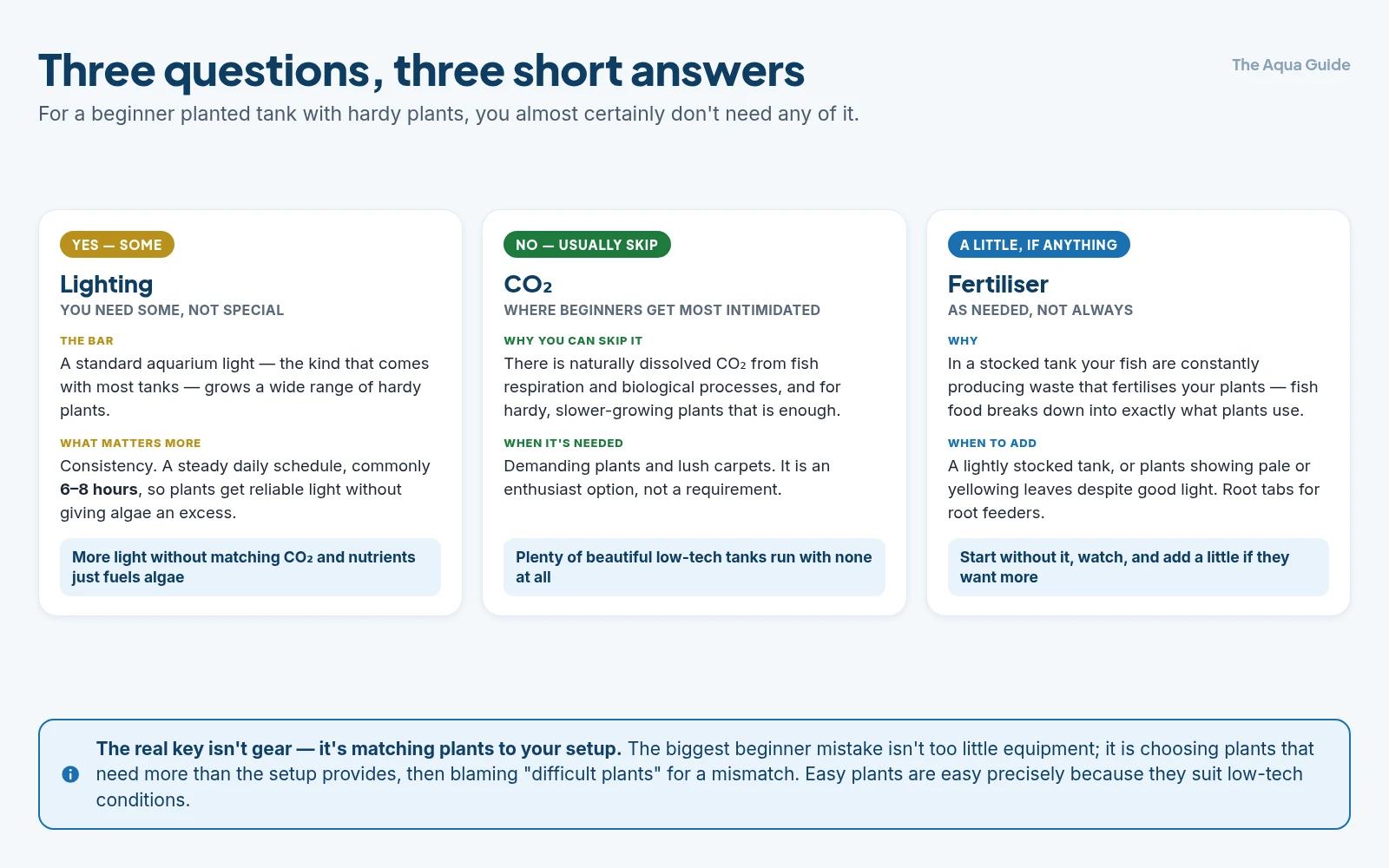
For an easy, beginner planted tank with hardy plants: you need a basic light, you generally don't need added CO₂, and you need little or no fertilizer (your fish provide most of it). The fancy equipment becomes relevant only if you choose demanding plants or chase a high-tech aquascape. The single most important factor isn't gear — it's choosing the right plants for the setup you have.
Now let's look at each element.
Lighting: You Need Some, Not Special
Plants need light to photosynthesize, so this is the one genuine requirement — but the bar is much lower than people think.
A standard aquarium light, the kind that comes with most tanks or kits, is enough to grow a wide range of hardy plants. You do not need expensive high-output or specialized "plant" lighting for easy species like java fern, anubias, hornwort, and the other beginner plants. What matters more than raw power is consistency: run your light on a steady daily schedule (commonly around 6–8 hours) so plants get reliable light without giving algae an excess to feed on.
Special high-output lighting only becomes necessary for demanding plants — particularly carpeting plants and red, light-hungry species — that need intense light to thrive. For everything beginner-friendly, your standard light is fine. And note the trade-off: more light without matching CO₂ and nutrients just fuels algae, so cranking up lighting isn't a free upgrade.
CO₂: Optional, and Usually Skip It
Carbon dioxide is where beginners get most intimidated, picturing pressurized cylinders and regulators. Here's the reality: easy plants don't need added CO₂.
Plants need carbon to grow, and they get it from carbon dioxide. In your tank, there's naturally some dissolved CO₂ from fish respiration and biological processes — and for hardy, slower-growing plants, that's enough. They'll grow happily on the ambient CO₂ already present. Added CO₂ (a "high-tech" setup) dramatically boosts growth and is needed for demanding plants and lush carpets, but it's an enthusiast option, not a beginner requirement. Plenty of beautiful, healthy "low-tech" planted tanks run with no added CO₂ at all.
If you ever want faster, denser growth or want to keep CO₂-hungry species, you can add it later — but you can absolutely start (and stay) without it. Don't let CO₂ intimidate you out of trying plants.
Fertilizer: A Little, If Anything
Plants need nutrients beyond nitrogen — small amounts of various minerals and trace elements. The question is whether your tank already provides enough.
In a stocked aquarium, your fish are constantly producing waste that fertilizes your plants — fish food breaks down into exactly the nutrients plants use. For many beginner tanks with hardy plants and a reasonable fish population, this is enough, and you need little or no added fertilizer. If your tank is lightly stocked or your plants show signs of nutrient deficiency (like pale or yellowing leaves despite good light), a modest dose of liquid fertilizer fills the gap easily and cheaply. Root-feeding plants (like Amazon swords and vallisneria) benefit from root tabs pushed into the substrate near their roots.
So fertilizer is "as needed," not "always." Start without it, watch your plants, and add a little if they seem to want more. You don't need a shelf of bottles.
The Real Key: Match Plants to Your Setup
Here's the principle that ties it all together. The biggest mistake beginners make isn't having too little equipment — it's choosing plants that need more than their setup provides. A demanding carpeting plant will struggle and melt under a basic light with no CO₂, and the beginner blames themselves or "difficult plants," when the real issue was a mismatch.
Flip it around: choose plants suited to a basic setup (a standard light, no CO₂, fish-provided nutrients), and they'll thrive without any special gear. The easy plants are easy precisely because they're matched to low-tech conditions. So rather than buying equipment to support demanding plants, simply pick plants that suit the equipment you have. That's the beginner's path to a lush planted tank.
When the Fancy Gear Is Worth It
To be fair, CO₂, high-output lighting, and a full fertilizer routine aren't pointless — they're how enthusiasts grow demanding species, dense carpets, vivid red plants, and competition-grade aquascapes. If you fall in love with the hobby and want to push into that territory, the gear delivers genuinely impressive results. It's just not where a beginner needs to start, and it's not required to enjoy a healthy, attractive planted tank. Think of it as an advanced upgrade path, available when and if you want it.
The Bottom Line
For a beginner planted tank, you need a basic aquarium light (run on a consistent daily schedule), you generally don't need added CO₂ (hardy plants grow fine on the CO₂ naturally present), and you need little or no fertilizer (your fish provide most nutrients, with a little liquid fert or root tabs only if plants want more). The expensive CO₂ systems, high-output lighting, and fertilizer regimens are enthusiast tools for demanding plants and high-tech aquascapes — not requirements for enjoying live plants. The real secret isn't gear; it's matching your plant choices to your setup. Pick easy plants suited to a basic tank, and you'll have a thriving planted aquarium without any of the intimidating equipment.
Related guides
- The beginner's guide to live aquarium plants
- The easiest fast-growing plants for beginners
- Aquarium lighting basics: brightness and photoperiod
- CO₂ injection: pressurised systems and alternatives
- Advanced fertilisation: dosing methods for planted tanks
- Floating and carpeting plants for beginners
- Why are my plant leaves melting or yellowing?
- What equipment do you actually need vs store upsells
Got questions about your specific setup? Drop them in our Community Forum — we love helping new fishkeepers get started right.