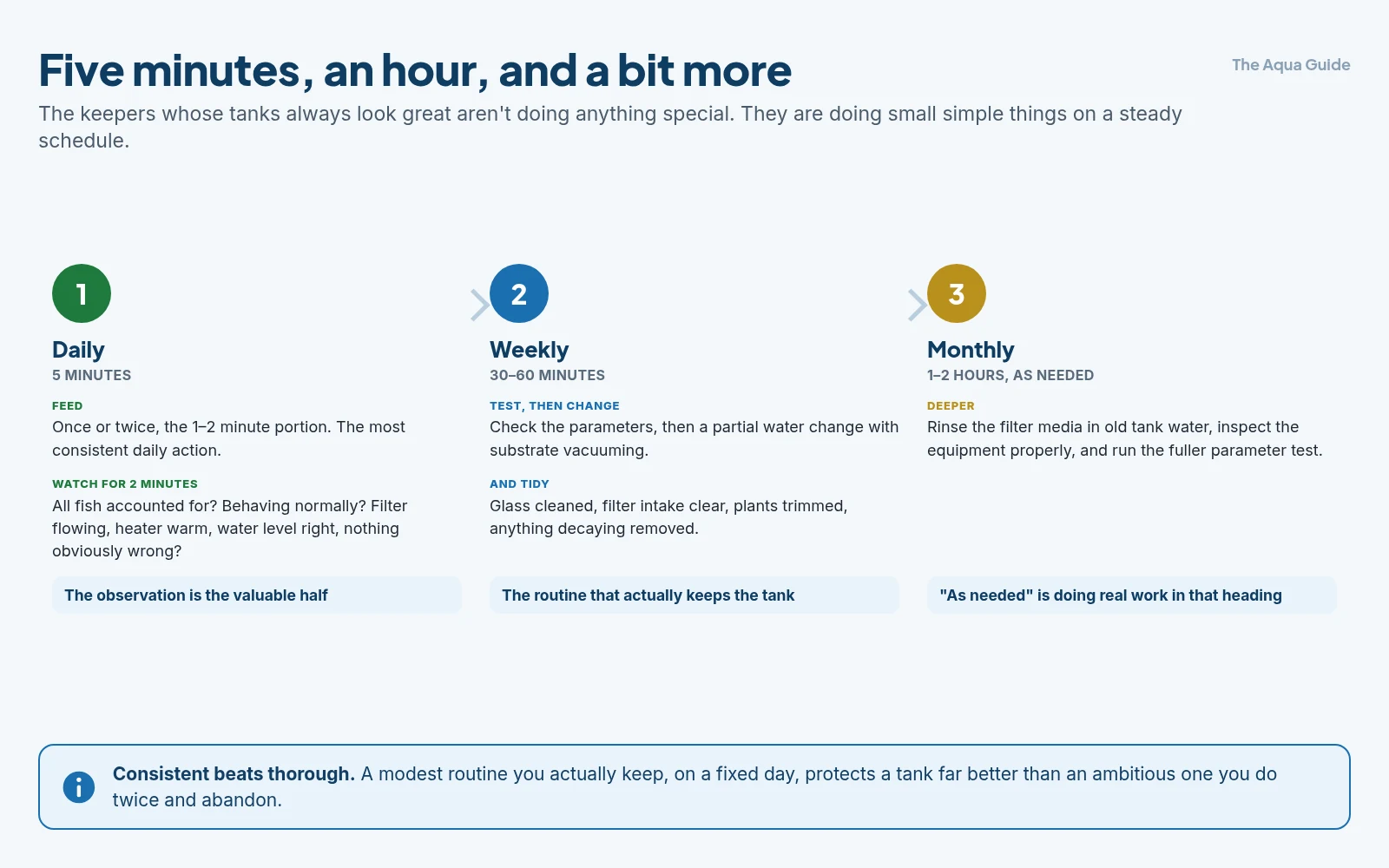
A well-maintained aquarium doesn't take much time — but it does take consistent time. The keepers whose tanks always look great aren't doing anything special; they're doing small simple things on a steady schedule. Here's exactly what to do daily, weekly, and monthly, broken down so you can build it into a routine that actually fits your life.
At a glance: the two-minute daily look
| Check | What you're looking for |
|---|---|
| The fish | All accounted for? Some hiding is normal; persistent absence is worth investigating |
| Their behaviour | Active, alert, breathing steadily |
| For trouble | Clamped fins, faded colour, gasping, scratching |
| The filter | Running, with normal flow |
| The heater | Warm, or its indicator light behaving |
| The water level | Where it should be |
| Anything obviously wrong | Leaks, equipment noise, unusual cloudiness |
Two minutes of watching is the single highest-value habit in the hobby. It is how problems get caught on day one instead of day ten.
The Daily Routine (5 Minutes)
The daily list is small and quick. Most days it takes 5 minutes total.
Feed your fish. Once or twice a day, the 1–2 minute portion (covered in detail elsewhere). The most consistent daily action.
Observe for 2 minutes. Just watch the tank. Notice:
- Are all fish accounted for? (Some hiding is normal; persistent absence is worth investigating.)
- Are fish behaving normally? Active, alert, breathing steadily?
- Any visible signs of stress or disease — clamped fins, faded color, gasping, scratching?
- Is the filter running with normal flow?
- Is the heater warm (or operating its indicator light)?
- Is the water level appropriate?
- Anything obviously wrong — leaks, equipment noise, unusual cloudiness?
This 2-minute check is the most valuable habit in fishkeeping. It catches problems early, when they're small and easy to fix, rather than later when they've become disasters.
Top up evaporation if needed. Tanks lose water to evaporation over a few days. If the level has dropped noticeably (a half inch or so), add dechlorinated water to top it up. Use room-temperature water and add it slowly to avoid temperature shock.
That's the entire daily list. If everything looks fine, you're done in 5 minutes including feeding.
The Weekly Routine (30-60 Minutes)
Once a week, the core maintenance task: the water change. This is the single most important regular task in fishkeeping.
Water change of 20–30% of tank volume. (More if needed; less can be okay for very lightly stocked or heavily planted tanks.) The detailed how-to of water changes is in Part 3, but here's the routine version:
- Test your water before changing (especially in newer tanks). Note ammonia, nitrite, nitrate, pH. This catches developing problems.
- Unplug the heater and filter for safety (they don't like running dry if water drops below their intakes).
- Siphon water out using a gravel vacuum, working it through different areas of the substrate to suck up accumulated waste. The siphon water goes into a bucket and goes down the drain.
- Prepare new water: tap water in a clean bucket, treated with dechlorinator, matched roughly to tank temperature.
- Pour new water back in gently to avoid stirring up the substrate.
- Plug everything back in. Wait a few minutes before turning the heater on (let glass acclimate to new water temperature).
- Observe — fish should resume normal behavior within minutes.
While you're already in maintenance mode, these tasks slot in well:
- Wipe interior glass with an algae scraper or pad if any film is forming on the viewing pane.
- Trim plants that have grown unruly. Replant or discard cuttings.
- Check equipment — filter flow, heater operation, light schedule.
- Skim the surface if any film has built up on the water surface.
The whole weekly routine takes 30–60 minutes depending on tank size and how much you're trimming/cleaning. For a typical 20–30 gallon community tank, expect about 30 minutes once you're in a rhythm.
The Monthly Routine (1-2 Hours, As Needed)
Less frequent tasks that handle the things that don't need weekly attention.
Clean the filter — but only if flow has noticeably reduced. Filter cleaning is the most important monthly task (and not on a strict monthly schedule — clean when needed). The technique: rinse mechanical media (sponges, floss) in old tank water you reserved from your weekly water change, never tap water. Leave biological media alone unless it's visibly clogged. (Full filter cleaning detail is in Part 6.)
Replace consumables as needed:
- Filter floss/polishing pads if they're falling apart
- Activated carbon (if running it) every 3–4 weeks of active use
- Test kit reagents if they've reached expiry
- Bulbs in light fixtures every 6–12 months for fluorescent or after their rated life for LED
Deep visual inspection. Once a month, take a closer look at the whole system:
- Equipment condition — any unusual wear, fading, or stress?
- Heater age and reliability (heaters fail; aging ones are worth replacing proactively)
- Filter housing for hairline cracks or leaks
- Stand and support — any sagging, water damage, or shifting?
- Plants — any failing, melting, or overgrown?
- Stock — anyone missing, unusually colored, or behaving oddly?
Plant trimming and propagation. If you have live plants, monthly is a good cadence for substantial trimming, replanting cuttings, or removing dead growth.
The monthly tasks aren't on a calendar schedule so much as a "check-in once a month" basis. Some months things will need attention; some months not much will. The point is to look.
What's NOT on the List
A few things beginners sometimes do as "maintenance" that don't help (or actively hurt):
Don't do partial water changes daily in a healthy tank — that's overkill, disruptive, and unnecessary. Weekly is right.
Don't replace all your filter media at once. Replace gradually (a piece at a time over weeks) so bacteria seeds onto new media before old comes out. Wholesale replacement crashes cycles.
Don't rinse media under the tap. Killing your bacteria is exactly what regular maintenance should prevent, not cause.
Don't add bottled bacteria, "tonics," or supplements as routine. Established tanks don't need these. Save them for specific situations.
Don't tear down and "fully clean" the tank. This isn't maintenance — it's a crash. Avoid it.
Don't over-vacuum the substrate, especially in planted tanks. Get the easy debris off the surface and skim the top layer; don't dig deep weekly.
Adapting the Routine to Your Tank
Different tanks need different rhythms.
Heavily-stocked or messy fish (large cichlids, goldfish, plecos): more frequent and larger water changes, possibly twice a week, with more siphoning.
Lightly-stocked planted tanks: sometimes longer between water changes (every 10–14 days) is fine. Plants absorb some waste. But still test periodically to confirm.
New tanks (first 1–2 months after cycling): monitor more carefully. Smaller more-frequent water changes during the first weeks after stocking, while bacteria are still scaling up.
Tanks with delicate species (shrimp, certain catfish, sensitive plants): smaller, gentler water changes — same volume but split across more frequent changes, or matched parameter (temperature, pH) more carefully.
The 20–30% weekly framework is a good default; adapt up or down based on what your tank actually needs.
Building the Habit
A few practical tips that help with consistency:
Same day of the week. Make Sunday morning (or whenever fits) "tank day." If it's part of your routine, you don't have to decide whether to do it.
Keep supplies accessible. Dechlorinator, bucket, gravel vacuum, test kit — all in one place near the tank, ready to grab. Friction kills habits.
Don't aim for perfect. A 15% water change you actually do beats a 30% change you keep postponing. Consistency beats intensity.
Build the observation habit. That 2-minute daily look is more valuable than most people realize. Make it part of feeding time so it happens reflexively.
Note things you notice. A simple log (paper or phone) of major events — water changes, problems, additions, equipment changes — helps you spot patterns over time.
When to Do Extra
A few situations call for extra maintenance beyond the schedule:
- After medication treatments — extra water changes to remove residue
- After significant stocking changes — closer monitoring of parameters
- During algae outbreaks — more frequent water changes and surface cleaning
- During or after disease outbreaks — typically more attentive care
- Hot summer weather — water holds less oxygen warm; sometimes need extra surface agitation or temperature management
The schedule is the baseline; specific situations layer on top.
The Bottom Line
A consistent maintenance routine — 5 minutes daily (feeding + observation + top-up), 30–60 minutes weekly (water change + general tidy), 1–2 hours monthly (filter cleaning when needed, consumables, deep inspection) — keeps an aquarium healthy without consuming your life. Build it into your week as a habit, use the same day each week so you don't have to decide, and focus on the basics rather than over-cleaning or over-supplementing. The keepers whose tanks always look great aren't doing anything elaborate; they're just doing simple things consistently. Match the rhythm to your tank's specific needs, stay observant, and the maintenance side of fishkeeping stays manageable forever.
Related guides
- Maintenance schedule templates
- The correct step-by-step water change
- How to clean your filter without crashing the cycle
- How to spot a healthy vs stressed fish
- How often should you do a water change — and how much?
- Water parameters cheat sheet
- How often and how much to feed your fish
- Aquarium water quality: the complete guide
Got questions about your specific setup? Drop them in our Community Forum — we love helping new fishkeepers get started right.