The two questions every new fishkeeper asks: how often, and how much? The answers are simpler than people think, and they're almost always more conservative than instinct suggests. Here's how to feed your fish in a way that keeps them healthy without overloading your tank.
How often and how much should you feed your fish?
Feed only what your fish can finish in one to two minutes, once or twice a day. If food is still drifting after two minutes you have overfed; many experienced keepers feed just once daily.
At a glance: how often
| Who | How often | Why |
|---|---|---|
| Most community fish | Once or twice a day | One is perfectly adequate, and many experienced keepers do only that. Two smaller portions divide the daily total rather than adding to it |
| Fry | 3–5 times a day for the first weeks | Growing rapidly with tiny stomachs. A temporary stage — adult patterns resume after a few weeks |
| Some predators and large slow-growing fish | Less than once a day, sometimes every other day | Research the specific species rather than assuming the community rule |
| Mixed surface and bottom feeders | The same total, split between floating and sinking food | Don't feed extra so the bottom-dwellers get some — use sinking food as part of the total |
What matters more than once-versus-twice is the total daily amount, and consistency: the same time each day, the same modest portion. Fish thrive on routine.
The Two-Minute Rule
This is the single most useful principle in fish feeding:
Feed only what your fish can eat in 1 to 2 minutes.
That's it. If food is still drifting around after 2 minutes, you've added too much. If it's gone in 30 seconds, you might want to add a tiny bit more next time. Once you can eyeball this amount for your specific tank and fish, you don't need to overthink portions ever again.
The amount looks shockingly small at first — a small pinch of flakes for a typical community tank — but that's actually correct. Fish stomachs are tiny, often roughly the size of their eye. They don't need much.
How Often: Once or Twice a Day
For most community fish, once or twice a day is plenty. The choice between one and two daily feedings is personal:
One feeding per day is perfectly adequate for most fish. Many experienced keepers feed only once daily and their fish are healthy, active, and live full lifespans. It's also simpler — one feeding to remember, less waste, less risk of overfeeding.
Two feedings per day (smaller portions each) more closely mimics natural opportunistic feeding and spreads the food across more of the day. If you split feedings, the total daily amount stays the same — you're dividing, not adding.
What matters more than once-vs-twice is the total daily amount and consistency. Same time(s) each day, same modest portions. Fish thrive on routine.
Avoid feeding more than twice daily for most species — it's almost always more food than they need, and the excess fouls the water.
What About Fry, Picky Eaters, and Special Cases?
A few exceptions worth noting:
Fry (baby fish) need more frequent, smaller feedings — typically 3–5 times a day for the first weeks — because they're growing rapidly and have tiny stomachs. This is a temporary stage; adult feeding patterns resume after a few weeks.
Some predator species and large slow-growing fish may eat less often than once daily — sometimes every other day or even less frequently. Research the specific needs of any non-community species you keep.
Mixed-species tanks with surface and bottom feeders may need food that reaches both zones (sinking pellets in addition to flakes, for instance) — but the total food going into the tank still follows the 1–2 minute rule. Don't feed extra so the bottom-dwellers get some; use sinking food as part of the total portion.
Why Less Is Genuinely More
It feels counterintuitive that fish need so little food, but understanding why helps you trust the rule.
Fish are cold-blooded. Unlike mammals (us), fish don't burn energy keeping warm. Their metabolic needs per unit body weight are far lower than ours, which means they need far less food than you'd intuitively guess.
Wild fish are opportunistic. In nature, fish go through periods of feast and famine. They evolved to handle days without food, taking advantage when food is plentiful but not requiring three meals a day to thrive. A slightly hungry fish is biologically normal; a constantly stuffed fish is not.
Their stomachs are tiny. A fish's stomach is roughly the size of its eye. That's it. Even a small flake fills a meaningful portion of that volume.
Uneaten food doesn't disappear. Anything fish don't eat sinks, breaks down, and becomes ammonia — exactly the toxic waste your filter is fighting. Every bit of overfed food is a small ammonia source.
Should I Believe the Container Directions?
Most fish food containers say something like "feed 2–3 times daily, as much as your fish will eat in 5 minutes." This advice is usually too generous — it sells more food, but it leads to overfeeding.
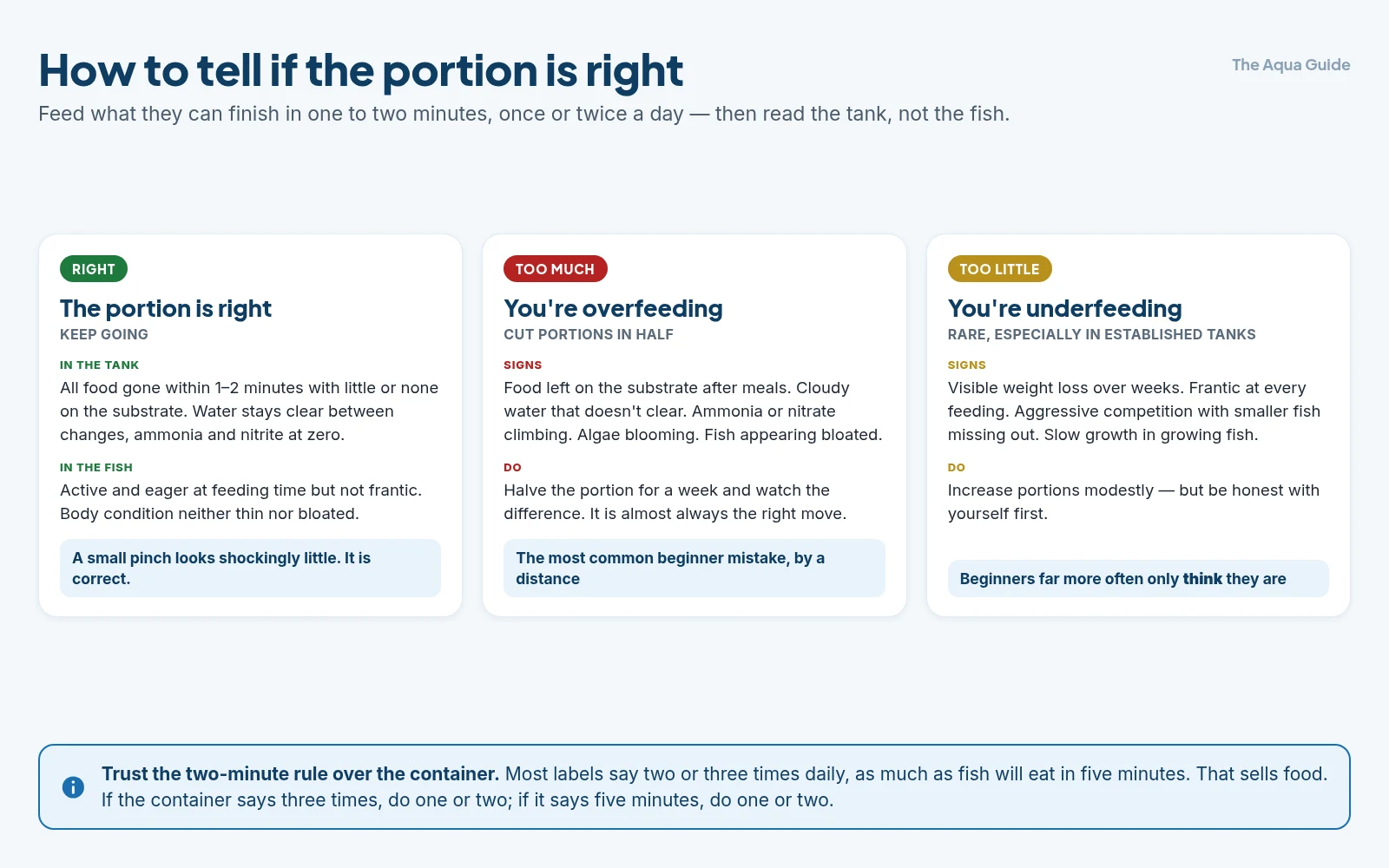
Trust the 1–2 minute rule over the container directions. If the container says feed 3 times, do 1–2. If it says 5 minutes' worth, do 1–2 minutes. Food manufacturers benefit from you using more food; your fish don't.
Watching for the Right Portion
A few signs that you're feeding the right amount:
- All food is consumed within 1–2 minutes with little or none left on the substrate.
- Fish are active and eager at feeding time but not frantic.
- Body condition is good — neither thin (visible spine, sunken belly) nor bloated.
- Water stays clear between water changes; no buildup of debris on the substrate.
- Ammonia and nitrite stay at zero in your tests.
Signs you're overfeeding (covered in more detail elsewhere):
- Food left on the substrate after meals
- Cloudy water that doesn't clear
- Ammonia or nitrate climbing
- Algae blooming
- Fish appearing bloated
If you see these signs, cut your portions roughly in half for a week and watch the difference. It's almost always the right move.
Signs You're Underfeeding
For completeness — though rare, especially in established tanks:
- Visible weight loss over weeks
- Fish frantic at feeding times every time
- Aggressive food competition with smaller fish missing out
- Slow growth in growing fish
If you genuinely see these signs, increase portions modestly — but be honest with yourself, because beginners much more often think they're underfeeding when they're actually feeding correctly.
A Practical Routine
A simple workable feeding routine for a typical community tank:
- Once a day, at roughly the same time each day, drop a small pinch of high-quality flake or pellet food into the tank.
- Watch for 1–2 minutes. If food is gone, perfect. If food remains, you've fed slightly too much — note for next time.
- Don't add more even if fish seem hungry afterward — they always seem hungry, and that's normal.
- Skip a day occasionally if you want (fasting has its own benefits, covered elsewhere).
That's it. Five seconds of feeding, two minutes of observation, repeated daily. The simplicity is the point.
A Note on Different Foods
When you feed sinking pellets (for bottom-dwellers) alongside floating flakes (for top/mid feeders), apply the 1–2 minute rule to the combined feeding. Don't feed full portions of both — split the total accordingly. (Choosing what to feed is its own detailed topic.)
The Bottom Line
Feed your fish what they can finish in 1–2 minutes, once or twice a day, at the same time(s) consistently — and trust that the small amount you're giving is correct, despite instincts and food-container labels suggesting more. Fish are cold-blooded, have tiny stomachs, and evolved to handle modest food intake; less food is healthier for them and far easier on your tank. Watch for the signs of overfeeding (uneaten food, cloudy water, climbing ammonia, algae) and cut back if you see them. Get this habit right and the most common source of beginner aquarium problems disappears.
Related guides
- Why overfeeding is the #1 beginner mistake
- Choosing the right food: flakes, pellets, frozen, live
- Should you fast your fish, and when?
- Vacation feeding: what to do when you're away
- What are safe ammonia, nitrite and nitrate levels?
- How to spot a healthy vs stressed fish
- The beginner's guide to feeding and daily care
- The nitrogen cycle, explained
Got questions about your specific setup? Drop them in our Community Forum — we love helping new fishkeepers get started right.