Substrate is the foundation of any aquascape — literally. It supports plant roots, holds hardscape in place, creates the slope that establishes depth, and (for some types) actively nourishes plants. The substrate you choose affects what plants will thrive, how the scape ages, how much maintenance it requires, and ultimately how the tank looks long-term. Here's the complete guide to substrate choices for aquascaping.
At a glance: choosing one
| If you want... | Then... |
|---|---|
| A planted tank with demanding species | Aquasoil. It feeds the roots, and it lowers pH and softens slightly — which suits soft-water species anyway |
| Something predictable and cheap | Pool filter sand or black diamond sand. Both are inert and change nothing |
| Hard alkaline water for African cichlids | Crushed coral or aragonite, deliberately, because raising pH and hardness is the point |
| Soft-water tetras or discus | Anything except crushed coral. It will hold your water where they cannot thrive |
Check coloured gravels before buying. Most are inert, but not all of them — and finding out after the tank is full is an expensive way to learn.
Why Substrate Matters
In a basic fish tank, substrate is mostly cosmetic — gravel looks nicer than bare glass. In an aquascape, substrate is functional:
Plant root support. Plants need substrate to anchor and grow into.
Nutrient supply. Some substrates actively feed plants through roots; others are inert and require water-column fertilization.
Water chemistry effects. Some substrates alter pH and hardness (helpful for some species, problematic for others).
Slope and depth. Substrate creates the foundation slope that gives an aquascape depth.
Visual character. Color, texture, and grain size affect the scape's overall feel.
Bacterial colonization. Substrate provides surface area for beneficial bacteria essential for the nitrogen cycle.
Getting substrate right at setup is crucial — changing substrate later means tearing the tank apart.
The Major Substrate Categories
Three broad types dominate the aquascape world:
Active Substrates (Aquasoil)
Specialized planted-tank substrates designed to actively support plant growth. Sometimes called "aquasoil" generically (ADA Aqua Soil is the brand that pioneered the category).
What they are: Baked clay-based granules infused with nutrients and beneficial compounds. Common brands: ADA Aqua Soil (Amazonia and others), Tropica Aquarium Soil, Fluval Stratum, ControSoil, Landen Aquasoil.
Look: Dark brown to black; spherical granules typically 1–4mm; rich, "earthy" appearance.
Pros:
- Excellent plant growth (best of any substrate type)
- Active nutrient release for the first 6–18 months
- Naturally lowers pH and softens water (good for soft-water plants and shrimp)
- Visual aesthetic is generally appealing
- Granules are uniform, easy to slope
Cons:
- Expensive (often $30–60 per bag, multiple bags needed for larger tanks)
- Releases ammonia initially — must be cycled before adding sensitive fish
- Nutrient depletion over time (1–2 years) — eventually becomes inert
- Compresses over years — gradually breaks down
- Lowers pH significantly — not suitable for hard-water species (African cichlids, livebearers in alkaline tanks)
Best for: Plant-heavy nature aquariums, shrimp tanks, high-tech setups, anyone serious about plant growth.
Use carefully if you have: Hard-water species; want stable parameters; budget concerns; large tanks where cost adds up.
Inert Substrates (Sand, Gravel, Specialty Inerts)
Substrates that don't actively affect water chemistry or supply nutrients.
Examples:
- Pool filter sand — fine-grained, cheap, neutral
- Play sand — even cheaper, fine
- Black diamond blasting sand — black, dramatic, inexpensive
- Aquarium gravel — wide variety of sizes and colors
- Inert specialty substrates — Seachem Flourite Black, CaribSea Eco-Complete
Look: Varies hugely — from fine white sand to coarse colored gravel to black "natural" looks.
Pros:
- Cheap (especially pool filter sand, play sand — often $10–20 for a large bag)
- Doesn't release ammonia at startup
- Doesn't affect pH significantly
- Long-lasting (doesn't degrade)
- Wide color and texture variety
- Stable, predictable chemistry
Cons:
- No direct plant nutrition (rely on water-column fertilization or root tabs for plant nutrition)
- Some sands are TOO fine and compact (anaerobic pockets, gas problems)
- Doesn't lower pH for soft-water species
Best for: Beginners (cheap and simple), hardy plant tanks, fish-focused tanks with modest planting, biotopes needing specific substrate types, anyone wanting maximum chemistry control.
Hybrid / Layered Substrates
Combining substrate types for different effects.
Common combinations:
- Aquasoil on top, inert base — saves money (less aquasoil needed) while preserving plant benefits
- Inert substrate base, with root tabs for plant nutrition
- Cap of fine sand over aquasoil — visual aesthetics but maintains aquasoil function
- Different substrates in different zones — sand foreground, aquasoil mid/background
Pros: Cost optimization; visual flexibility; matched zones to plants/animals.
Cons: More complex to set up; substrates can intermix over time.
Specific Product Recommendations
For Plant-Heavy Aquascapes
ADA Aqua Soil Amazonia (or generic equivalent) — the gold standard. Excellent plant growth, well-known performance. Expensive but justified for serious plant tanks.
Tropica Aquarium Soil — similar to ADA, slightly cheaper, very good.
Fluval Stratum — budget aquasoil option. Good plant growth, less dramatic nutrient release.
ControSoil — well-regarded among shrimp keepers.
For Mid-Range Plant Tanks
Seachem Flourite Black — inert but with rich color. Use with root tabs and water-column fertilizers.
CaribSea Eco-Complete — inert with some claimed nutrient release; popular choice.
Pool filter sand with root tabs — budget-friendly option that works for many easy-to-medium plants.
For Specific Effects
Black diamond blasting sand — dramatic dark look, cheap, inert. Popular for biotope tanks.
Pure white play sand or aragonite sand — light, bright look. Aragonite for African cichlids only (it buffers pH).
Colored aquarium gravel — for tanks where chemistry matters less than appearance.
For Shrimp Tanks
Active aquasoil (ADA, Tropica, ControSoil) for cherry and other Neocaridina; some Caridina species need specific buffered substrates.
Avoid: Substrates with sharp edges that can damage shrimp.
Grain Size Considerations
Coarse gravel (4-6mm+): Easy to clean, but plant roots struggle to grow into it; food and waste sinks between grains and is hard to remove.
Fine gravel (2-4mm): Good balance of plant root growth and cleanability. Common aquarium choice.
Coarse sand (1-2mm): Ideal for plant roots; easy to vacuum surface; doesn't compact too much.
Fine sand (under 1mm): Looks beautiful but can compact tightly, creating anaerobic pockets. Use with caution.
For aquascaping: Most aquasoils fall in the 1–4mm range — ideal for plant roots and aesthetics.
Substrate Depth
The right depth depends on what you're growing:
Carpet plants (hairgrass, Monte Carlo, glossostigma): 2–3 inches minimum. Deeper substrate allows root spread.
Most stem plants and rosette plants: 2–3 inches in planted areas.
Background tall plants: 3–4 inches at minimum, especially for slope.
Hardscape-only or low-light tanks: 1–2 inches is sufficient.
Slope considerations: Front of tank can be shallower (1–2 inches); back of tank deeper (3–5 inches) for visual depth.
Total substrate volume calculations: Plan on about 1 pound of substrate per gallon for an average tank. Specialized aquasoils are sold by volume — 9-liter bags typically cover a 20-gallon tank to about 2 inches depth.
Setting Up Substrate Slope
A crucial aquascaping technique. Steps:
1. Plan the slope. Decide where the highest point will be (often back-corner, or wherever your dominant rock/wood will be).
2. Add substrate gradually. Start with a thin layer everywhere (1 inch in front), then build up the back area.
3. Use barriers if needed. Substrate naturally migrates over months — flatter eventually. Use rocks or thin substrate dividers (some keepers use plastic strips, mesh) to maintain steep slopes.
4. Build retaining structures. For dramatic slopes, the slope itself can be supported by rocks or buried mesh. Make sure the structure is hidden.
5. Final shape adjustments. Use a long flat tool to smooth and shape the slope. Avoid sharp transitions; gentle curves look more natural.
6. Allow for substrate compression. Loose substrate compacts over the first few weeks. Build slightly higher than the final desired height.
The Aquasoil Setup Process
If using active aquasoil, the process differs slightly:
1. Dry pour. Most aquasoils are added dry. Open the bag and pour into the tank without water.
2. Shape the slope. Easier to shape dry. Push and contour to your design.
3. Add hardscape. Place rocks and wood on the substrate.
4. Slowly fill with water. Cover substrate with plastic wrap or a plate to prevent the aquasoil from churning. Pour water slowly onto the wrap/plate. Once water level is above substrate, remove the cover.
5. Cloudiness phase. Water may be cloudy for hours to days as fine particles settle. This is normal.
6. Expect ammonia release. Aquasoils release ammonia for 2–4 weeks during initial cycling. Do extra water changes; don't add fish during this period.
7. Cycle the tank. Standard cycling procedure (Part 2). Most aquasoils accelerate cycling because they release ammonia naturally.
Substrate and Water Chemistry
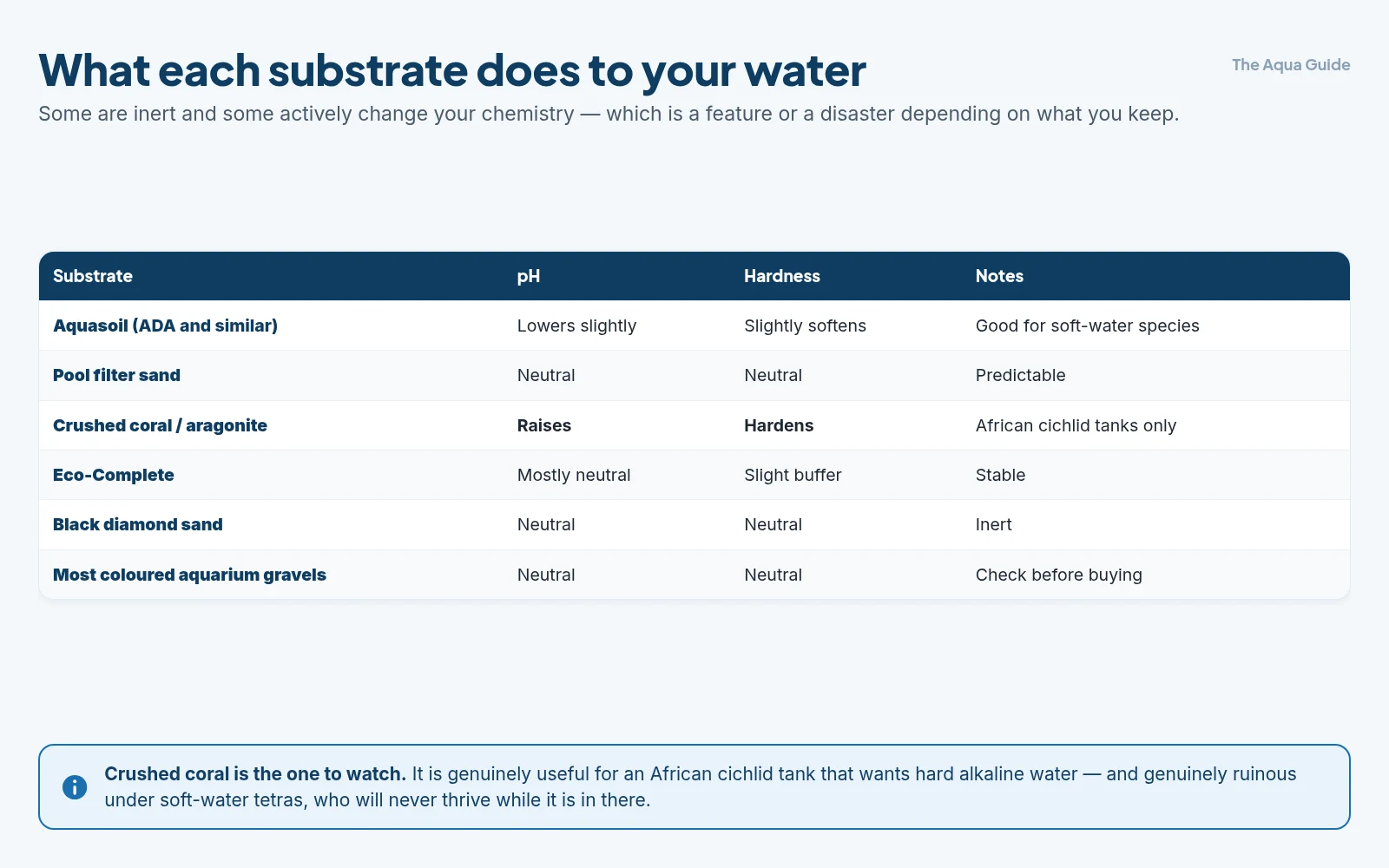
Different substrates have different effects:
| Substrate | pH Effect | Hardness Effect | Notes |
|---|---|---|---|
| Aquasoil (ADA, etc.) | Lowers slightly | Slightly softens | Good for soft-water species |
| Pool filter sand | Neutral | Neutral | Predictable |
| Crushed coral / aragonite | Raises | Hardens | African cichlid tanks only |
| Eco-Complete | Mostly neutral | Slight buffer | Stable |
| Black diamond sand | Neutral | Neutral | Inert |
| Most colored aquarium gravels | Neutral | Neutral | Check before buying |
Test before committing. A small sample in a jar of water for a few days tells you whether a substrate affects chemistry. Especially important for unknown sands or specialty products.
Maintaining Substrate Long-Term
Substrate behavior changes over time:
First weeks: New aquasoil releases nutrients vigorously; sand compacts; plant roots establish.
Months 1–6: Plants spread roots through substrate; gradual nutrient depletion in aquasoils.
Year 1–2: Aquasoils approach nutrient exhaustion; need root tabs or water-column dosing.
Year 2+: Aquasoils may compact significantly; some keepers replace substrate at this point.
Sand-based tanks: Generally stable indefinitely; benefit from periodic shallow vacuuming and root tab additions for plants.
Vacuum approach: In planted tanks, vacuum gently over the top of substrate (don't dig deep — disturbs roots). Bare-bottom or sand tanks tolerate deeper vacuuming.
Common Substrate Mistakes
Not enough substrate. A thin layer doesn't support plants or create depth. Plan for adequate depth.
Wrong type for plants. Trying to grow demanding carpet plants in coarse gravel — won't work. Match substrate to plant needs.
No nutrient plan. Inert substrate without root tabs or fertilizer doesn't support plants long-term. Plan how plants will be fed.
Adding fish to aquasoil too early. Ammonia release will kill fish. Always cycle aquasoils properly.
Too-steep slopes without support. They flatten over months. Use barriers if you want dramatic terrain.
Mixing substrate types randomly. Inert sand mixed with aquasoil over time loses both benefits. Use deliberate layers if combining.
Wrong chemistry for fish. Aquasoil-acidified water plus livebearers (which prefer alkaline) creates ongoing problems. Match substrate to fish.
Cheap "aquarium gravel" of unknown composition. Test first; some contain crushed coral that buffers pH.
The Bottom Line
Substrate is the literal foundation of any aquascape and affects plant growth, water chemistry, depth, and aesthetics for the life of the tank. Three broad categories: active aquasoils (ADA Aqua Soil and similar) for serious plant growth — expensive but excellent, lowers pH naturally, requires cycling for ammonia release; inert substrates (pool filter sand, gravel, Black Diamond) for cheap, stable, neutral options that need root tabs or water-column fertilizers for plant growth; and hybrid layered approaches that optimize cost and function. Match substrate to your goals: plant-heavy nature aquariums and shrimp tanks justify aquasoil; fish-focused tanks with modest planting work with inert sand plus root tabs; biotopes need specific substrate types. Use 2–3 inches of depth (more in slope back), slope from front (1–2 inches) to back (3–5 inches) for visual depth, support steep slopes with barriers, and account for substrate compression. Aquasoils need an extra cycling period due to initial ammonia release. Match substrate chemistry to your fish (avoid aquasoils with hard-water fish; avoid crushed coral with soft-water fish). Most great aquascapes use aquasoil; most successful beginner tanks use sand with root tabs — both approaches work, and the choice often comes down to budget and ambition level.
Related guides
- How to plant and anchor aquarium plants
- Understanding pH, KH and GH
- Setting up your first aquascape, step by step
- Hardscape: choosing and placing rocks
- Aquascape styles: nature, iwagumi, Dutch, jungle
- Aquarium plants quick reference
- Advanced fertilisation: dosing methods for planted tanks
- Aquascaping for beginners
Got questions about your specific setup? Drop them in our Community Forum — we love helping new fishkeepers get started right.