A finished aquascape isn't actually finished. Unlike a painting that's done when the artist puts down the brush, an aquascape is alive — plants grow, designs evolve, the scape passes through phases. Maintenance is the ongoing dialogue between your vision and what the tank wants to do. Here's how to keep an aquascape looking its best over months and years, and how to think about its inevitable evolution.
At a glance: which phase are you in?
| When | What it looks like | What to do |
|---|---|---|
| Weeks 1–4 | Sparse, and slightly ugly | Nothing dramatic. Let it root |
| Months 1–3 | Visible growth, carpets spreading, first algae | Start pruning |
| Months 3–6 | Beginning to match your vision | Significant pruning, and replacing what isn't working |
| Months 6–12 | Its best. Lush, established, settled | Maintain it, and photograph it |
| Year 1+ | Developing its own character | Replant, refresh, adjust |
| 1–3 years | The design no longer works | Rescape |
Knowing the phase tells you whether to worry or wait, and most beginner panic happens in weeks 1–4 — which is exactly when nothing is wrong.
The Aquascape Lifecycle
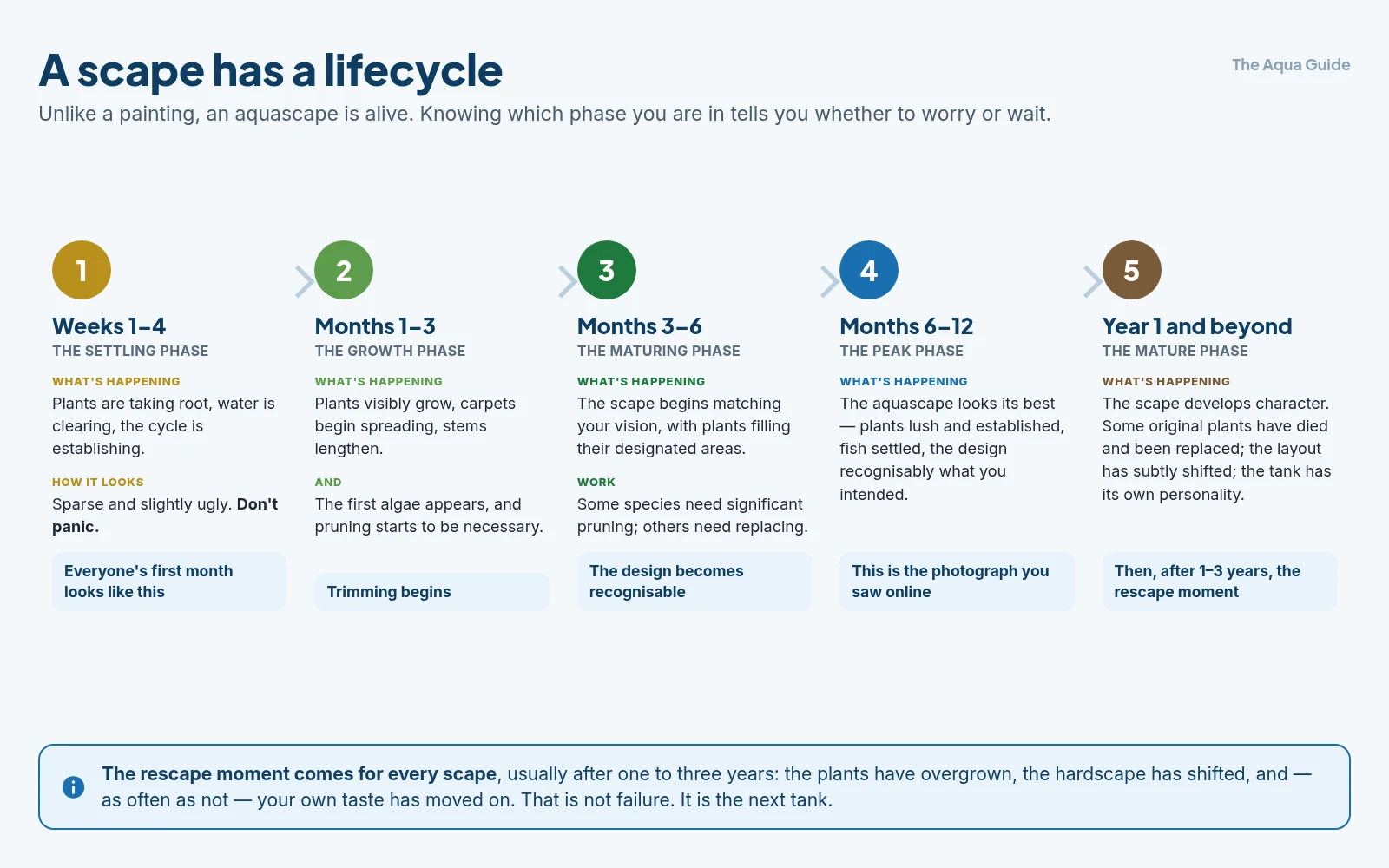
Every aquascape passes through recognizable phases:
Weeks 1–4: The settling phase. Plants are taking root, water is clearing, the cycle is establishing. The tank looks sparse and slightly ugly. Don't panic.
Months 1–3: The growth phase. Plants visibly grow, carpets begin spreading, stems lengthen. The first algae appears. Pruning begins to be necessary.
Months 3–6: The maturing phase. The scape begins matching your vision. Plants fill in their designated areas. Some species need significant pruning; others need to be replanted.
Months 6–12: The peak phase. The aquascape looks its best. Plants are lush and established, fish are settled, the design is recognizably what you intended.
Year 1+: The mature phase. The scape develops character. Some original plants have died and been replaced; the layout has subtly shifted; the tank has its own personality. This is when many keepers find their tanks most beautiful.
The rescape moment. Eventually — after 1–3 years for most scapes — the design no longer works. Plants have overgrown, hardscape has shifted, the keeper's taste has evolved. Time for a major redesign or full rebuild.
Understanding these phases changes how you think about maintenance: you're not maintaining a static scene, you're guiding an evolving system.
The Maintenance Toolkit
A few specific tools make aquascape maintenance much easier:
Curved aquascaping scissors. Long-handled, curved blades reach into the tank without disturbing the water surface or other plants. Essential for trimming stem plants and carpets.
Long aquascaping tweezers. Plant placement and removal in established tanks. Reaches the back of the tank without your hand getting wet.
Algae scraper. Cleans glass without disturbing plants. Magnetic scrapers (one part inside, one outside) work well for tall tanks.
Pinch siphon. For precision substrate cleaning and water changes in planted tanks.
Pre-filter sponge. Slips over filter intake to prevent debris and fish/shrimp from being sucked in.
Spray bottle of dechlorinator. For misting plants during partial water changes or rescapes.
Soft brush. For cleaning hardscape and reaching crevices.
Total investment: $30–80 for a good basic toolkit. Worth it for any serious aquascaper.
The Weekly Routine
A typical aquascape maintenance week:
1. Visual inspection (5 minutes). Look at the tank from your usual viewing angle. What's grown too much? What's struggling? Any algae? Are any fish hiding unusually?
2. Light pruning (10–20 minutes). Trim the fastest-growing plants back to their designated heights. Remove yellowing or damaged leaves.
3. Glass cleaning (5 minutes). Algae scraper across the front and sides. Don't worry about the back glass — it's invisible.
4. Water change (20–30 minutes). 25–30% water change, gravel vacuuming where appropriate (avoid disturbing plant roots).
5. Dosing fertilizers (if you use them — comprehensive fertilizer mixes or specific deficiency targets).
6. Hardware checks. Filter intake clear? Heater functional? Lighting on schedule? CO₂ system (if used) working properly?
Total weekly time: 45–75 minutes for a typical aquascape. Less for low-maintenance jungle styles, more for high-maintenance Dutch or precision Iwagumi.
Pruning Plants
Plant pruning is the central skill of aquascape maintenance. Different plants need different techniques:
Stem Plants (Rotala, Ludwigia, Bacopa, etc.)
The "top and replant" method:
- Cut the top portion of healthy stems (the top 3–6 inches)
- Remove the lower stump or let it regenerate
- Replant the cuttings into the substrate
- Over weeks, the cuttings root and the tank becomes fuller
Frequency: Every 1–3 weeks for fast-growing stems.
Important: Replanted cuttings often look healthier than the original old stems. Many aquascapers regularly cycle stems this way for vigor.
Carpet Plants (Hairgrass, Monte Carlo, Glossostigma)
Trim to height with curved scissors:
- Trim across the top of the carpet at the desired height
- Removes longer "shaggy" growth, keeps the carpet uniform
- Trim more often early in growth (encourages spreading), less once established
Important: Don't trim too aggressively — leave at least half the plant height. Severe pruning can damage carpet plants.
Frequency: Every 2–4 weeks during active growth.
Anubias, Java Fern, Bucephalandra (Rhizome plants)
Minimal pruning:
- Remove yellowing or damaged leaves at the rhizome
- Trim oversized rhizomes if they're crowding the scape
- Never trim healthy growing leaves arbitrarily — these plants grow slowly
Splitting rhizomes: Older plants can be divided. Cut the rhizome between leaves with sharp scissors; each piece can be reattached to hardscape and will grow into a new plant.
Cryptocoryne and Echinodorus (Rosette plants)
Outer leaf removal:
- Pull damaged or oversized outer leaves at their base
- The plant naturally produces new leaves from the center
- Don't trim the leaves themselves (they don't regrow from cuts)
Cryptocoryne specifically: Sometimes goes through "crypt melt" — most leaves die back, but the rhizome remains alive. Wait it out; new growth emerges.
Mosses
Light trimming with scissors:
- Cut moss back to manageable shape every few weeks
- Trim where it's overgrowing onto other features
Tie-down replacements: Mosses sometimes detach over time. Reattach with thread or glue.
Managing Plant Density and Coverage
Two opposite problems can develop:
Too Sparse (Bare Areas Appearing)
Common causes:
- Plants dying from disease, lighting issues, or nutrient deficiency
- Fish or shrimp uprooting plants
- Substrate becoming nutrient-depleted
Solutions:
- Replant cuttings from healthier areas
- Add root tabs to feed substrate-rooted plants
- Identify and address the underlying cause
- Consider adding new plant species suited to current conditions
Too Dense (Smothering the Scape)
Common causes:
- Fast-growing plants outpacing slow-growers
- Lack of regular pruning
- Plants spreading beyond their designated areas
Solutions:
- Remove substantial portions of fast-growing species
- Reshape carpet plants to maintain clean borders
- Replant only sufficient stems to fill the planned area
- Sometimes: replace fast-growers with slower species
The right balance: enough plant density to outcompete algae, but not so much that the scape loses its composition.
Hardscape Adjustments Over Time
Plants change, but rocks and wood are largely stable. Still, some adjustments happen:
Driftwood may shift slightly as substrate compacts under it. Sometimes needs re-leveling.
Algae and biofilm accumulate on hardscape. Some growth is desirable ("patina"); too much obscures the original character. Periodic scrubbing with a soft brush during water changes helps.
Mosses and plants attached to hardscape grow, sometimes too much. Trim to maintain visibility of the underlying rock/wood structure.
Some woods soften over years (especially softer species like cholla). Eventual replacement may be needed.
For most aquascapes, hardscape stays in place for the life of the scape (1–3+ years) until a full redesign.
Dealing with Algae in Mature Scapes
Algae management never ends, but it gets easier with experience. The principles from Part 9 apply:
Steady balance. Match lighting to plant capacity, manage nutrients, maintain consistent CO₂ if used.
Spot treatment. When algae appears in a specific area, address it specifically — manual removal, spot-dosing liquid carbon, etc.
Algae eaters. Mature scapes benefit from a well-balanced cleanup crew (otocinclus, amano shrimp, nerite snails — see algae eaters guide).
Don't panic-react. Algae outbreaks usually have specific causes. Identify the cause; don't make multiple changes simultaneously.
Accept some. A truly algae-free tank is unusual. Some background algae is part of natural-looking environments.
Replanting and Refreshing
Over time, scapes benefit from periodic refreshes:
Quarterly: Trim and replant fast-growing stems. Replace any failing plants.
Half-yearly: Reshape carpet plants. Replace older sections of stem plant groups with fresh cuttings.
Yearly: Consider whether any species should be replaced entirely. Re-evaluate the plant palette.
Multi-year: A complete rescape may be necessary or desired. Total removal, hardscape redesign, fresh plants.
Refreshing keeps a scape looking vital. Without it, even well-maintained tanks gradually lose definition and character.
When to Rescape
Signs it's time for a major redesign:
The original vision no longer works. Plants grew differently than expected; hardscape proportions feel wrong; the design has aged poorly.
You're tired of looking at it. Personal taste evolves. A scape that excited you 18 months ago may now feel stale.
Persistent problems. Algae you can't beat, plants that won't thrive, fish that don't suit the environment.
Equipment changes. Upgrading lighting, adding CO₂, changing filter — sometimes makes a fresh start sensible.
You've seen something better. Inspiration from other scapes drives many redesigns. That's healthy.
A typical aquascape lifespan before major rescape: 1–3 years. Some keepers rescape more often; some maintain the same scape for many years through gradual evolution.
The Major Rescape Process
When the time comes:
1. Document the existing scape with photos. You'll learn from comparing this to the new design.
2. Remove fish to a holding container for several hours (a separate tank, large bucket with aeration, or fish bag).
3. Drain most of the water, keeping some for replanting.
4. Remove plants gently. Save healthy ones in a bucket of tank water for replanting.
5. Remove hardscape. Plan the new arrangement outside the tank as you did originally.
6. Adjust substrate as needed. Reshape slopes, top off depleted aquasoil, add new substrate if expanding.
7. Place new hardscape. Apply everything you learned from the first setup.
8. Replant. Use saved plants plus new ones as needed.
9. Refill with water, matching temperature and parameters to what fish are accustomed to.
10. Reinstall fish after re-acclimating.
Honest reality: A rescape disturbs everything. The biological filter remains in the filter (don't replace media), but you'll see some mini-cycling. Test water for 2–4 weeks afterward. Don't add new fish for at least a month.
The Bottom Line
Aquascapes are living designs that evolve through recognizable phases — settling (weeks 1–4), growth (months 1–3), maturing (months 3–6), peak (months 6–12), mature (year 1+), and eventually rescape (after 1–3 years). A weekly maintenance routine of 45–75 minutes — visual inspection, pruning, glass cleaning, water change, fertilizer dosing, hardware checks — keeps a typical scape healthy. Pruning techniques vary by plant type: top-and-replant stems, height-trim carpets, leaf-base removal for rosettes, minimal touch for slow-growing rhizome plants. Manage density between too-sparse and too-dense; refresh plants quarterly; reshape and replace seasonally; rescape entirely every 1–3 years when the design no longer works. Hardscape mostly stays stable but accumulates algae and patina over time. Algae management never ends but becomes easier with experience and a stable cleanup crew. The mental shift: maintenance isn't preservation, it's collaboration with the living system — guiding plants toward your vision while accepting and incorporating how they actually want to grow. Done well, maintenance is one of aquascaping's quietly rewarding pleasures: a weekly hour of close engagement with your underwater landscape, watching it evolve under your guiding hand.
Related guides
- Setting up your first aquascape, step by step
- Aquascaping for beginners
- Composition and design principles in aquascaping
- The beginner's guide to aquarium algae
- Aquascape styles: nature, iwagumi, Dutch, jungle
- Why are my plant leaves melting or yellowing?
- The daily, weekly and monthly maintenance checklist
- Aquarium photography: capturing your tank
Got questions about your specific setup? Drop them in our Community Forum — we love helping new fishkeepers get started right.