Driftwood is the other half of aquascape hardscape — the organic counterpart to stone. Where rocks suggest mountains and structure, driftwood suggests trees, forests, riverbanks, and natural growth. Most successful aquascapes use either rocks, driftwood, or both — and using wood well opens up entire styles (jungle, forest, root scapes) that rocks alone can't achieve. Here's the complete guide to aquascaping with driftwood.
Why Driftwood
A few unique contributions wood makes to aquascapes:
Organic shapes. Curves, branches, and root structures impossible to find in stones.
Natural authenticity. Real underwater environments often feature fallen logs, branches, and root systems. Wood replicates this directly.
Tree-like focal points. A well-placed piece of branching driftwood reads instantly as a tree, anchoring the scape's "story."
Texture variety. Bark, grain, knots, and hollow areas add visual complexity.
Surface for plant attachment. Mosses, anubias, java fern, and Bucephalandra all attach beautifully to driftwood.
Color and warmth. Wood's brown tones complement green plants and contrast with grey stones.
Tannin release. Tannins from many wood types tint the water amber and acidify slightly — desirable for blackwater biotopes and many species' natural preferences.
For some aquascape styles (jungle, biotope, root-themed nature aquariums), driftwood is the central element. For others (Iwagumi), it's absent. Most middle-ground styles use both wood and stone together.
At a glance: choosing wood
| Wood | What it's like | Watch for |
|---|---|---|
| Spiderwood | Twisted and branchy, like tree branches or roots. Highly sculptural, relatively cheap, and several pieces combine well | Floats initially — weeks of soaking or weighting. Branches can be fragile |
| Mopani | Dense two-toned hardwood from southern Africa, dark brown and cream, naturally smooth | Heavy tannin release — significant tinting for months. But it sinks immediately, with no soaking |
| Manzanita | Sculptural branching hardwood from western North America, reddish-brown to grey | Expensive and hard to source. Sinks after a brief soak, with minimal tannins |
The trade-off runs through all of them: the woods that sink without soaking tend to be the ones that stain your water, and the ones that stay clear tend to float for weeks.
Common Aquascape Wood Types
Several wood varieties dominate the modern hobby:
Spider Wood (Azalea Wood)
The branching specialty. Twisted, branchy, often forked wood that resembles tree branches or roots.
Look: Light brown to grey-brown; intricate branching patterns; thin curving structure.
Pros: Highly sculptural; creates tree-like focal points; comes in many sizes; relatively cheap; multiple pieces can be combined into larger structures.
Cons: Floats initially (must be soaked or weighted for weeks); branches can be fragile; lighter tannin release than darker woods.
Best for: Nature aquarium tree scapes, jungle styles, tall verticals, forest themes.
Mopani Wood
The dark dramatic option. Hardwood from southern Africa.
Look: Two-toned brown — dark brown and lighter cream-brown sides; dense, heavy, naturally smooth.
Pros: Very dense (sinks immediately, no soaking needed); long-lasting; striking two-toned coloration; smooth surface easy to clean.
Cons: Heavy tannin release (significant water tinting for months); sometimes hard to find naturally-shaped pieces.
Best for: Blackwater biotopes, African-themed scapes, dramatic dark hardscape.
Manzanita Wood
The sculptural branching. Hardwood from western North America, prized in aquascaping.
Look: Reddish-brown to grey; smooth bark; intricate branching; varies from delicate twigs to substantial root pieces.
Pros: Beautiful natural shapes; sinks readily after brief soaking; minimal tannin release; long-lasting.
Cons: Expensive; can be hard to source; pieces vary widely in shape.
Best for: High-end nature aquarium scapes, focal-point tree structures.
Malaysian Driftwood
The classic workhorse. Generic dense hardwood from Southeast Asia.
Look: Dark brown; dense; natural shapes ranging from slabs to branches.
Pros: Sinks immediately; widely available; affordable; durable.
Cons: Heavy tannin release; less sculptural than spider wood or manzanita.
Best for: General-purpose scapes, biotopes, beginner hardscape.
Mangrove Wood
The classic river/swamp option. Wood from mangrove trees.
Look: Dark brown; often features attractive bark texture; comes in various forms.
Pros: Authentic for blackwater biotopes; long-lasting; natural appearance.
Cons: Significant tannin release; needs soaking; sometimes contains residual salt from coastal origins (rinse thoroughly).
Best for: Asian blackwater biotopes, betta and ricefish tanks.
Cholla Wood
The hollow tubular novelty. Skeleton of dead cholla cactus.
Look: Light brown; honeycombed/lattice texture; tubular hollow structures.
Pros: Excellent for shrimp tanks (hiding places, surface area); cheap; biofilm grows readily; sinks reasonably.
Cons: Not very visually dominant; releases tannins; can decay over months.
Best for: Shrimp tanks, biotope tanks needing hiding caves, supplementary hardscape.
Bogwood
Old preserved wood. Wood from bogs that has been partially fossilized.
Look: Very dark brown to nearly black; dense and heavy; natural worn shapes.
Pros: Very long-lasting; sinks immediately; striking dark color.
Cons: Heavy; less sculptural; significant tannin release at first.
Best for: Dark biotopes, dramatic scapes, large tanks where weight is fine.
Other Specialty Woods
Sumatra wood, Tigerwood, Hornwood — various imported woods with unique character. Generally treated similarly to Malaysian driftwood.
Stay away from: Pine, cedar, evergreens (resinous), painted or treated woods, woods from your backyard unless you really know your species (some are toxic; many leach problematic compounds).
Tannins: The Wood Effect on Water
Most natural driftwood releases tannins — organic compounds that:
- Tint water amber/tea-colored
- Slightly lower pH (makes water more acidic)
- Have antibacterial properties (a mild benefit for fish)
- Recreate blackwater environments (preferred by many South American and Southeast Asian species)
For most community tanks, tannin release is fine — it fades over time, and some keepers actively want it. The tea-colored "blackwater" look is genuinely beautiful with appropriate fish.
To minimize tannins:
- Soak the wood for weeks before adding to the tank (water in a bucket, changed several times)
- Boil shorter pieces for an hour or more (releases tannins faster)
- Use activated carbon in the filter to absorb tannins from tank water
To embrace tannins:
- Use Indian almond leaves or oak leaves to enhance the effect
- Avoid activated carbon
- Accept that the tank will have a yellowish-amber tint
Preparing Wood for Aquarium Use
Most driftwood needs preparation:
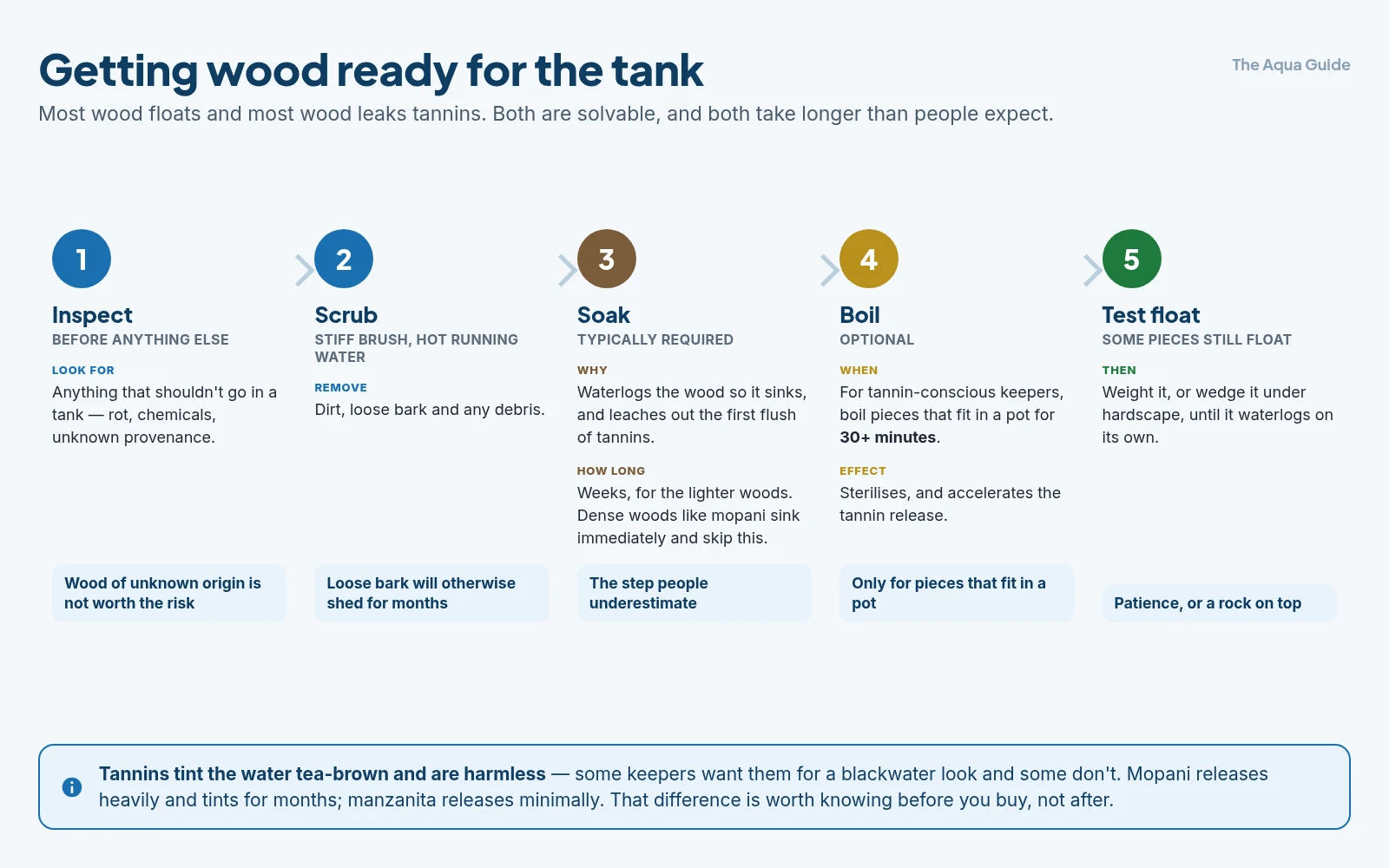
1. Inspect for safety. Look for:
- Loose bark (peel it off — it will rot in the tank)
- Mold or rot (avoid these pieces)
- Sharp protrusions (sand or trim)
- Embedded debris (clean out)
2. Scrub thoroughly. Stiff brush under hot running water. Remove dirt, loose bark, any debris.
3. Soak (typically required).
- Spider wood: 1–4 weeks (long soak needed)
- Manzanita: 1–2 weeks
- Malaysian/Mopani/Bogwood: 1 week or sinks immediately (often)
- The wood needs to absorb water; replace soak water every few days
4. Boil (optional). For tannin-conscious keepers, boil pieces that fit in a pot for 30+ minutes. Sterilizes and accelerates tannin release.
5. Test float. Some pieces still float after soaking. For these:
- Weight them with rocks initially
- Drill and screw to a piece of slate or large flat rock for permanent weighting
- Wait longer (sometimes months) for the wood to fully saturate
Composition Principles for Driftwood
Many principles overlap with rock placement, but driftwood has specific considerations:
Direction and flow. Branching wood inherently suggests direction — branches point somewhere. Use this:
- Branches angled upward and inward suggest growth
- Branches angled downward suggest erosion or natural rootscape
- Avoid branches pointing out of the tank (lead the eye away)
The "tree" approach. A piece of spider wood with rising branches reads as a tree. Position it like a tree would grow: trunk rising from the substrate, branches reaching upward and outward.
The "root" approach. Multiple pieces of wood arranged as if a tree root system has been exposed. Branches penetrating into substrate; some lower, some higher.
Combining pieces. A single piece of driftwood is often visually limited. Combining 2–3 pieces (carefully, so the joints don't show obviously) creates more substantial focal points. Wedge pieces together, or use aquarium-safe epoxy/glue.
Vary heights with wood. Different wood pieces at different heights create depth. The tallest piece is the focal point; smaller pieces support and extend the composition.
Embed in substrate. Wood should look planted in substrate, not perched on top. Push the base partially into the substrate, with substrate built up around it.
Asymmetry. Same principle as rocks. Don't center the dominant piece; place at a rule-of-thirds point.
Wood + Rock Combinations
The most common aquascape arrangement is rocks at the base, wood rising from them. This combination:
- Suggests a natural geological setting (tree growing among rocks)
- Provides solid grounding for the wood
- Creates strong visual hierarchy (stable rock base + organic wood movement)
- Allows different plants to attach to different surfaces
Classic arrangement: a triangular layout with a large rock at the base of one third, a piece of driftwood rising from behind/beside it, plants filling in around.
Anchoring Plants to Driftwood
Many plants attach beautifully to wood:
Mosses (java moss, Christmas moss, fissidens) — wedge into wood crevices or tie with thread
Anubias — wedge rhizome into a wood crevice or tie with thread; eventually attaches firmly
Java fern — same method as anubias
Bucephalandra — attaches readily to wood; provides color and texture
Riccia, monte carlo, dwarf hairgrass — for advanced "growing carpet on wood" effects (more demanding)
Attachment methods:
- Cotton thread — wraps around plant and wood; dissolves in weeks after the plant attaches
- Fishing line — permanent; less visible but harder to remove later
- Cyanoacrylate gel (super glue) — small dab on rhizome, hold against wood for a few seconds. Underwater-safe gel works fine.
Don't bury rhizomes (anubias, java fern) under substrate — they rot. Attach to wood or rock surfaces only.
Driftwood Maintenance
Over months and years:
Tannin release fades. Most wood significantly reduces tannin output after 3–6 months in the tank. Water tinting becomes minimal long-term.
Some wood softens or degrades. Especially softer woods (cholla, some spider wood pieces). They may need replacement after 1–3 years.
Algae growth on wood. Diatoms and biofilms naturally colonize wood. Algae eaters (otocinclus, shrimp) help control. Some keepers welcome the "natural patina" of algae-coated wood.
Fish behavior around wood. Many species use wood for hiding, breeding (some plecos breed in wood crevices), and grazing. Wood supports the bioregion of the tank, not just the aesthetics.
Common Beginner Mistakes
Adding wood without soaking. It floats, refuses to sink, frustrates everyone. Plan ahead.
Using non-aquarium-safe wood. Backyard sticks, treated lumber, resinous evergreens — all risky to dangerous. Stick with proven aquarium wood types.
Too much wood. Like rocks, restraint matters. One dominant piece plus 1–2 supporting pieces usually beats a tank full of wood.
Wrong wood for the scape. Spider wood in a hardscape-minimal Iwagumi looks wrong; clean smooth manzanita in a wild jungle feels out of place. Match wood to style.
Branches pointing every direction randomly. Establish a flow direction. Branches should align with the composition's intent.
Not anchoring plants. Plants placed loosely on wood drift off. Always tie or glue.
Hidden tannin shock. Adding heavy-tannin wood to a tank with sensitive fish without soaking first causes sudden chemistry shifts. Always soak first.
The Bottom Line
Driftwood adds organic curves, tree-like focal points, plant-attachment surfaces, and natural authenticity to aquascapes. Common varieties: spider wood for branching tree forms (must soak weeks), mopani for dense dark dramatic pieces (sinks immediately, heavy tannins), manzanita for high-end sculptural shapes, Malaysian driftwood for general purpose, mangrove for blackwater biotopes, cholla for shrimp hideouts. Most wood releases tannins that tint water amber — embrace this for biotopes, or minimize with extended soaking and activated carbon. Prepare wood by inspecting, scrubbing, soaking for 1–4 weeks (depending on type), optionally boiling. Compose with intent: directional branches, asymmetric placement at rule-of-thirds points, combinations for substantial focal points, partial substrate embedding. Combine with rocks for the strongest hardscape arrangements. Anchor plants (mosses, anubias, java fern, Bucephalandra) to wood with thread or super glue. Driftwood transforms a planted tank into a living forest scene — and many keepers find wood-forward scapes more naturally appealing than stone-dominant ones.
Related guides
- Hardscape: choosing and placing rocks
- Composition and design principles in aquascaping
- Aquascape styles: nature, iwagumi, Dutch, jungle
- Setting up your first aquascape, step by step
- How to plant and anchor aquarium plants
- Substrate choices for aquascapes
- Filter media explained: mechanical, biological, chemical
- Aquascaping for beginners
Got questions about your specific setup? Drop them in our Community Forum — we love helping new fishkeepers get started right.