Aquascaping has evolved into several distinct traditions, each with its own design philosophy, plant choices, and visual character. Knowing the major styles helps you understand what you're seeing in others' work — and points you toward the aesthetic that resonates most with you. Here's the guide to the four most influential aquascape styles, what defines each, and how to recognize and approach them.
At a glance: which style suits you
| If you want... | Then... |
|---|---|
| A landscape — mountains, a gorge, a riverbank | Nature Aquarium. Hardscape does the structural work and plants soften it |
| Minimalism, and the discipline of it | Iwagumi. A few perfectly arranged stones, one carpet plant, and a great deal of empty space |
| Plants as the whole point | Dutch. No hardscape needed; the composition is arrangements of contrasting species |
| Lushness, and less pruning | Jungle. Dense, organic, slightly chaotic — and the most forgiving of the four |
| A specific real place, faithfully | Biotope. Species and hardscape chosen to match one actual habitat |
Jungle is the kindest to a beginner, because minimal pruning and high density hide a multitude of sins. Iwagumi is the least forgiving: with three stones and one plant, there is nowhere for a mistake to hide.
Nature Aquarium
The most influential modern style, developed by Japanese aquarist Takashi Amano beginning in the 1980s and codified through his books and the company ADA. The Nature Aquarium style now dominates international aquascape competitions and most online aquascape content.
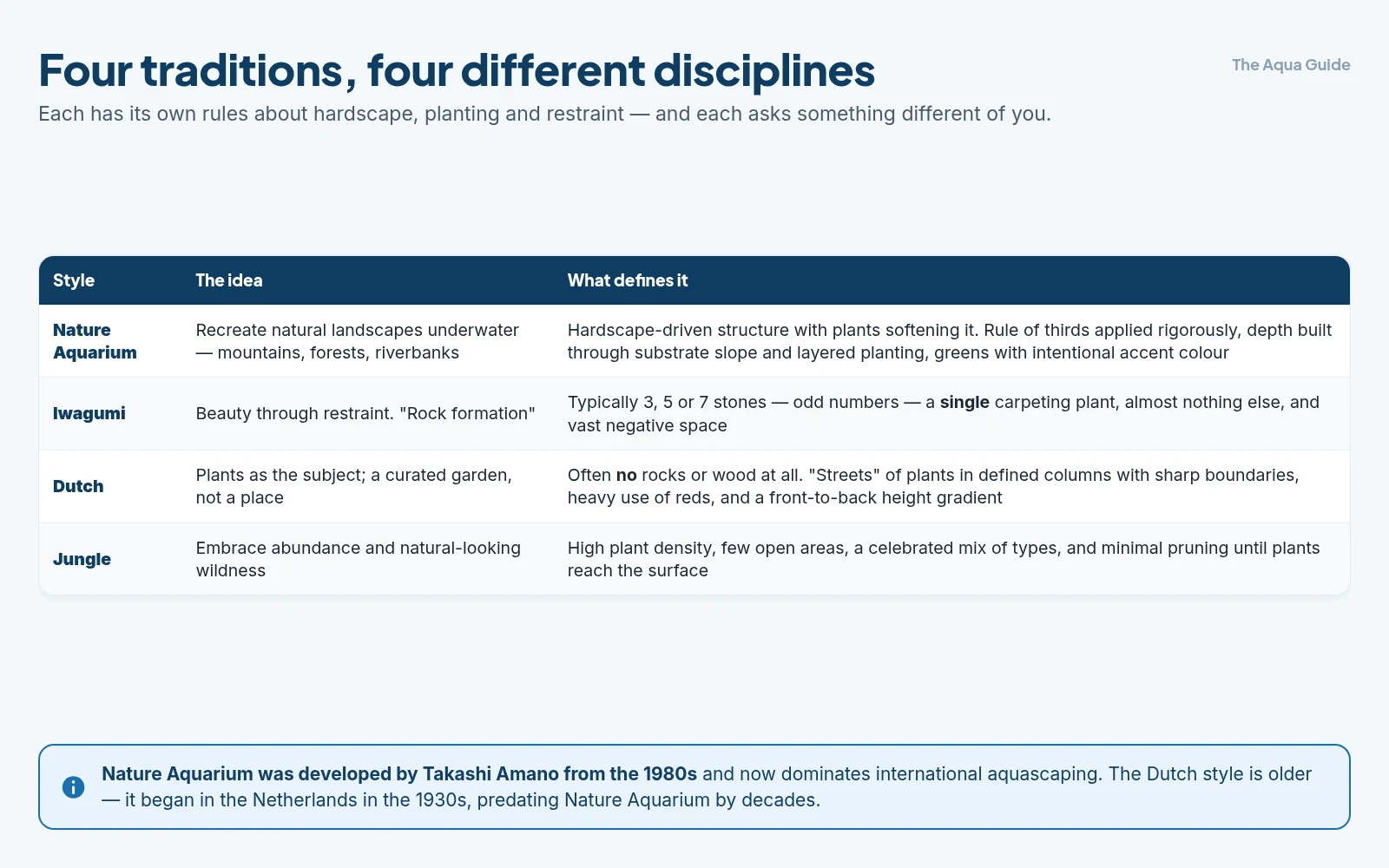
Philosophy: Recreate natural landscapes underwater — mountains, forests, riverbanks, alpine meadows. Plants and hardscape work together to suggest a slice of nature, often with a strong sense of scale and depth.
Key characteristics:
- Landscape inspiration. Many Nature Aquarium scapes reference specific natural environments — mountain forests, mossy gorges, riverside views.
- Hardscape-driven structure. Rocks (often seiryu or dragon stone) and driftwood form the bones; plants soften and fill.
- Strong composition. Rule of thirds, focal points, asymmetric balance are applied rigorously.
- Depth illusion. Substrate slopes, perspective trickery, layered plants create the feeling of a vast scene in a small tank.
- Plant variety with restraint. Multiple species, but used purposefully — not every plant available, just the right ones.
- Color palette dominated by greens with intentional accent colors (red plant, brown wood).
- Often features: Carpet plants in the foreground, mid-ground stems and ferns, background tall plants, prominent hardscape focal point.
Famous examples: Most ADA showcase tanks; most competition winners at major aquascaping contests; many of the most-shared aquascape photographs online.
Plant choices commonly used: Cuba (Hemianthus callitrichoides), monte carlo, hairgrass carpets, rotala varieties, anubias attached to wood, mosses (especially weeping moss, Christmas moss).
Difficulty: High at the master level; surprisingly approachable at the beginner level if you focus on basic composition.
Best for: Aquascapers interested in design and natural beauty; competition-minded keepers; anyone drawn to landscape-inspired underwater scenes.
Iwagumi
Minimalist rock-focused composition derived from Japanese garden traditions and refined through Nature Aquarium principles. Iwagumi literally means "rock arrangement" in Japanese.
Philosophy: Beauty through restraint. A few perfectly-arranged stones, surrounded by a single carpeting plant, with vast negative space. The composition's strength comes from what's NOT included.
Key characteristics:
- Minimal hardscape. Typically 3, 5, or 7 stones (odd numbers).
- Single carpet plant. One foreground plant species (usually hairgrass, monte carlo, or glossostigma) creates a uniform meadow.
- Almost no other plants. Some Iwagumi tanks have one or two small stem plant clusters; many have none.
- Strong negative space. Large areas of open foreground, with stones rising from the carpet.
- Strict rock arrangement. The three-stone system (oyaishi, fukuishi, soeishi) and its extensions provide the structural grammar.
- Color palette extremely limited. Greens, with stone tones as the only contrast.
- Photography-worthy from the side. Iwagumi tanks are often described as "Japanese gardens underwater."
Famous examples: ADA's classic Iwagumi setups; many competition entries; the style most associated with Takashi Amano's earliest work.
Plant choices: Hairgrass (Eleocharis acicularis or parvula), monte carlo, glossostigma, dwarf hairgrass. The plant must form a uniform low carpet.
Difficulty: Visually simple, technically demanding. The carpet must be perfect; the rock arrangement must be precise; weeds and algae are immediately visible against the clean composition.
Best for: Aquascapers who appreciate minimalism, Japanese aesthetics, and the challenge of perfection through simplicity.
Common challenges: Algae shows easily; carpet plants take time to establish; rock arrangement must be near-perfect because there's nothing to hide it behind.
Dutch Style
The plant-focused tradition developed in the Netherlands beginning in the 1930s — predating Nature Aquarium by decades. Often called the "garden" style of aquascaping.
Philosophy: Plants as the central subject. Hardscape is minimal or absent; the composition comes from arrangements of contrasting plant species like flower garden beds.
Key characteristics:
- Plant-dominant. Often no rocks or driftwood at all; plants fill the entire tank.
- "Streets" of plants. Plants arranged in clearly-defined columns or groups, with sharp boundaries between species.
- Color and texture contrast. Heavy use of red plants for color; varied leaf shapes for texture variety.
- Terraced heights. Front-to-back height gradient maintained through plant choices and pruning.
- No imitation of natural landscapes. The scape doesn't try to look like a "place" — it's intentionally a curated garden.
- Strict maintenance. Plants are pruned to maintain sharp species boundaries; weeds and crossover plants are removed.
- Diagonal lines. Plant arrangements often feature diagonal "streets" running across the tank for visual flow.
Famous examples: Classic Dutch competition tanks; Filipe Oliveira's work; various Dutch-style showcases at the NBAT (Dutch Aquarium Society).
Plant choices: Rotala varieties, ludwigia (especially repens "rubin"), alternanthera, hygrophila, lobelia, pogostemon, ammania — emphasis on stem plants with strong color/texture characteristics.
Difficulty: High maintenance. Requires constant pruning to maintain boundaries; demanding plant species need good lighting and fertilization.
Best for: Keepers who love plants for their own sake; gardeners who want to translate flower-bed design underwater; those who don't mind frequent pruning.
Practical reality: Dutch tanks are less common in modern online aquascape content than Nature Aquarium scapes, but they have a devoted following and produce stunning results.
Jungle Style
The wild, lush, untamed approach. Less codified than the other styles, jungle style is more of a category than a tradition.
Philosophy: Embrace abundance and natural-looking wildness. Plants grow freely; pruning is minimal; the overall feel is dense, organic, slightly chaotic.
Key characteristics:
- High plant density. Tanks are heavily planted with relatively few open areas.
- Mix of plant types. Stem plants, rosette plants, mosses, floaters — variety is celebrated.
- Minimal pruning. Plants are allowed to grow until they reach the surface or become genuinely problematic, then trimmed.
- Hardscape often secondary. Some pieces of driftwood or rocks anchor the design, but plants dominate.
- Naturalistic feel. The tank looks like a wild stream or river overgrown with vegetation.
- Forgiving design. Mistakes hide in the abundance.
- Often features: Floating plants on the surface, tall background plants, mid-ground bushes, sometimes a clearing or path through the growth.
Famous examples: Many less competition-focused tanks; biotope-style scapes; "wabi-style" tanks emphasizing natural ageing.
Plant choices: Wide variety — fast growers (hornwort, water sprite, water wisteria), mid-ground plants (cryptocoryne, anubias, java fern), foreground plants if any (java moss, low-growing plants).
Difficulty: Beginner-friendly. The style is forgiving of mistakes; plants growing wildly is the point.
Best for: Beginners who want a beautiful tank without the maintenance burden of Dutch or precision of Iwagumi; keepers who prefer natural-looking environments; busy people who can't prune weekly.
Biotope
A specialty style focused on ecological accuracy. Recreates a specific natural environment with appropriate plants, substrate, hardscape, and fish — like an underwater museum diorama.
Philosophy: Authenticity over aesthetics. A biotope tank tells the story of a specific place — Amazon blackwater, African Rift Lake, Southeast Asian river.
Key characteristics:
- Specific geographic focus. A "Rio Negro biotope," "Lake Malawi biotope," etc.
- Region-appropriate everything. Only plants and fish from that region; substrate, water chemistry, hardscape matching the natural environment.
- Less concerned with visual composition. Authenticity matters more than rule-of-thirds.
- Research-intensive. Requires understanding the specific habitat — water parameters, plants, fish species, behaviors.
- Often features: Leaf litter, specific wood types, regionally-correct rocks, soft-water for Amazon biotopes, hard water for African setups.
Common biotopes:
- Amazon blackwater — driftwood, leaf litter, tannin-stained water, tetras and corys
- Southeast Asian river — moderate plants, peat substrate, rasboras and gouramis
- Lake Tanganyika — rocks and shells, high pH, alkaline, specific cichlid species
- South American Amazonian — sand bottom, driftwood, sword plants, angelfish and discus
Famous examples: Various biotope competition winners; environmentally-focused keepers; species-specific breeding setups.
Plant choices: Highly restricted by region. Some biotopes have very few plants; others are densely planted with regional species.
Difficulty: Research is the main challenge; execution can be simple once you know what's needed.
Best for: Keepers interested in fish ecology and natural environments; species-focused keepers; those who find competition-style aquascapes feel "artificial."
Other Notable Styles
Wabi-kusa. Originated in Japan; emphasizes plants growing on emerged moss balls or in moss bowls. Some plants are partially out of water. More art-piece than landscape.
Riparium. Plants growing partially emergent — half submerged, half above water. Often features houseplant species that tolerate water.
Paludarium. Hybrid water/land tank with significant land area featuring terrestrial plants. Adjacent to aquascaping but distinct.
Walstad / Diana Walstad method. A low-tech approach using regular potting soil capped with sand. Focuses on creating a balanced, self-sustaining ecosystem. Less concerned with aesthetics, more with biology.
Bonsai-style. Driftwood arranged to mimic bonsai trees, with moss for foliage. A specialty niche with passionate practitioners.
Choosing a Style
Several factors influence which style suits you:
Time available for maintenance:
- High maintenance: Dutch (constant pruning), Iwagumi (algae control on clean carpets)
- Medium: Nature Aquarium (balanced)
- Low: Jungle, Walstad
Experience level:
- Beginner-friendly: Jungle, simple Nature Aquarium
- Intermediate: More refined Nature Aquarium, basic biotopes
- Advanced: Iwagumi (technically demanding), Dutch (high-maintenance), complex biotopes
Aesthetic preference:
- Naturalistic landscapes: Nature Aquarium
- Minimalist: Iwagumi
- Plant gardens: Dutch
- Wild abundance: Jungle
- Ecological authenticity: Biotope
Available equipment:
- High-tech setups (CO₂, strong lighting): All styles possible
- Low-tech (no CO₂): Jungle, Walstad, simple biotopes work best
Budget:
- Higher cost: Iwagumi (precision plants), Dutch (many demanding stems), Nature Aquarium with aquasoil
- Lower cost: Jungle, basic biotopes, Walstad
Mixing Styles
You don't have to commit to one style purely. Many aquascapes are hybrids — a Nature Aquarium with Iwagumi influence, a jungle with some Dutch-style color contrasts, a biotope with composition-aware placement.
The best approach for most keepers: learn the principles of each style, understand what makes them distinctive, and develop your own preferred eclectic approach over time.
The Bottom Line
The four major aquascape styles offer distinct approaches: Nature Aquarium for landscape-inspired natural beauty with strong composition (the dominant modern style, championed by Takashi Amano); Iwagumi for minimalist rock-focused compositions with carpet plants and significant negative space (beautiful when perfect, demanding technically); Dutch for plant-garden compositions with sharply-defined species "streets" and color contrast (high maintenance but stunning); and Jungle for wild, lush, beginner-friendly natural-looking scapes (forgiving and easy). Specialized approaches include biotope (ecological recreations of specific habitats), wabi-kusa (emergent plant compositions), walstad (low-tech soil-based methods), and various niche styles. Match style to your time, experience, aesthetic preference, equipment, and budget — and don't feel obligated to commit to a single tradition. Most successful keepers develop personal eclectic approaches that draw on multiple traditions. Studying the major styles trains your eye and helps you understand what you're seeing in others' work, even when your own approach is different.
Related guides
- Aquascaping for beginners
- Composition and design principles in aquascaping
- Hardscape: choosing and placing rocks
- Hardscape: driftwood selection and placement
- Setting up your first aquascape, step by step
- Substrate choices for aquascapes
- Aquascape maintenance and evolution over time
- Floating and carpeting plants for beginners
Got questions about your specific setup? Drop them in our Community Forum — we love helping new fishkeepers get started right.