There's a moment many keepers reach when functional fishkeeping isn't quite enough — when looking at the tank, you start wondering what would make it beautiful, not just healthy? That's the beginning of aquascaping: the practice of designing your aquarium as a deliberate underwater landscape. It draws on principles from gardening, photography, and natural landscape design, and it's the most artistic side of the hobby. Here's the introduction to everything aquascaping. Each topic below opens into a more detailed guide, but by the end of this page you'll have the whole framework for thinking about your tank as a designed space.
At a glance: what aquascaping is, and isn't
| It isn't | Because |
|---|---|
| Just having plants | A tank with plants thrown in is planted, but not necessarily aquascaped |
| Just expensive equipment | Beautiful scapes can be built in modest tanks with basic gear |
| Just imitating one style | There are many traditions, and most keepers develop their own approach |
| Just for show | Aquascaped tanks are still functional homes for fish — just designed thoughtfully |
What separates it from a regular planted tank is intention: the keeper has thought about composition, depth, focal points, colour and proportion, and arranged the elements deliberately rather than randomly.
What Aquascaping Actually Is
Aquascaping is the deliberate arrangement of hardscape (rocks and wood), plants, substrate, and open space inside an aquarium to create a visually compelling scene. Some people think of it as gardening underwater; others as landscape painting in three dimensions. Both views are accurate.
A few things aquascaping is not:
- It's not just "having plants" — a tank with plants thrown in is planted, but not necessarily aquascaped
- It's not just "expensive equipment" — beautiful scapes can be built in modest tanks with basic gear
- It's not just "imitating a single style" — there are many traditions, and most keepers develop their own approach
- It's not just "for show" — aquascaped tanks are still functional homes for fish, just designed thoughtfully
What separates aquascaping from regular planted tanks is intention. The keeper has thought about composition, depth, focal points, color, and proportion — and arranged the elements deliberately rather than randomly.
Why Aquascape?
Several reasons keepers start to take this seriously:
Aesthetic enjoyment. A well-designed tank is genuinely beautiful to look at — more rewarding than just a functional fish tank.
Creative outlet. Aquascaping is one of few hobbies that combines biology, design, gardening, and patience. Each tank is a multi-month canvas.
Fish are happier. Tanks with thoughtfully placed hardscape and plants offer more natural environments — hiding places, swimming corridors, territorial zones — that fish appreciate.
Photography and sharing. A beautiful aquascape photographs well. Many keepers love sharing progress shots, "scape diaries," and finished compositions.
Continuous evolution. Unlike a painting, an aquascape is alive — plants grow, the design develops, layouts evolve. It's an ongoing creative project.
Achievement. Successfully producing a beautiful tank is genuinely impressive — both to yourself and to anyone who sees it.
The Major Aquascape Styles
Nature, Iwagumi, Dutch and jungle are the four you will meet, and each has its own rules about hardscape, planting and restraint. Aquascape styles covers all four with what each demands of you.
The Core Design Principles
Focal point, the rule of thirds, depth and negative space do most of the work, and they are learnable rather than innate. Composition and design principles covers them with examples.
What You'll Need
Hardscape, substrate, plants and — depending on ambition — light and CO2. Each is a choice in its own right: rocks, driftwood, substrate, CO2, fertiliser and lighting.
The Beginner's Mistake: Trying Too Hard Too Fast
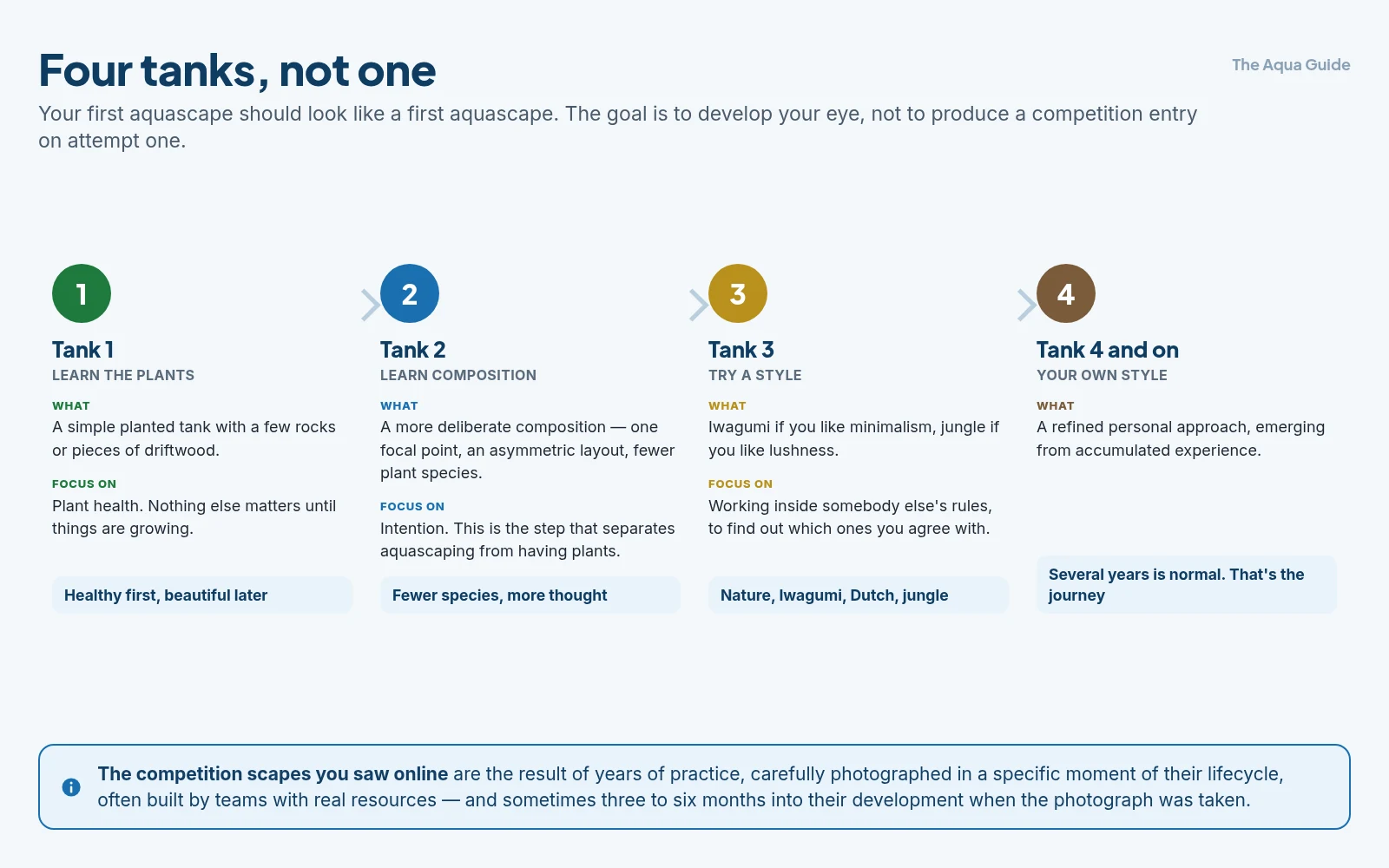
A common pitfall: beginners look at competition-winning aquascapes online, then expect their first tank to look similar. It won't. The competition scapes are:
- The result of years of practice and experience
- Carefully photographed in specific moments of their lifecycle
- Often built by teams with significant resources
- Sometimes 3–6+ months into their development when photographed
Your first aquascape should look like a first aquascape — imperfect, learning, evolving. The goal is to develop your eye and skills, not to produce a competition entry on attempt one.
A reasonable progression:
Tank 1: A simple planted tank with a few rocks or pieces of driftwood. Focus on plant health.
Tank 2: A more deliberate composition — one focal point, asymmetric layout, fewer plant species.
Tank 3: Trying a specific style — Iwagumi if you like minimalism, jungle if you like lushness.
Tank 4+: Refined personal style emerging from accumulated experience.
Most aquascapers go through several years of progression before producing tanks they're proud of. That's the journey, and it's the point.
When to Start
Aquascaping is a skill that develops over time, and the best way to learn is by doing. You don't need to wait for perfect conditions, perfect equipment, or perfect knowledge. A few signals it's time:
- You have a tank running for several months and feel ready to redesign
- You're starting a new tank and want to do it deliberately
- You've seen aquascapes online that inspired you
- Your existing tank is healthy but feels "thrown together" and you want to elevate it
Don't wait for the "right tank" — start with what you have. Aquascaping principles work in any size tank.
The Mental Shift
The biggest shift from regular keeping to aquascaping is thinking about your tank as a designed space. Instead of "where should I put this rock?" think "what's the story this scape tells, and what does this rock contribute to it?"
This mindset takes practice. Eventually, you start seeing scapes (in your tank, in others' tanks, online) with the eye of a designer — noticing focal points, judging proportions, seeing what works and what doesn't.
That shift is the heart of aquascaping. Not the equipment or the techniques — the way of looking.
The Bottom Line
Aquascaping is the deliberate design of an aquarium as an underwater landscape — combining hardscape (rocks and driftwood), plants, substrate, and open space to create a visually compelling scene. It draws on design principles like focal points, rule of thirds, depth and perspective, negative space, and asymmetric balance — all working together to feel natural rather than placed. Major styles (Nature Aquarium, Iwagumi, Dutch, Jungle, Biotope) offer different traditions to explore, but beginners shouldn't feel obligated to pick one — start with naturalistic eclectic approaches and let your style emerge. You don't need expensive equipment, just thoughtful intention; the most important "tool" is the mental shift from random arrangement to deliberate composition. Expect your first scapes to be imperfect — aquascaping develops over years of practice, and that progression is part of the point. The detailed guides in this section take each piece further, from rocks and wood to substrate, styles, setup process, and long-term maintenance.
Related guides
- Aquascape styles: nature, iwagumi, Dutch, jungle
- Composition and design principles in aquascaping
- Setting up your first aquascape, step by step
- Hardscape: choosing and placing rocks
- Hardscape: driftwood selection and placement
- Substrate choices for aquascapes
- Aquascape maintenance and evolution over time
- The beginner's guide to live aquarium plants
Got questions about your specific setup? Drop them in our Community Forum — we love helping new fishkeepers get started right.
Aquascaping, step by step
The mindset above is the part that is hard to look up. Everything below is the craft, and each has its own page.
- The four styles — Nature, Iwagumi, Dutch and jungle
- Composition and design — focal points, thirds, depth
- Your first aquascape — the build, step by step
- Choosing and placing rocks — and why most people use too few
- Driftwood — selection, preparation and placement
- Substrate choices — what each type does for plants
- Planting and anchoring — getting plants to stay put
- Easiest plants to start with — fast growers that forgive mistakes
- Floating and carpeting plants — the two that behave very differently
- CO2, fertiliser and lighting — when you actually need them
- CO2 injection — pressurised systems and alternatives
- Maintenance over time — how a scape changes as it grows in
- Melting or yellowing leaves — what the plant is telling you