It's a genuinely frustrating moment: you do a water change expecting to fix the cloudiness, and the water is just as hazy as before — or somehow worse. A water change feels like it should clear cloudy water, so when it doesn't, something deeper is going on. The reason is simple once you understand it: a water change only fixes cloudiness if cloudiness was caused by something a water change removes. Let's diagnose why yours persists and what actually clears it.
The Core Insight
A water change removes a portion of your water and the stuff dissolved or suspended in it. So it clears cloudiness only when the haze is caused by something that gets diluted or removed — like excess dissolved nutrients or some suspended debris. But several common causes of cloudiness are not fixed by a water change at all, and one is even made worse by it. Figuring out which type you have is the whole game.
There are two main kinds of cloudiness, and they behave very differently after a water change.
Cause 1: A Bacterial Bloom (Water Change Won't Fix It — May Worsen It)
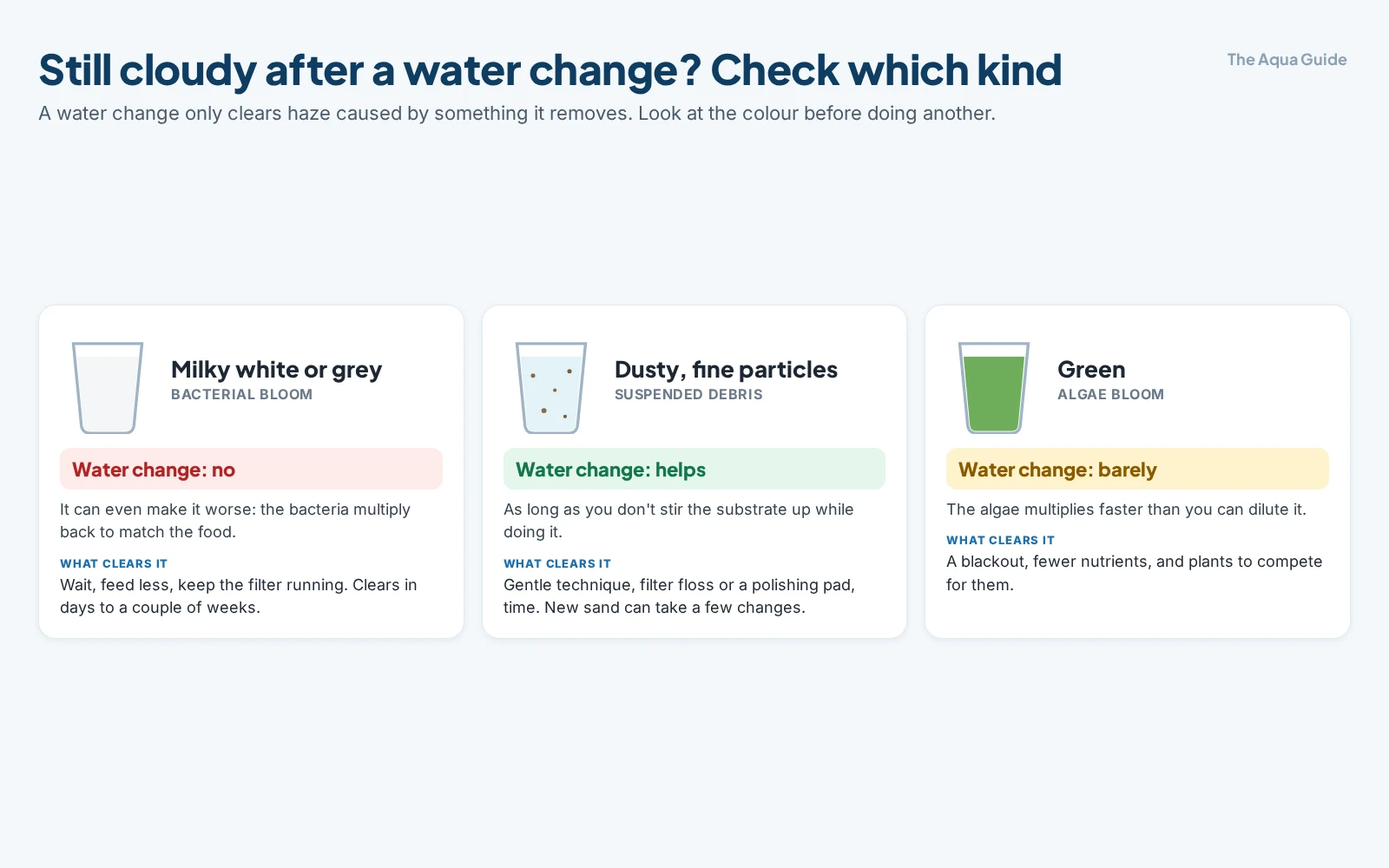
If your water is milky, whitish, or grayish-hazy, you almost certainly have a bacterial bloom — a population explosion of free-floating bacteria. This is extremely common in new tanks and after disturbances, and here's the counterintuitive part: a water change doesn't fix a bacterial bloom, and can actually make it worse.
Why? The bloom is bacteria multiplying to consume an excess of dissolved nutrients (often from overfeeding, a new tank, or disturbed substrate). A water change removes some bacteria, but it also stirs things up and the remaining bacteria simply multiply right back to match the available food. Sometimes the fresh nutrients and disturbance even fuel a bigger bloom. People end up doing water change after water change, frustrated that the milkiness keeps returning.
The fix for a bacterial bloom is patience, not water changes. A bloom clears on its own once the bacteria balance out — usually within days to a couple of weeks. To help it along, stop overfeeding (excess food is the usual fuel), make sure your filter is running well, and simply wait. The bloom will settle as the bacterial population stabilizes onto surfaces. Resisting the urge to keep doing water changes is, counterintuitively, the right move.
Cause 2: Suspended Debris or Fine Particles (Water Change Helps, but Technique Matters)
If your cloudiness is more like floating dust or fine particles rather than a milky haze, it's physical debris suspended in the water — often stirred up from the substrate, or fine particles from new sand or soil. A water change does help here, but if it's still cloudy afterward, a few things may be going on.
You may have stirred up more debris during the water change itself — vacuuming aggressively or pouring water in hard can kick up fine particles, leaving the water cloudier right after. The fix is gentler technique and a little time for it to resettle and get caught by the filter. Your filter may also not be polishing the water well: weak flow, clogged media, or the lack of fine mechanical filtration (like filter floss) means tiny particles stay suspended. Adding or cleaning fine mechanical media helps capture them. And brand-new substrate (especially sand or aqua soil) can take several water changes and days of filtration before it stops clouding.
Cause 3: Green Water (A Water Change Barely Dents It)
If the cloudiness is distinctly green, you've got a free-floating algae bloom, not ordinary cloudiness. Water changes barely help because the algae multiplies far faster than you can dilute it. Green water needs its own approach — removing light (a blackout), reducing nutrients, and adding competition from plants — rather than water changes alone. (Green water has its own dedicated guide.)
At a glance: which cloudiness is it?
| What you see | What it is | What the water change does |
|---|---|---|
| Milky white or grey, in a newish tank, and it keeps coming back after changes | A bacterial bloom | Nothing good — it may worsen it. Stop changing water obsessively, stop overfeeding, and wait it out |
| Fine floating particles or dustiness, worse right after disturbing the substrate | Suspended debris | Helps, but technique matters. Gentle handling, good mechanical filtration, and a little time |
| Green | An algae bloom | Barely dents it. This one needs light and nutrient control, not water changes |
The core insight is that "cloudy" is three different problems, and a water change is the right answer to only one of them — which is why doing more of it can leave you further from clear water than when you started.
How to Diagnose Which You Have
Match your cloudiness to the type:
If it's milky white or gray and especially if it's a newish tank or keeps coming back after water changes — it's a bacterial bloom. Stop changing water obsessively, stop overfeeding, and wait it out.
If it's fine floating particles or dustiness, worse right after disturbing the substrate — it's suspended debris. Gentle technique, good mechanical filtration, and a little time will clear it.
If it's green — it's an algae bloom, needing light and nutrient control, not water changes.
The General Fixes That Help Most Cases
Beyond the specific cause, a few things support clearing almost any cloudiness: make sure your filter is running properly and contains fine mechanical media to polish out particles; stop overfeeding, since excess food fuels both bacterial blooms and nutrient-driven haze; be gentle during maintenance so you're not constantly re-suspending debris; and give it time, because the most common cause (a bacterial bloom) genuinely just needs patience. Crucially, recognize when more water changes are not the answer — for a bacterial bloom, restraint beats repetition.
The Bottom Line
If your water is still cloudy after a water change, it's because the cause isn't something a water change removes. The most common reason is a bacterial bloom — milky, common in new tanks — which water changes don't fix and can even worsen; the cure is patience, less feeding, and letting the bacteria balance out over days to weeks. Suspended debris responds to gentle technique, good mechanical filtration, and time. Green water needs light and nutrient control, not dilution. Diagnose by the look — milky, dusty, or green — and apply the matching fix. Often the hardest but most correct step is to stop doing water changes and simply let a harmless bloom clear itself.
Related guides
- Fish tank water cloudy? What's wrong and how to fix it
- Green water and free-floating algae blooms
- How to clear green water without a UV sterilizer
- The best live plants for clearing cloudy water
- Filter media explained
- How often should you do a water change?
Got questions about your specific setup? Drop them in our Community Forum — we love helping new fishkeepers get started right.