Bringing fish home is exciting — and the next twenty minutes determine whether they thrive or die of shock. The water in the bag from the store has a different temperature, pH, and possibly hardness than your tank. Tipping a fish straight from one to the other is one of the leading causes of new-fish death, and it's completely avoidable. Here's how to acclimate fish properly, the two common methods, and the small details that prevent the most preventable losses.
How do I acclimate new fish to my tank?
Float the sealed bag for 15–20 minutes to equalize temperature, then add a small amount of tank water to the bag every few minutes for 20–30 minutes, then net the fish out into the tank. Never pour the bag water in, and use the slower drip method instead for shrimp, sensitive species or fish that have been shipped a long way.
At a glance: the five things not to do
| Don't | Why |
|---|---|
| Pour the bag water into your tank | Worth repeating on its own line. Use a net |
| Skip acclimation, even for "hardy" fish | The cost is thirty minutes; the benefit is real |
| Acclimate for too long | Beyond about an hour, ammonia in the bag water is a bigger threat than the temperature mismatch |
| Add fish from two sources at once, in one go | Acclimate each batch separately unless they came from the same place |
| Feed immediately | Wait until the next day. Stressed fish don't eat well, and uneaten food fouls the water at the most fragile time |
Before you start: don't feed before the trip home, get them home quickly, turn the tank lights off, and leave the water level slightly low to allow for what you add.
Why Acclimation Matters
Fish are exquisitely sensitive to sudden changes in water chemistry and temperature. When you drop a fish from the bag into your tank, three things can hit it at once: a temperature swing (the bag may have cooled or warmed in transport), a pH shift (your tank water may be more acidic or alkaline than the store's), and a change in hardness or other parameters (water differs across sources). Any one of these is stressful; all three together can be lethal — a kind of internal shock that may not show for hours or days.
Proper acclimation is the simple practice of letting the bag water and your tank water mix gradually, so the fish adjusts step by step instead of being shocked. It takes 15–60 minutes and dramatically improves first-week survival.
Before You Start
A few preparations make acclimation easier. Don't feed your fish before the trip home if you bought from a store nearby — fish in transit do better with empty stomachs. Get the fish home quickly without prolonged stops; long bag time stresses them and degrades the water (ammonia builds). Turn off your tank lights before adding new fish — bright light on stressed new arrivals adds to the shock. And prepare your tank ahead of time: water level slightly low to allow for the added water, water tested and parameters known.
Method 1: The Float-and-Mix Method (Simple)
The standard method, suitable for most fish from most sources.
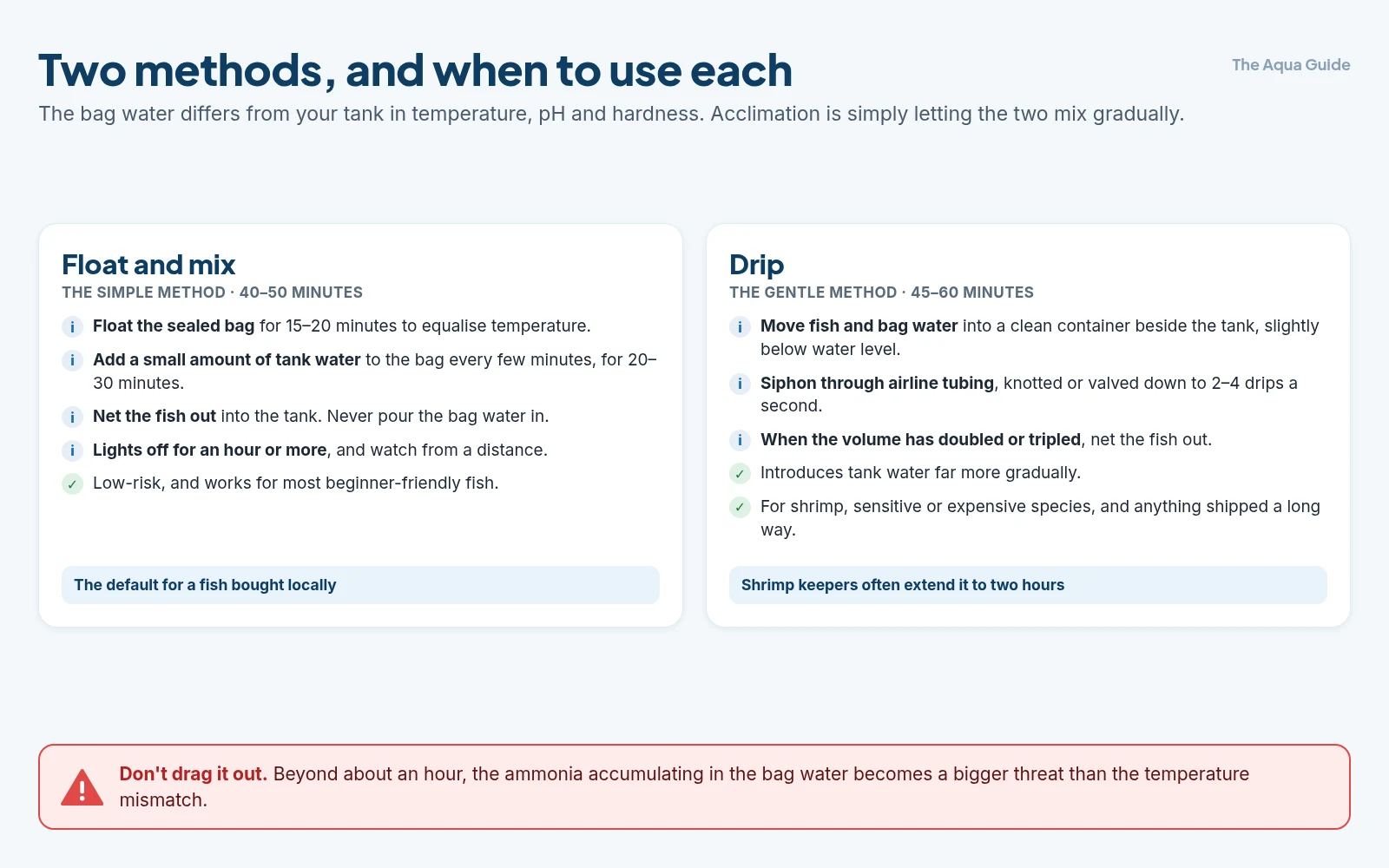
Step 1 — Float the bag. Float the closed bag in your tank water for 15–20 minutes. This equalizes temperature between the bag and your tank. Don't open the bag yet; just let it float, supported by the water surface.
Step 2 — Open and add tank water gradually. Open the bag, then add small amounts of your tank water to the bag every few minutes. A common approach: add about ¼ cup (or one fish-cup volume) every 4–5 minutes, for around 20–30 minutes total. By the end, the bag contains mostly your tank water with a small fraction of the original.
Step 3 — Net the fish into the tank. Do not pour the bag water into your tank. Bag water may contain ammonia buildup, parasites, or copper from store tanks — none of which you want in your display. Instead, gently net the fish out of the bag and into your tank, and discard the bag water. A soft fine-mesh net is gentlest.
Step 4 — Lights off, observe. Leave the tank lights off for an hour or more after adding new fish. Watch from a distance — don't crowd the tank. Most fish will hide initially and emerge as they settle.
The whole process takes around 40–50 minutes. It's simple, low-risk, and works for most beginner-friendly fish.
Method 2: The Drip Method (Slower, Gentler)
For sensitive species, expensive specimens, or shipped fish that have been in their bags for many hours, the drip acclimation method is gentler still.
Setup. Transfer the fish and bag water into a clean container or specimen cup, deep enough to keep the fish submerged. Place the container next to your tank, slightly below water level.
The drip. Set up a length of airline tubing as a siphon from your tank to the container, with a knot or valve in the tubing to slow the flow to a steady drip — perhaps 2–4 drips per second. Tank water drips slowly into the container, gradually mixing with the bag water over 45–60 minutes.
When done. When the container's volume has roughly doubled or tripled, you've achieved good mixing. Net the fish out (again, don't pour the water in) and add them to your tank with lights off.
Drip acclimation is more involved but introduces tank water far more gradually than the float-and-mix method, making it ideal for delicate fish, shrimp (which are particularly sensitive), and any fish that traveled long distances.
Special Cases
A few situations need different handling.
Shrimp and invertebrates are particularly sensitive to parameter shifts. Drip acclimation over a full hour is the standard recommendation; some shrimp keepers extend it to two hours.
Plants generally don't need acclimation but appreciate a quick rinse in dechlorinated water before being added, especially if they come with snails or pests visible.
Fish from a friend's established tank with similar parameters to yours need less acclimation than store fish — a 15-minute temperature float and a simple net-over is often enough.
Long-shipped fish (online orders that have been in bags 24+ hours) need careful handling. Their bag water has accumulated ammonia, so opening the bag exposes them to a sudden pH shift that can release that ammonia as toxic. Either drip acclimate carefully, or do a "plop and drop" — net the fish straight into the tank without mixing — guided by what the seller recommends for the species.
What NOT to Do
A few common mistakes.
Don't pour the bag water into your tank. Worth repeating. Use a net.
Don't skip acclimation entirely even for "hardy" fish. The cost is 30 minutes; the benefit is real.
Don't acclimate too long. Beyond about an hour, ammonia in the bag water becomes a bigger threat than the temperature mismatch. Don't drag the process out indefinitely.
Don't add multiple fish simultaneously without separate acclimation unless they came from the same source. If you're adding fish from two different stores in one day, acclimate each batch separately.
Don't feed immediately. Wait until the next day to feed new fish. Stressed fish don't eat well, and uneaten food fouls water during the most fragile time.
After Acclimation
Once your new fish are in the tank, leave them alone for the rest of the day. Lights stay off (or dim), feeding waits until tomorrow, and you observe quietly. Some hiding is normal; gasping at the surface, frantic swimming, or visible distress are warning signs that something went wrong with acclimation or with the tank itself.
Test your water over the following days to make sure the new fish haven't pushed your bioload past your filter's capacity. Watch for signs of disease — even seemingly-healthy new fish sometimes bring something with them — for the first couple of weeks. (This is exactly why quarantine, where possible, is so valuable.)
The Bottom Line
Acclimating new fish properly is one of the simplest and most impactful habits in fishkeeping. The standard float-and-mix method — float the bag 15–20 minutes to equalize temperature, then add small amounts of tank water to the bag every few minutes for 20–30 minutes, then net the fish out into the tank without pouring the bag water in — takes under an hour and dramatically improves new-fish survival. For sensitive species, shrimp, or long-shipped fish, use the slower drip method instead. Never skip acclimation, never pour bag water into your tank, never feed immediately, and watch your new arrivals quietly with lights off for the rest of the day. Get the first hour right and you've passed the most fragile moment of any new fish's life with your tank.
Related guides
- Quarantine: why and how
- Adding fish in batches: how slow is slow enough?
- How to spot a healthy vs stressed fish
- Community tank compatibility: what gets along
- Freshwater shrimp: cherry, amano and more
- How many fish can my tank hold?
- What are safe ammonia, nitrite and nitrate levels?
- The beginner's guide to choosing fish
Got questions about your specific setup? Drop them in our Community Forum — we love helping new fishkeepers get started right.