From Aqua Guide, the free encyclopedia
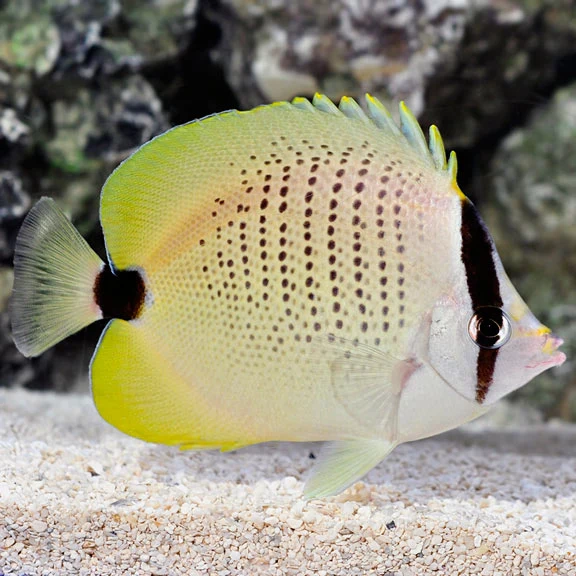
Lemon Butterflyfish
Chaetodon miliaris
- Temperature
- 24–27 °C
- Salinity
- 1.02 – 1.026 SG
- Min. tank size
- 280 L
- Lifespan
- 7-10 years
- Diet
- omnivore
- Care level
- moderate
| Scientific classification | |
|---|---|
| Scientific Name: | Chaetodon miliaris |
| Family: | Chaetodontidae |
| Origin: | Pacific reefs (notably Hawaii) |
| Care Characteristics | |
| Care Level: | moderate |
| Diet: | omnivore |
| Max Size: | 13.00 cm |
| Water Type: | marine |
| Temp Group: | tropical |
| Reef Safe: | Reef Safe with Caution |
| Temperament: | peaceful |
| Min Group: | Can be kept alone |
| Varieties: | No cultivated strains — this is a wild-caught fish, and as a Hawaiian and Johnston Atoll endemic its supply is tied to that fishery. Colour is consistent: a whitish or yellow body with vertical rows of dark spots, a broad black stripe running from above the eye to the base of the operculum, and a large black patch on the caudal peduncle. The genus Chaetodon is very large and splits usefully by diet. The generalists and plankton feeders — this species, C. auriga and C. lunula among them — are the ones that survive in aquaria. The obligate corallivores, which eat only live polyps, should be left on the reef, and they include some of the most beautiful members of the family. Anyone choosing a butterflyfish should check which group it belongs to before anything else. |
| Lifespan: | 7-10 years |
Quick Tips
- Bioload:Medium
- Min Tank:280 L
- Substrate:Live rock with caves; open swimming space
- Plant Safe:Yes
- Filtration:High (clean water; some flow)
Lemon Butterflyfish (Chaetodon miliaris) is a species of fish in the family Chaetodontidae. It is native to Pacific reefs (notably Hawaii). The lemon or millet butterflyfish is the butterflyfish for a reef tank, and the reason is its diet. Most of the family eats coral, and the strict corallivores die in aquaria. This one feeds primarily on zooplankton, taken by suction from the water column, with opportunistic polychaete worms and small invertebrates from the seafloor — which makes it far better suited to a reef aquarium than the specialist coral feeders. It reaches 13 cm and is endemic to the Hawaiian Islands and Johnston Atoll, found down to 250 metres. It is a schooling, mid-water, non-territorial fish with large gonads relative to body size, suggesting promiscuous mating.
Compatibility
- Temperament
- peaceful
- Keep in
- Can be kept alone
- Swims
- middle
- Fin nipper
- No
- Delicate fins
- No
- Reef
- Reef Safe with Caution
Species similar to Lemon Butterflyfish
Matched on family, then category, then water type