From Aqua Guide, the free encyclopedia
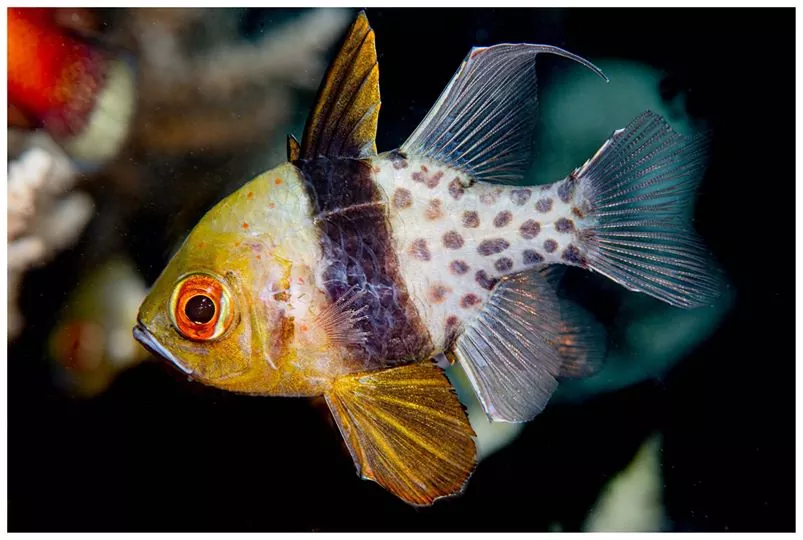
Pajama Cardinalfish
Sphaeramia nematoptera
- Temperature
- 24–27 °C
- Salinity
- 1.02 – 1.026 SG
- Min. tank size
- 110 L
- Lifespan
- 4-5 years
- Diet
- carnivore
- Care level
- easy
| Scientific classification | |
|---|---|
| Scientific Name: | Sphaeramia nematoptera |
| Family: | Apogonidae |
| Origin: | Western Pacific reefs |
| Care Characteristics | |
| Care Level: | easy |
| Diet: | carnivore |
| Max Size: | 8.50 cm |
| Water Type: | marine |
| Temp Group: | tropical |
| Reef Safe: | Reef Safe |
| Temperament: | peaceful |
| Min Group: | 3+ together |
| Varieties: | No cultivated colour strains — the wild-type pattern is what is sold, and it is distinctive enough that nobody has tried to improve on it. Captive-bred specimens are available and are hardier and more willing to take prepared foods than wild fish. The species was described by Pieter Bleeker in 1856. The family Apogonidae is large and several cardinalfish reach the trade. Pterapogon kauderni, the Banggai cardinalfish, is the other common one and is Endangered. Sphaeramia orbicularis, the orbiculate cardinalfish, is a close relative of this species and slightly larger. Various Apogon and Ostorhinchus species appear sporadically. All are nocturnal or crepuscular, all are slow feeders, and most of the family are mouthbrooders — a reproductive strategy that makes cardinalfish unusually approachable for anyone wanting to breed a marine fish. |
| Lifespan: | 4-5 years |
Quick Tips
- Bioload:Low
- Min Tank:110 L
- Substrate:Live rock and sand reef setup
- Plant Safe:Yes
- Filtration:Moderate (reef conditions)
Pajama Cardinalfish (Sphaeramia nematoptera) is a species of fish in the family Apogonidae. It is native to Western Pacific reefs. The pajama cardinalfish looks assembled from three different fish: a greenish-yellow face, a broad dark band across the middle, and a silver rear scattered with orange polka dots, with red eyes above the lot. It reaches 8.5 cm, comes from the western Pacific between Java and Fiji, and is peaceful, hardy and slow-moving. Its social life is more interesting than the appearance suggests. The species forms hierarchies in groups and shows size-assortative pairing — both males and females prefer mates of similar size to themselves — and it practises social monogamy, though extra-pair fertilisations occur regularly. Males are paternal mouthbrooders, incubating eggs for 8 to 31 days.
Compatibility
- Temperament
- peaceful
- Keep in
- Groups of 3+
- Swims
- middle
- Fin nipper
- No
- Delicate fins
- No
- Reef
- Reef Safe
Species similar to Pajama Cardinalfish
Matched on family, then category, then water type