From Aqua Guide, the free encyclopedia
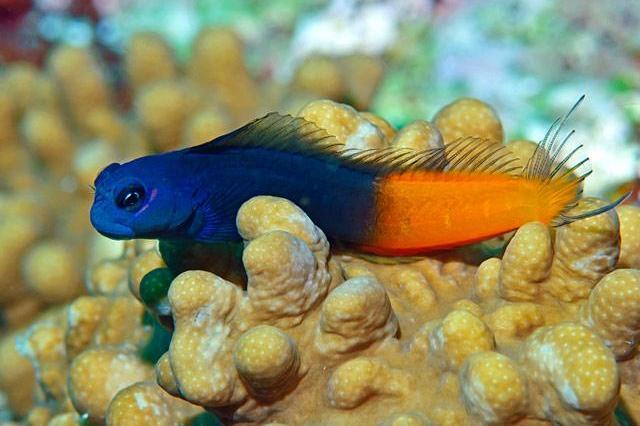
Bicolor Blenny
Ecsenius bicolor
- Temperature
- 24–27 °C
- Salinity
- 1.02 – 1.026 SG
- Min. tank size
- 75 L
- Lifespan
- 2-6 years
- Diet
- herbivore
- Care level
- easy
| Scientific classification | |
|---|---|
| Scientific Name: | Ecsenius bicolor |
| Family: | Blenniidae |
| Origin: | Indo-Pacific reefs |
| Care Characteristics | |
| Care Level: | easy |
| Diet: | herbivore |
| Max Size: | 11.00 cm |
| Water Type: | marine |
| Temp Group: | tropical |
| Reef Safe: | Reef Safe with Caution |
| Temperament: | peaceful |
| Min Group: | Can be kept alone |
| Varieties: | No cultivated strains — this is a wild-caught fish, and the variation is natural. The species displays three distinct colour phases, including the characteristic bicolour pattern of a blue-grey front and an orange rear. Individuals shift between phases with mood, maturity and circumstance, which regularly confuses buyers who expect a fixed appearance. It has accumulated several historical synonyms, including Salarias bicolor and Ecsenius hawaiiensis. The genus Ecsenius is large and several members reach the trade: E. midas, the midas blenny, which is golden and swims more freely than most blennies; E. stigmatura, the tail-spot blenny; and E. gravieri, the Red Sea mimic blenny. Among other aquarium blennies, the lawnmower blenny, Salarias fasciatus, is the standard algae-grazing choice and grows larger, while the various fang blennies are smaller and quite different in habit. |
| Lifespan: | 2-6 years |
Quick Tips
- Bioload:Low
- Min Tank:75 L
- Substrate:Live rock with crevices and film algae
- Plant Safe:Yes
- Filtration:Moderate (reef conditions)
Bicolor Blenny (Ecsenius bicolor) is a species of fish in the family Blenniidae. It is native to Indo-Pacific reefs. The bicolor blenny is a small, comic, endlessly busy fish that spends its day wedged in a hole with only its head out, watching, then darting across the rock to graze and wedging itself somewhere else. It reaches 11 cm and ranges across the Indo-Pacific from the Maldives to the Phoenix Islands, on clear lagoon and seaward reefs with mixed corals and algae-covered rocks, typically between 1 and 25 metres. The name describes the usual look — blue-grey at the front, orange at the rear — but the species displays three distinct colour phases and can shift between them, so a fish that arrives bicoloured may not stay that way. In the wild it is typically solitary, occupying abandoned tubes.
Compatibility
- Temperament
- peaceful
- Keep in
- Can be kept alone
- Swims
- bottom
- Fin nipper
- No
- Delicate fins
- No
- Reef
- Reef Safe with Caution
Species similar to Bicolor Blenny
Matched on family, then category, then water type